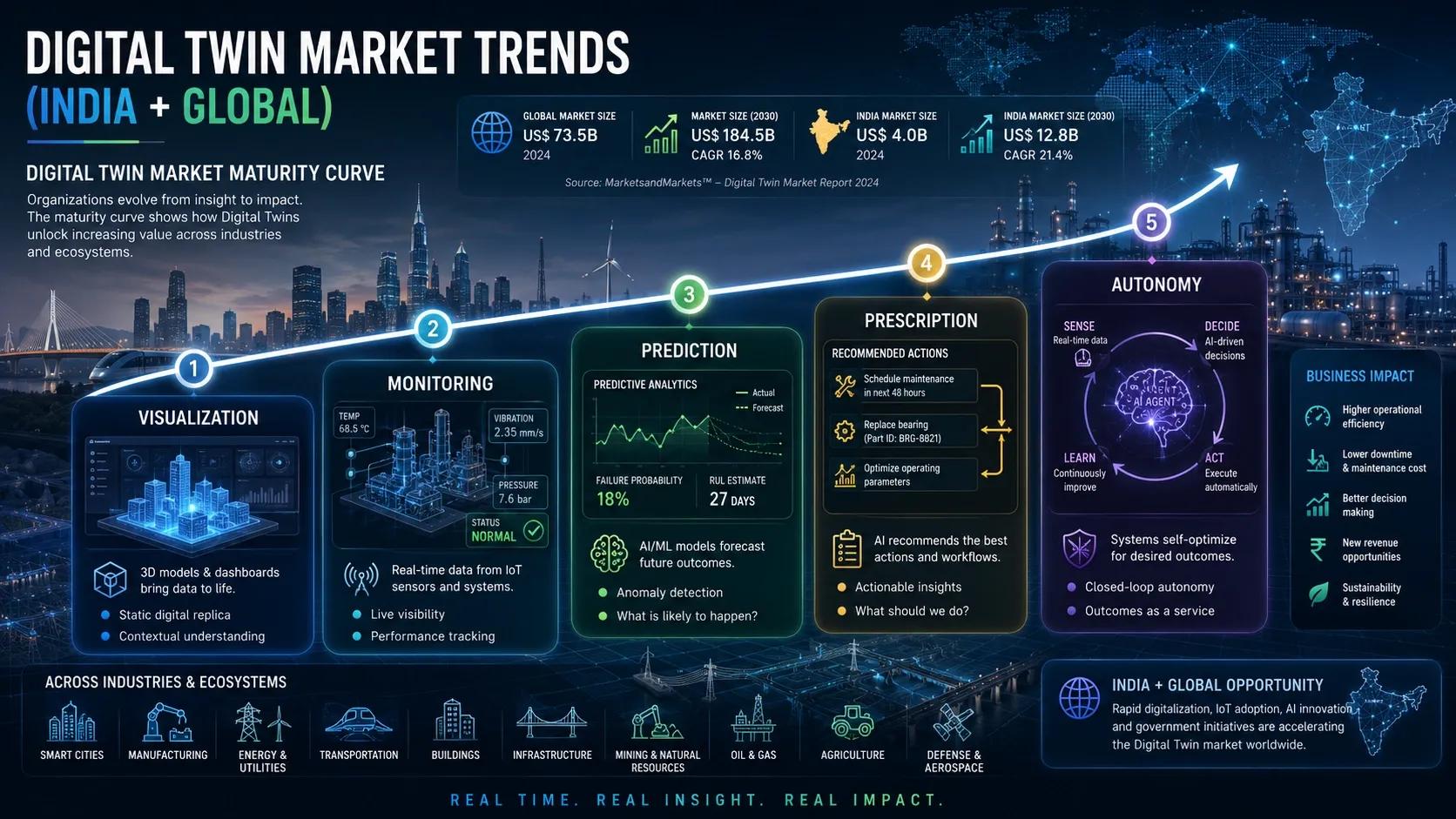
The Digital Twin market is no longer about creating virtual replicas.
It is moving toward something bigger:
👉 real-time decision infrastructure for industries, cities, and critical systems.
Introduction: Phase 5 Continuation
In Phase 5, we are exploring the future and strategic direction of Digital Twins.
So far, we discussed:
AI-driven autonomous Digital Twins
event-driven architectures
Digital Twins with XR
Edge AI and on-site decision systems
GeoAI-Powered Twins
Now we move to the market view.
Because Digital Twins are no longer limited to experimental pilots or innovation labs. They are increasingly being adopted across:
manufacturing
infrastructure
smart cities
energy
healthcare
ports
telecom
defense
logistics
Globally, market research firms differ on the exact market size because they use different definitions and forecast scopes. But the direction is consistent: the Digital Twin market is expected to grow sharply over the next decade. MarketsandMarkets™ estimates the global Digital Twin market will grow from USD 21.14 billion in 2025 to USD 149.81 billion by 2030, while Grand View Research estimates USD 35.82 billion in 2025 and USD 328.51 billion by 2033.
The real story is not only market growth.
The real story is why this growth is happening.
Trend 1: Digital Twins Are Moving from Visualization to Operations
Earlier Digital Twins were often used for:
3D visualization
asset representation
planning presentations
monitoring dashboards
Now the market is shifting toward operational use cases:
predictive maintenance
workflow automation
energy optimization
risk monitoring
real-time decision support
Deloitte’s 2025 analysis highlights how Digital Twins are moving beyond static models into dynamic environments that can unlock new industry advantages.
This means organizations are no longer asking only:
👉 “Can we see the system?”
They are asking:
👉 “Can the system help us decide and act?”
Trend 2: AI Is Becoming the Intelligence Layer
AI is becoming central to Digital Twin adoption.
The next generation of Digital Twins will not only mirror physical assets. They will:
detect patterns
predict failures
recommend actions
simulate scenarios
support autonomous workflows
The Business Research Company notes that future growth is being driven by AI-driven simulations, smart manufacturing, infrastructure digitalization, 5G connectivity, and real-time decision support.
This is important because AI changes the role of Digital Twins.
They move from:
👉 model-based representation
To
👉 intelligence-driven operations.
Trend 3: Industrial Digital Twins Remain a Major Growth Area
Manufacturing, industrial automation, and asset-heavy sectors remain among the strongest Digital Twin markets.
Why?
Because ROI is easier to measure through:
downtime reduction
throughput improvement
predictive maintenance
quality control
energy efficiency
asset lifecycle optimization
A 2024 review on Digital Twins and Industrial IoT highlights IIoT as a backbone technology for Digital Twins and connects them strongly with manufacturing and Industry 4.0 applications.
This explains why Digital Twins are gaining traction in factories, plants, refineries, power systems, and logistics networks.
Trend 4: Infrastructure Digital Twins Are Becoming Strategic
Globally, infrastructure owners are beginning to see Digital Twins as tools for:
planning
asset monitoring
resilience
safety
sustainability
lifecycle management
This is especially important for roads, railways, airports, ports, utilities, and smart cities.
In India, this is strongly visible through national-scale initiatives such as Sangam: Digital Twin , launched by the Department of Telecommunications ( DOT ) . The initiative aims to combine 5G, IoT, AI, AR/VR, AI-native 6G, and Digital Twin technologies for infrastructure planning and design.
This shows an important shift:
👉 Digital Twins are becoming part of infrastructure governance, not just engineering visualization.
Trend 5: India Is Emerging as a High-Growth Digital Twin Market
India’s Digital Twin market is expected to grow rapidly due to IoT, AI, smart cities, infrastructure modernization, industrial automation, and digital governance. Market Research Future projects the India Digital Twin market to grow at a 39.3% CAGR from 2025 to 2035.
This growth is supported by India’s broader digital infrastructure push.
PM GatiShakti, for example, is a GIS-based national master planning framework for multimodal infrastructure planning. It was launched in 2021 and is structured around seven engines: railways, roads, ports, waterways, airports, mass transport, and logistics infrastructure.
While PM GatiShakti is not a Digital Twin in the narrow technical sense, it reflects the same direction:
👉 integrated spatial planning
👉 data-driven infrastructure coordination
👉 cross-department decision support
These are foundational capabilities for future Digital Twin ecosystems.
Trend 6: Urban Digital Twins Are Moving into Real Projects
Urban Digital Twins are becoming more visible in India.
Varanasi’s 3D Urban Spatial Digital Twin project has been recognized for creating a city-scale 3D model for municipal governance, planning, monitoring, and response.
Similarly, Mumbai has started integrating its 3D digital model with civic systems such as building proposals, estates, and property tax functions, with the aim of improving transparency, approvals, and urban management.
This is an important market signal.
The future of urban Digital Twins will not be only about 3D city models.
It will be about connecting them with:
approvals
property records
utilities
mobility
disaster management
taxation
infrastructure maintenance
That is where real value will emerge.
Trend 7: Ports and Logistics Are Becoming Strong Digital Twin Use Cases
Ports are high-value environments for Digital Twins because they involve:
vessels
cargo
equipment
yard operations
customs
energy
emissions
hinterland logistics
India’s V.O.Chidambaranar Port Authority has implemented a Digital Twin platform that integrates IoT sensors, GPS, LiDAR, drone imaging, and CCTV for port management, predictive analytics, scheduling, congestion reduction, and operational visibility. The initiative is reported as the first such implementation by a major Indian port.
This shows the market direction clearly.
Digital Twins are not just for asset visualization.
They are becoming:
👉 operational coordination platforms.
Trend 8: Asia-Pacific Is Becoming a Major Growth Region
Asia-Pacific is increasingly important in the Digital Twin market.
Fortune Business Insights™ reports that Asia-Pacific accounted for USD 6.7 billion in 2025, representing 27.40% of total market revenue, and projects growth across China, India, Japan, South Korea, and other countries.
This matters for India because the region is becoming a strong adoption zone for:
industrial automation
infrastructure modernization
smart cities
energy transition
telecom upgrades
manufacturing digitization
India’s opportunity is not just domestic adoption.
It can also become a Digital Twin talent, engineering, and platform development hub.
Trend 9: Interoperability and Governance Will Define Market Maturity
As adoption increases, the biggest challenge will not be creating Digital Twins.
It will be scaling them.
That requires:
common asset IDs
open APIs
BIM-GIS integration
enterprise system integration
data ownership
lifecycle governance
cybersecurity
sovereign data architecture
Without this, organizations may build many isolated Digital Twins that cannot communicate.
The market will increasingly reward platforms and service providers that solve interoperability, not just visualization.
Trend 10: The Market Is Moving Toward Autonomous and Event-Driven Twins
The next wave will combine:
AI
Edge AI
event-driven architecture
XR
IoT
cloud platforms
enterprise integration
This will create Digital Twins that can:
detect events
understand context
recommend actions
trigger workflows
learn from outcomes
This is where Digital Twins move from:
👉 digital models
To
👉 decision systems.
Indian Context: What This Means for Businesses
For India, the opportunity is large but uneven.
The most promising sectors include:
smart cities
ports and logistics
highways and railways
power and utilities
manufacturing
mining
water and disaster management
telecom infrastructure
healthcare infrastructure planning
But the market will mature only when organizations move beyond pilot projects.
The next stage requires:
measurable KPIs
clear ROI models
data governance
enterprise integration
operational ownership
change management
Digital Twin success will depend less on the beauty of the model and more on how deeply it improves decisions.
Conclusion
The Digital Twin market is growing globally and in India.
But the real trend is not market size.
The real trend is maturity.
Digital Twins are moving from:
👉 visualization
To
👉 prediction
To
👉 prescription
To
👉 controlled autonomy
The organizations that benefit most will be those that treat Digital Twins not as software tools, but as operational intelligence systems.
For India, this is a major opportunity.
If built with open standards, sovereign data thinking, geospatial intelligence, AI, and enterprise integration, Digital Twins can become a foundation for smarter infrastructure, better governance, and more resilient industries.
Top 10 Citations / References Used
MarketsandMarkets: Digital Twin Market forecast: global market expected to grow from USD 21.14 billion in 2025 to USD 149.81 billion by 2030.
Grand View Research, Inc : Digital Twin Market Size: estimated USD 35.82 billion in 2025 and projected USD 328.51 billion by 2033.
The Business Research Company: Digital Twin Global Market Report: highlights 2025 market size, 2030 projection, and growth drivers including AI simulations, smart manufacturing, infrastructure digitalization, 5G, and real-time decision support.
Precedence Research : Digital Twin Market: projects the global market from USD 27.53 billion in 2025 to USD 572.03 billion by 2035.
Fortune Business Insights: Digital Twin Market: notes Asia-Pacific revenue and adoption across China, India, Japan, South Korea, and others.
Deloitte : How digital twins can unlock new industry advantages: discusses how Digital Twins are moving toward dynamic environments and business value.
PIB, Government of India: Sangam: Digital Twin initiative: describes DoT’s initiative combining 5G, IoT, AI, AR/VR, AI-native 6G, Digital Twin, and next-generation computational technologies.
PIB, Government of India: DoT and ITU collaboration: highlights AI-driven Digital Twin technologies for future-ready infrastructure planning.
Digital India / PM GatiShakti: describes PM GatiShakti as a national master plan for multimodal connectivity infrastructure driven by seven infrastructure engines.
The Times Of India : VOC Port Digital Twin: reports VO Chidambaranar Port Authority implementing a Digital Twin platform for port management, predictive analytics, scheduling, and operational visibility.