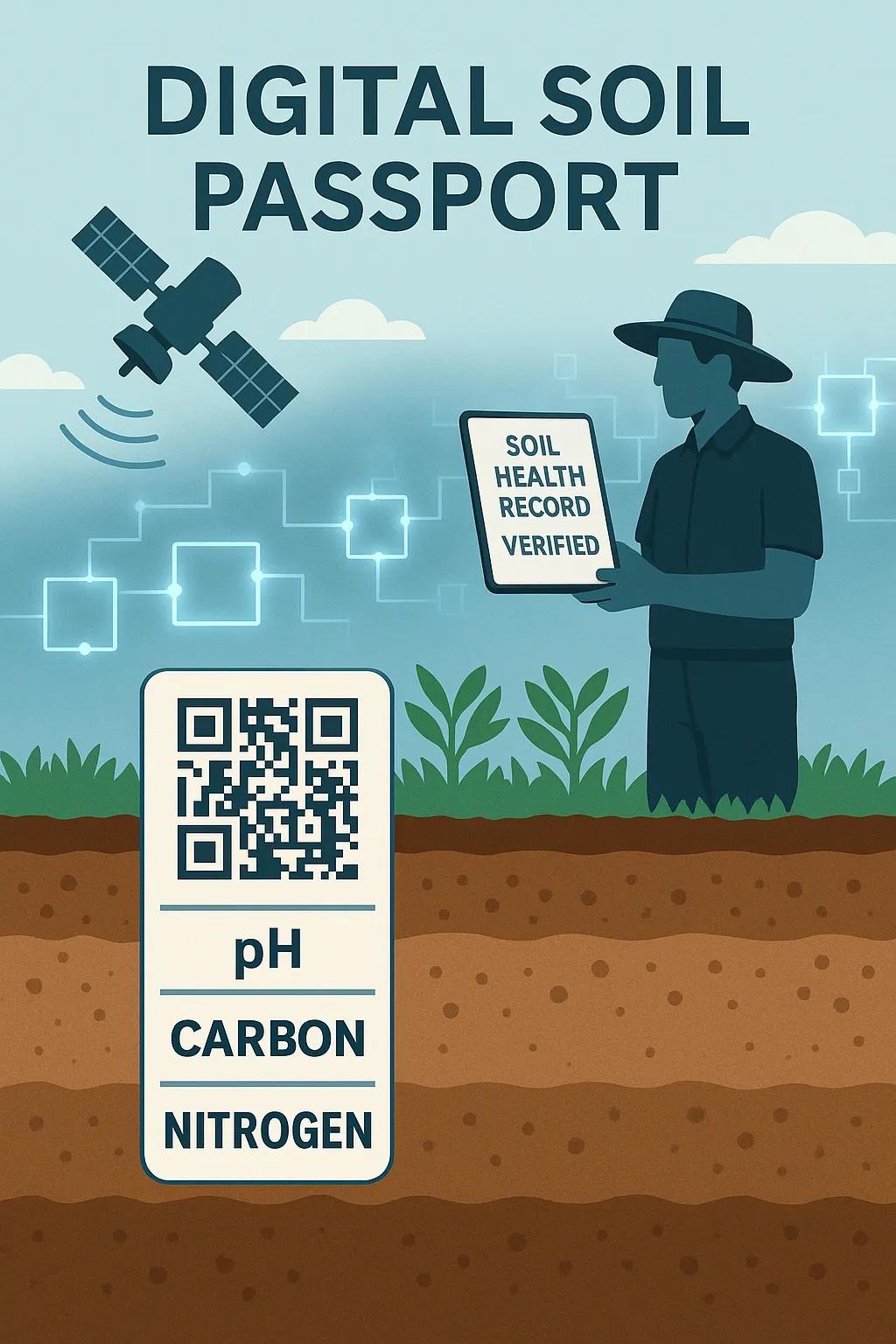
Soil is the foundation of agriculture. Its health determines the productivity, sustainability, and resilience of farming systems. However, soil data is often fragmented, inconsistent, and inaccessible across stakeholders. This has led to inefficient soil management, poor decision-making, and missed opportunities for sustainable intensification. Enter the Digital Soil Passport, a unified, blockchain-secured system that combines geospatial intelligence, soil analytics, and distributed ledger technology to provide a verifiable and traceable soil health record.
This article explores the concept of a digital soil passport, the role of blockchain in securing data provenance, and how geospatial technology enables spatial-temporal mapping of soil conditions. It also discusses implementation frameworks, use cases, and technical considerations in bringing this innovation to scale.
1. What Is a Digital Soil Passport?
A Digital Soil Passport (DSP) is a persistent, location-specific, digital record that captures essential attributes of soil health over time. These include physical (texture, compaction), chemical (pH, NPK levels, salinity), biological (microbial activity, carbon content), and land-use history indicators. The goal is to provide:
Longitudinal traceability of soil quality
Credibility and verification of agricultural claims
Data interoperability between farmers, researchers, policymakers, and insurers
Unlike traditional soil reports, the digital passport is dynamic and decentralized, updated with each agronomic activity or testing event.
2. The Role of Geospatial Technologies
Geospatial data provides the essential spatial context that anchors each soil record to a specific plot of land. Key components include:
GPS coordinates and cadastral boundaries for field identification
Remote sensing data (satellite or UAV) for observing land use, vegetation health, and erosion trends
Digital Elevation Models (DEMs) to analyze drainage and slope factors
Geo-referenced soil sample points and in-situ sensor networks (e.g., IoT-based soil moisture or EC sensors)
These datasets feed into GIS platforms and are layered with thematic soil data, enabling visualization and spatial analysis of soil variability. Over time, changes can be monitored, predicted, and benchmarked across similar agroecological zones.
3. Blockchain for Data Integrity and Trust
Traditional soil records are often siloed, subject to manual errors, and prone to tampering. Blockchain, as an immutable ledger, offers a powerful solution for secure and decentralized data management. Its integration into soil passports brings the following benefits:
Immutability : Each soil test or field observation is timestamped and stored on-chain or referenced via a hash.
Provenance : The source of data (lab, sensor, satellite) is recorded, providing an auditable trail.
Access control : Smart contracts define who can view, update, or verify data (e.g., agronomists, certification bodies).
Interoperability : With open APIs and decentralized identifiers (DIDs), the system can connect with agri-fintechs, government land records, and sustainability scorecards.
A hybrid architecture is often used, blockchain for metadata and off-chain storage (e.g., IPFS or cloud) for large geospatial or image files.
4. Architecture of a Digital Soil Passport System
A typical digital soil passport system integrates the following modules:
A. Soil Data Collection Layer
Laboratory testing kits or mobile-based rapid soil test devices
IoT sensors embedded in fields for continuous monitoring
UAV imagery and satellite-derived soil moisture or crop vigor indices
B. Geospatial Integration Layer
GIS engine for mapping parcels and overlaying soil health parameters
Temporal change detection algorithms
Spatial modeling (e.g., kriging, NDVI-based fertility zoning)
C. Blockchain Infrastructure Layer
Public or permissioned blockchain (e.g., Ethereum, Hyperledger, Polygon)
Smart contracts for identity, data logging, and incentivization
Decentralized identifiers (DIDs) for land parcel ownership mapping
D. User Interface and Application Layer
Farmer dashboard for input recommendations and alerts
Government and insurer portals for compliance and subsidy eligibility
APIs for agri-tech startups or carbon registries
5. Key Use Cases
a. Sustainable Land Management
With persistent records of nutrient levels, pH shifts, and organic carbon trends, farmers can reduce over-fertilization and implement precision agriculture techniques.
b. Carbon Sequestration Validation
Soil organic carbon levels tracked over time can support carbon credit generation, and blockchain ensures transparent MRV (Monitoring, Reporting, and Verification).
c. Crop Insurance and Credit Scoring
Insurers and agri-lenders can use verified soil passports to assess risk profiles and land productivity potential before underwriting loans or policies.
d. Land Certification and Dispute Resolution
Digital soil passports linked to cadastral maps can support fair valuation, leasing contracts, and compliance with agroecological zoning laws.
e. Traceability in Organic and Regenerative Agriculture
Certifying agencies can verify compliance with soil health benchmarks, enabling farmers to fetch premium prices in export or niche markets.
6. Challenges and Considerations
Data Accuracy and Standardization: Harmonizing lab tests, in-situ sensors, and remote sensing-derived proxies remains a technical hurdle. Calibration and standardized metadata are essential.
Farmer Adoption and Digital Literacy: Low-cost interfaces, multilingual support, and mobile-based access are key to scaling adoption in smallholder ecosystems like India or sub-Saharan Africa.
Blockchain Scalability and Energy Use: Choosing eco-friendly, scalable blockchain platforms (e.g., PoS-based chains) is important for sustainability and affordability.
Institutional Buy-in: Integration with agricultural departments, land record systems, and agri-fintechs is needed to mainstream the digital passport as a formal credential.
7. Future Outlook
As agri-data governance becomes a national priority in countries like India (e.g., under the Digital Public Infrastructure for Agriculture - DPIA), soil becomes a strategic asset. A soil passport system, powered by geospatial AI and blockchain, could be the backbone of resilient and traceable agri-supply chains.
Further innovation may include:
AI-based soil health predictions from remote sensing
Token incentives for soil conservation behaviors
Interoperability with drone spraying systems or smart irrigation tools
Integration with SDG monitoring frameworks for soil-related indicators (e.g., SDG 2.4.1 on sustainable agriculture)
Conclusion
The Digital Soil Passport represents a paradigm shift in how we record, verify, and manage the invisible yet invaluable asset beneath our feet, soil. By fusing blockchain's transparency with geospatial intelligence, we unlock new value for farmers, policymakers, and agribusinesses alike. It is not just about digitization; it’s about trust, traceability, and transformation in agriculture.