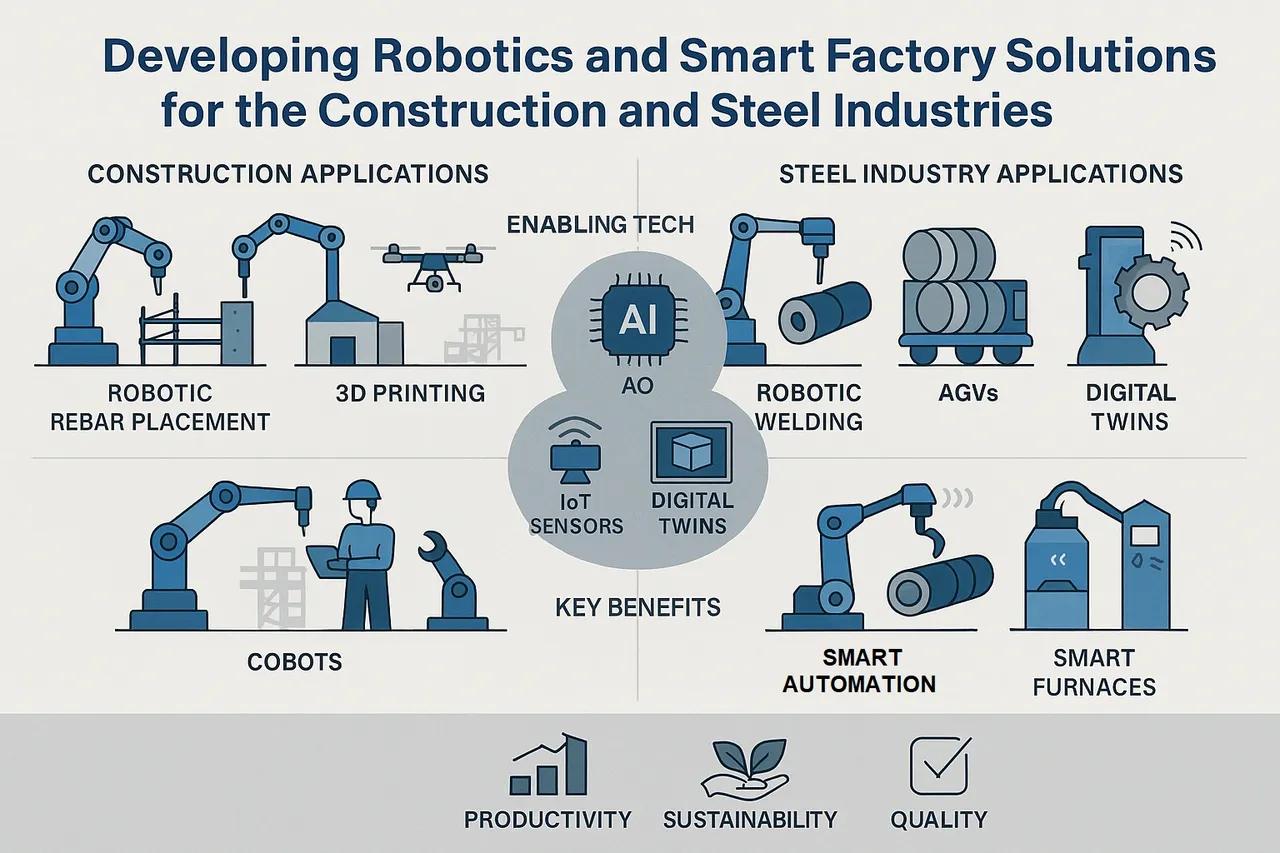
Technical infographic illustrating robotics and smart factory solutions for construction and steel industries
The construction and steel industries are experiencing a paradigm shift as robotics and smart factory solutions emerge as critical enablers of efficiency, safety, and productivity. Companies like ROBOCON Technologies Co.,Ltd. from the Republic of Korea are pioneering this transformation by developing specialized automation systems that address longstanding challenges in rebar processing, steel fabrication, and construction operations. This technological revolution represents more than mere automation, it embodies a comprehensive reimagining of how these fundamental industries operate.
The Current Landscape of Construction and Steel Industry Automation
Market Growth and Industry Adoption
The global construction robotics market has demonstrated remarkable growth, expanding from $168.2 million in 2022 to a projected $774.6 million by 2032. This exponential growth reflects the industry's urgent need to address critical challenges including skilled labor shortages, rising material costs, and increasing safety demands. Similarly, the steel industry is experiencing widespread adoption of AI and automation technologies, with major players like ArcelorMittal , Tata Steel , and POSCO HOLDINGS leading digital transformation initiatives.
The integration of robotics in construction addresses fundamental industry vulnerabilities highlighted during the COVID-19 pandemic, when the sector's reliance on human workforces became a significant operational risk. Only 55% of construction companies currently utilize robots, compared to 84% in automotive and 79% in general manufacturing, indicating substantial room for growth and technological adoption.
Key Technological Drivers
Smart factory implementation in construction and steel industries is driven by several technological convergences. The Industrial Internet of Things (IIoT) enables comprehensive data collection through sensors and connected devices, while artificial intelligence and machine learning algorithms process this information to optimize operations. Edge computing capabilities allow real-time decision-making at the point of production, reducing latency and improving responsiveness.
Digital twin technology plays a crucial role in smart factory operations, creating virtual replicas of physical systems that enable simulation, testing, and optimization before implementation. These digital models help manufacturers predict maintenance needs, optimize workflows, and train personnel on new systems without disrupting production.
Robocon's Revolutionary Approach to Rebar Processing
ARON Solution: Transforming Rebar Manufacturing
Robocon's flagship ARON robotic automation solution represents a breakthrough in rebar processing technology. This system can replace 70% of manual labor input while enabling continuous 24/7 operations. The solution addresses critical inefficiencies in traditional rebar processing, where straightening quality largely depends on operator skill levels. ARON's patented GSA (Geometric Straightening Algorithm) minimizes straightening time while ensuring reliable quality consistency.
The system integrates multiple robotic components including automatic loading robots from ABB , automatic tagging machines, conveyor systems, and customized grippers. This comprehensive automation approach transforms rebar processing from a labor-intensive, skill-dependent operation into a precise, consistent manufacturing process. The solution can be manufactured in portable container modules, enabling installation not only in factories but also directly on construction sites across various environments.
ANTON Solution: Revolutionizing Pre-Assembly Operations
Robocon's ANTON robotic automation solution targets pre-assembly operations, traditionally one of the most labor-intensive construction processes with over 90% reliance on manual labor. The system enables unmanned production through robotics-based automation, achieving 5-10 times the productivity of traditional manual operations for complex assemblies like PC Arch 6-ton segments.
The ANTON solution incorporates 3D machine vision-based optimized welding robot algorithms, delivering superior welding quality that directly impacts both structural integrity and safety. The system includes rebar loading robots, mounting systems, hoop rebar supply devices, assembly binding devices, automatic tool changers, and customized grippers, creating a fully integrated pre-assembly line.
Smart Factory Integration in Steel Industry Operations
Process Optimization and Quality Control
Modern steel industry smart factories leverage robotics for comprehensive process optimization. Companies like POSCO have implemented AI-powered smart steel mill projects that integrate complete digital connectivity across all business operations. These systems utilize AI furnace control mechanisms that monitor and adjust blast furnace operations in real-time, while robotic quality inspection systems deploy in high-speed rolling mills.
Predictive maintenance systems represent another critical application, where AI algorithms analyze production data to identify patterns and predict potential equipment failures. This proactive approach minimizes downtime while extending machinery lifespan, ensuring uninterrupted production schedules. Baosteel Group Co. 's implementation of AI-powered scheduling algorithms maximizes production shift schedules and equipment operational periods while IoT-powered energy control systems monitor and reduce carbon emissions through real-time analysis.
Advanced Manufacturing Processes
Steel industry automation extends beyond basic process control to encompass advanced manufacturing techniques. Digital twin technology enables manufacturers to create virtual replicas of production machines for performance monitoring, technician training, and equipment servicing. These models provide accessible information through tablets and smartphones, enabling immediate response to operational issues.
Robotic welding systems equipped with spatial recognition technology ensure consistent quality while handling tasks that are challenging for human operators. Multi-robot collaborative operations enhance efficiency and quality through synchronized teamwork, while 3D vision end plate assembly welding systems maintain stable welding quality through advanced spatial recognition capabilities.
Construction Site Automation and Safety Enhancement
On-Site Robotic Applications
Construction robotics has evolved beyond prefabrication facilities to encompass direct on-site applications. Automated bricklaying systems like SAM (Semi-Automated Mason) can lay up to 300 bricks per hour, approximately four times the rate of human bricklayers, while ensuring precise measurements and reducing construction errors. Similarly, automated rebar-tying robots like Tybot operate autonomously on large infrastructure projects, tying rebar at precise intervals for bridge and tunnel construction applications.
Concrete printing and structural fabrication represent emerging applications where robots create complex designs directly on construction sites. These systems drastically reduce construction time and labor requirements while enabling architectural possibilities that would be difficult or impossible through traditional methods. Drywall finishing robots utilize robotic precision to apply joint compound in single-step processes, reducing traditional five-day finishing schedules to two days.
Safety and Risk Mitigation
Robotics implementation fundamentally transforms construction site safety by removing human workers from hazardous environments. Robots handle dangerous tasks including working at heights, managing heavy loads, and operating in unsafe spaces. This automation enables new, safer construction methods while addressing the industry's reputation as a dangerous occupation that deters younger workers from construction careers.
Safety monitoring systems integrate wearable devices and sensors that monitor environmental hazards, worker health metrics, and location data. These systems generate real-time alerts when safety thresholds are breached, while low-latency private networks ensure instant communication of safety warnings to workers. The controlled environment approach exemplified by companies like Midland Steel moves dangerous steel fixing operations off-site to automated facilities, requiring fewer personnel at construction sites.
Industry 4.0 Integration and Future Developments
Artificial Intelligence and Machine Learning Applications
AI and machine learning technologies are reshaping automation capabilities across construction and steel industries. These systems enable robots to perform complex tasks with unprecedented precision and efficiency, transforming traditional production processes into highly optimized operations. Machine learning algorithms analyze production data to identify patterns and predict potential issues, allowing systems to adjust operations in real-time.
Predictive maintenance powered by machine learning represents a critical advancement, where monitoring systems collect real-time data from embedded sensors and process this information to detect anomalies before equipment failures occur. This proactive approach minimizes downtime while extending machinery lifespan, ensuring continuous production capabilities.
Collaborative Robotics and Human-Machine Integration
The evolution toward collaborative robotics (cobots) represents a significant trend in smart factory development. These systems work alongside human operators, handling repetitive and dangerous tasks while allowing workers to focus on creative problem-solving and innovation. This human-machine collaboration exemplifies Industry 4.0 principles, where technology enhances rather than replaces human capabilities.
Multi-robot collaborative operations utilize AI-driven coordination systems that enable seamless communication and task allocation. These technologies allow production lines to adapt dynamically to varying demands without compromising quality, creating flexible manufacturing environments that respond efficiently to market changes.
Economic Impact and Business Transformation
Cost Reduction and Efficiency Gains
Implementation of robotics and smart factory solutions delivers substantial economic benefits across construction and steel industries. Automated systems reduce operating costs through energy efficiency and material savings while improving product quality via real-time defect detection. Companies implementing these solutions report up to 50% increases in production efficiency alongside significant reductions in labor costs.
The precision capabilities of robotic systems minimize material waste and optimize resource utilization, contributing to improved profitability. Continuous operation capabilities enable 24/7 production schedules, maximizing asset utilization and reducing per-unit production costs. These efficiency gains translate into competitive advantages in increasingly demanding market environments.
Workforce Development and Skills Transformation
The integration of robotics necessitates comprehensive workforce development initiatives. Companies require personnel skilled in robotics operation, maintenance, and programming, creating opportunities for highly trained technical positions. Midland Steel's smart factory employs Building Information Modeling detailers, civil engineers, cost estimators, surveyors, robotic technicians, and steel reinforcement placers, demonstrating the diverse skill sets required in automated manufacturing environments.
Training and upskilling programs become essential for successful technology adoption. Organizations must prepare their workforce to work comfortably with data analytics, AI, and robotics systems. This transformation creates opportunities for younger generations to engage with construction and steel industries through technology-focused career paths, potentially addressing long-term labor shortages.
Challenges and Implementation Considerations
Technical and Integration Challenges
Smart factory implementation faces several technical hurdles including legacy infrastructure compatibility, system integration complexity, and cybersecurity requirements. Many industrial facilities operate with outdated systems that require significant upgrades to support modern automation technologies. The integration of information technology (IT) and operational technology (OT) demands careful coordination to ensure seamless functionality.
High initial investment costs present significant barriers for many companies, particularly smaller contractors and mid-sized operations. The complexity of integrating automation with existing construction workflows requires careful planning and change management strategies to ensure successful deployment. Organizations must also address concerns about human-robot collaboration and employee acceptance of automation technologies.
Regulatory and Standards Development
The rapid advancement of construction and steel industry robotics outpaces regulatory framework development, creating uncertainty for implementation decisions. Standards organizations must develop comprehensive guidelines for robotic safety, quality assurance, and operational protocols specific to construction and steel manufacturing environments. International coordination becomes essential as companies like Robocon expand globally from their Korean foundation.
Quality certification requirements, such as Robocon's CE Certificate for the ARON solution, demonstrate the importance of standardized safety and performance metrics. These certifications provide confidence for adopters while establishing benchmarks for industry-wide implementation. Collaborative efforts between manufacturers, regulators, and standards organizations will be crucial for sustainable market development.
Future Outlook and Technological Evolution
Emerging Technologies and Capabilities
The future of robotics in construction and steel industries will be characterized by increased autonomy, advanced AI integration, and enhanced collaborative capabilities. Fully autonomous job sites represent an achievable goal where fleets of self-driving machinery coordinate tasks without human intervention. These systems will utilize advanced sensor technologies, machine learning algorithms, and real-time communication networks to optimize operations continuously.
3D printing and additive manufacturing technologies will expand beyond current applications to enable complex structural component production directly on construction sites. These capabilities will support architectural designs that are currently impossible with traditional construction methods while reducing material waste and construction timeframes.
Global Market Expansion and Adoption
Companies like Robocon are positioned to expand their smart factory footprint to key markets worldwide, building from their Korean foundation. This global expansion will be supported by partnerships with established equipment manufacturers like MEP, the world's leading rebar equipment manufacturer. The integration of proven technologies with local market knowledge will accelerate adoption across diverse geographical regions.
The construction robotics market's projected growth to over £600 million by 2029 indicates substantial opportunities for technology providers and adopters. As successful implementations demonstrate clear return on investment, adoption rates will accelerate across both large-scale infrastructure projects and smaller construction operations.
Conclusion
The development of robotics and smart factory solutions for construction and steel industries represents a fundamental transformation that addresses critical challenges while creating new opportunities for efficiency, safety, and innovation. Companies like Robocon are pioneering this evolution through specialized solutions that automate dangerous, repetitive tasks while improving quality and productivity outcomes.
The integration of AI, machine learning, and advanced robotics creates manufacturing environments that continuously optimize operations while reducing human exposure to hazardous conditions. As these technologies mature and adoption rates increase, the construction and steel industries will evolve into highly efficient, safe, and sustainable operations that leverage human creativity alongside robotic precision.
Success in this transformation requires comprehensive strategies that address technical implementation, workforce development, and organizational change management. Organizations that embrace these technologies early will establish competitive advantages in markets increasingly defined by efficiency, quality, and safety standards. The future of construction and steel manufacturing lies in the intelligent integration of human expertise with robotic automation, creating industries that are more productive, safer, and better positioned to meet the challenges of global infrastructure development.