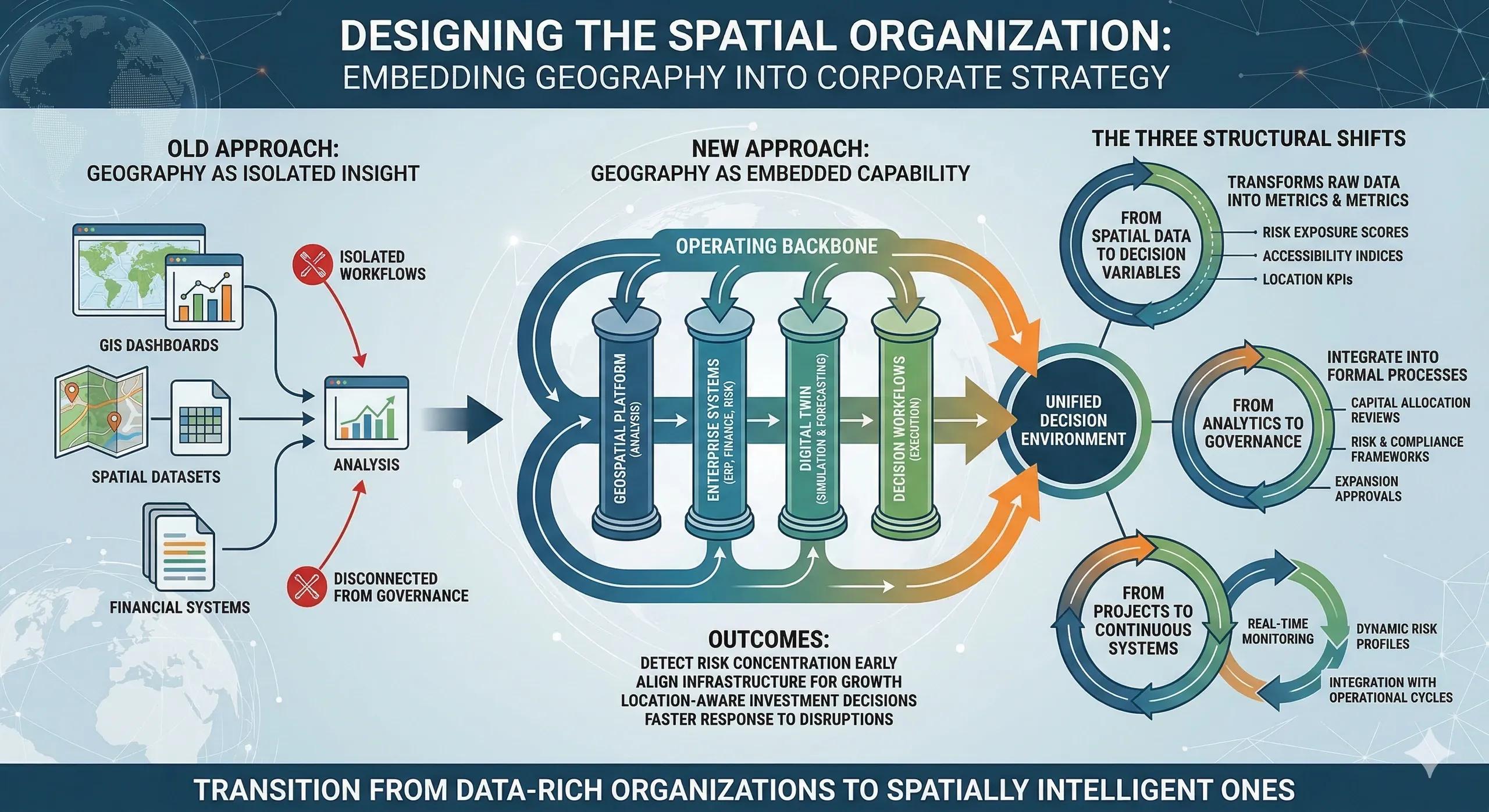
From Awareness to Implementation
Over the past few articles, one idea has become clear:
Geography is not just a supporting input.
It is a determinant of strategy, risk, and performance .
But recognizing this is only the first step.
The real challenge is different:
How do organizations actually embed geography into the way they operate?
Because until spatial intelligence is built into decision systems, it remains an insight layer, not an operating capability .
The Gap Between Insight and Integration
Most organizations today already have:
GIS platforms
spatial datasets
dashboards and analytics
Yet geography rarely influences core business decisions consistently .
Why?
Because spatial intelligence often sits:
outside financial systems
separate from operational workflows
disconnected from governance processes
The result:
Geography is visible but not embedded.
What It Means to Design a Spatial Organization
A spatial organization is not defined by tools.
It is defined by how decisions are structured around location intelligence .
This requires shifting from:
using maps occasionally → to
embedding geography into every critical decision pathway
The Three Structural Shifts
To move from awareness to implementation, organizations must make three structural shifts.
1️⃣ From Spatial Data to Decision Variables
Most organizations stop at visualization.
Spatial organizations translate geography into decision-ready metrics , such as:
risk exposure scores
accessibility indices
location-based performance indicators
supply chain vulnerability metrics
This allows geography to enter discussions alongside:
financial metrics
operational KPIs
risk indicators
2️⃣ From Analytics to Governance
Spatial intelligence becomes powerful only when it is part of formal decision processes .
This means embedding geography into:
capital allocation reviews
risk and compliance frameworks
expansion and investment approvals
infrastructure planning committees
At this stage, geography is no longer optional.
It becomes a required input .
3️⃣ From Projects to Continuous Systems
Many organizations use geospatial analysis as a one-time exercise.
Spatial organizations build continuous systems that:
monitor geographic exposure in real time
update risk profiles dynamically
integrate with operational decision cycles
This transforms spatial intelligence from a report into a living system .
A Practical Example
Consider a company evaluating expansion into new regions.
Traditional approach:
demand analysis
cost structures
regulatory review
Spatial organization approach:
infrastructure connectivity scoring
climate exposure assessment
supply chain proximity mapping
competitor density analysis
But the real difference is this:
These factors are not evaluated once.
They are integrated into ongoing decision workflows .
The Operating Backbone
Designing a spatial organization requires connecting multiple systems.
Key elements include:
geospatial platforms (for spatial analysis)
enterprise systems (ERP, risk, finance)
digital twins (for simulation and forecasting)
decision workflows (for execution)
The transformation happens when these systems are linked into a single decision environment .
The Monetization Bridge
As organizations move toward spatial maturity, there is growing demand for integrated platforms and advisory frameworks that connect geospatial intelligence with enterprise systems. This includes building decision models, digital twin environments, and governance structures that allow organizations to operationalize geographic insight at scale.
What Changes in Practice
When geography is embedded into strategy, organizations begin to:
detect risk concentration early
align infrastructure with long-term growth
make location-aware investment decisions
respond faster to regional disruptions
The difference is not more data.
It is better-structured decisions .
Looking Ahead
The next generation of organizations will not ask:
“Do we have spatial data?”
They will ask:
“Is geography embedded in how we make decisions?”
This shift defines the transition from data-rich organizations to spatially intelligent ones .
Closing Insight
Geography already shapes every business outcome.
The advantage comes when organizations stop observing it and start designing around it .