One of the most common questions in reality capture projects is also the most poorly framed:
“What will you deliver, point cloud, mesh, or as-built BIM?”
The problem is not the question itself.
The problem is assuming one of these is always the right answer .
Each deliverable represents a different level of abstraction , supports different decisions , and carries different costs and risks . Choosing the wrong one doesn’t just waste money, it can actively slow the project down.
This article explains when each deliverable makes sense , and how to choose intentionally.
1. Reality Capture Deliverables Are Not a Maturity Ladder
A common misconception is that:
Point Cloud → Mesh → BIM represents increasing maturity.
It doesn’t.
They are parallel artifacts , each optimized for different purposes.
More processed does not automatically mean more useful.
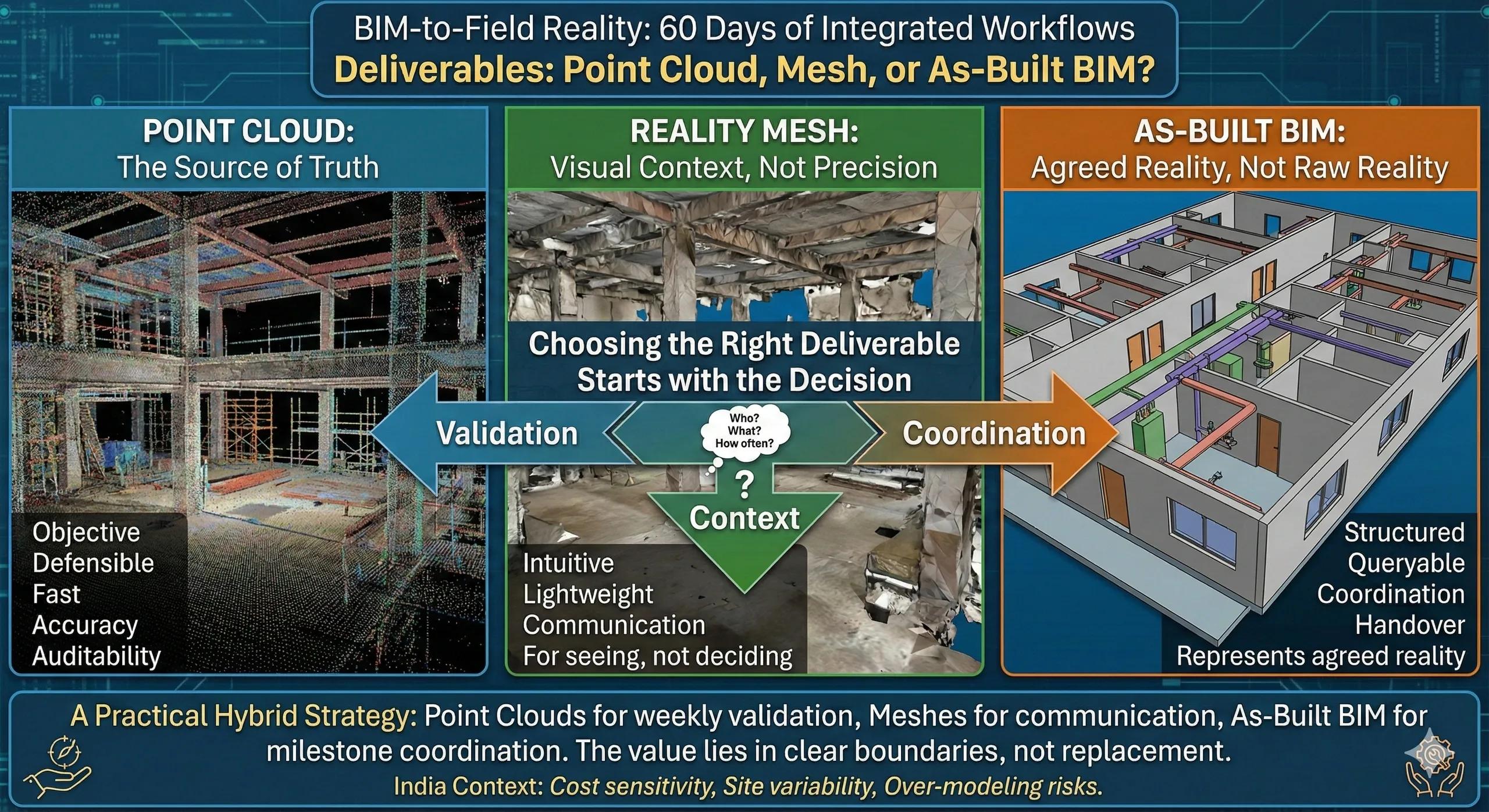
2. Point Clouds: The Source of Truth
What They Are
Raw or registered spatial measurements
Highest fidelity to reality
Minimal interpretation
Best Used For
Progress verification
Deviation and tolerance checks
Clash validation
Forensic reference
Dispute resolution
Strengths
Objective
Defensible
Fast to generate
Low interpretation risk
Limitations
Not intuitive for all users
Heavy files
Not decision-friendly without filtering
Rule: If you need accuracy and auditability, start with the point cloud.
3. Reality Meshes: Visual Context, Not Precision Control
What They Are
Surface reconstructions from scans or images
Optimized for visualization
Best Used For
Site context understanding
Communication with non-technical stakeholders
Progress storytelling
Asset visualization
Strengths
Intuitive
Lightweight for viewing
Visually compelling
Limitations
No true geometry
Poor for measurements
Unsuitable for tolerance or QA checks
Rule: Meshes are for seeing , not deciding .
4. As-Built BIM: Agreed Reality, Not Raw Reality
What It Is
Modeled abstraction of accepted site conditions
Filtered through approvals and decisions
Best Used For
Coordination
Downstream trade planning
Handover documentation
Operations and maintenance
Strengths
Structured
Queryable
Integrates with asset systems
Limitations
Expensive to maintain
Always lags reality
Risk of false precision if over-modeled
Rule: As-built BIM should represent what is agreed , not everything that exists.
5. The Most Common (and Costly) Mistake
Trying to use one deliverable for all purposes .
Examples:
Using BIM for progress tracking
Using meshes for QA
Expecting point clouds to replace models
Each misuse increases friction and reduces trust.
6. Choosing the Right Deliverable Starts with the Decision
Before selecting a deliverable, ask:
Who will use this?
What decision will it support?
How often does it need to change?
How defensible must it be?
Deliverables should follow decisions , not software capability.
7. A Practical Hybrid Strategy
Most successful projects use all three , deliberately:
Point clouds → weekly validation and control
Meshes → communication and context
As-built BIM → milestone-based coordination and handover
The value lies in clear boundaries , not replacement.
8. India Context: Why This Choice Matters More
In Indian projects:
Cost sensitivity is high
Site variability is significant
Over-modeling escalates quickly
Deliverable clarity helps:
Control costs
Set realistic expectations
Avoid “model for the sake of modeling”
9. Contractual Clarity Is Non-Negotiable
Every project should clearly define:
What is delivered
At what frequency
At what level of detail
For what purpose
Ambiguity here guarantees disputes later.
10. A Simple Deliverables Rule
If you don’t know what decision a deliverable supports, you don’t need it.
This rule alone eliminates most waste.
Conclusion
Point clouds, meshes, and as-built BIM are not competitors.
They are different answers to different questions .
When chosen intentionally:
Costs drop
Trust increases
Decisions speed up
Reality capture delivers ROI
When chosen blindly:
Expectations break
Models bloat
Teams disengage
In BIM-to-field workflows, the right deliverable is the one that helps someone decide, not the one that looks most advanced .