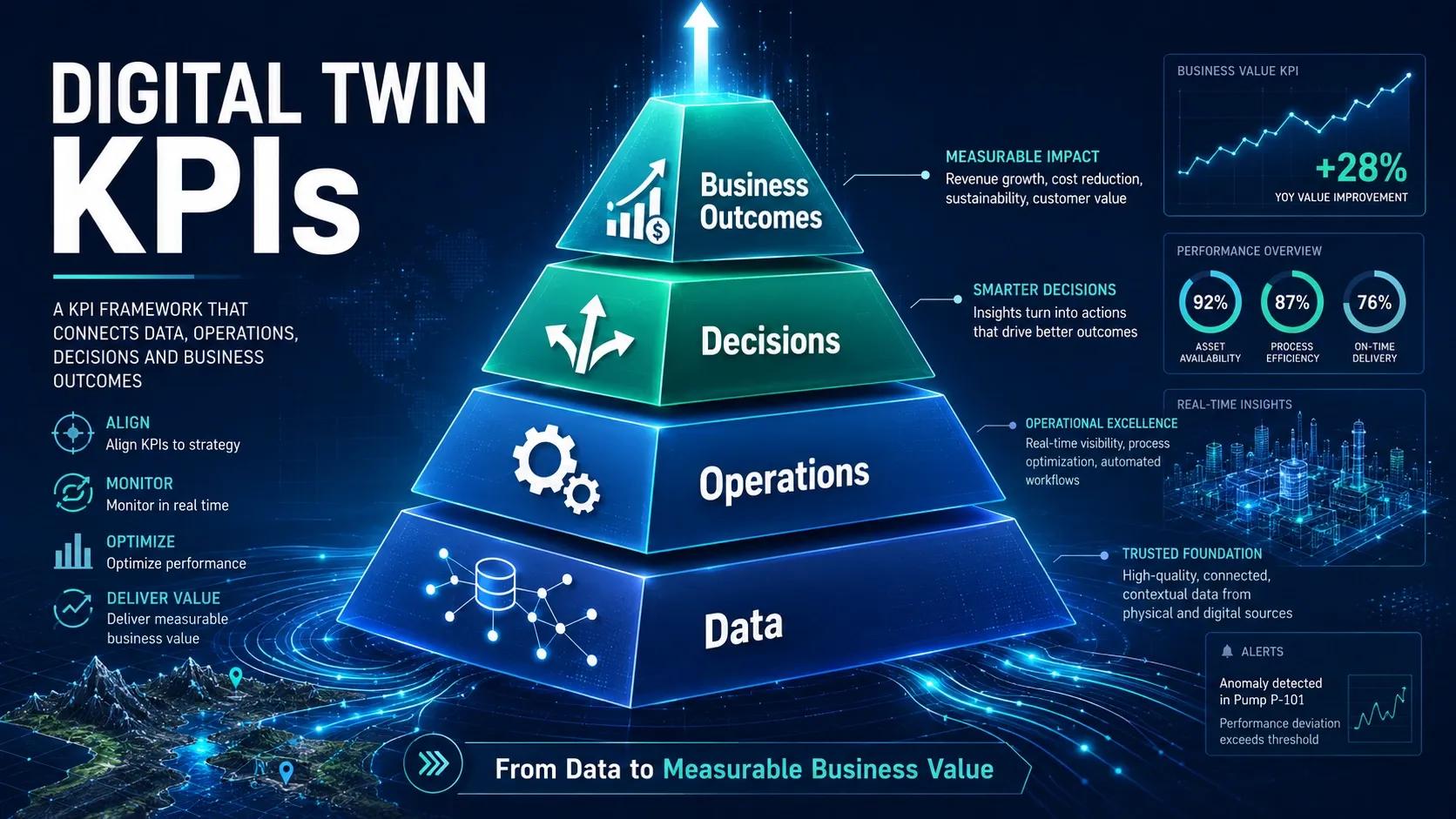
Most Digital Twin projects fail for one simple reason:
👉 they measure technology deployment, not business outcomes.
Introduction (Phase 4 Begins)
Over the last 40 days, we explored:
how Digital Twins are built
how data flows across systems
how industries use them operationally
From:
infrastructure
manufacturing
telecom
healthcare
logistics
defense
one pattern became clear:
👉 visibility alone does not create value
Now we enter:
PHASE 4: Operations, KPIs & ROI
This phase focuses on:
👉 how organizations measure success
👉 how Digital Twins generate operational value
👉 how decisions translate into ROI
And the first challenge is fundamental:
What exactly should a Digital Twin improve?
Because without measurable outcomes:
👉 even advanced systems become expensive dashboards.
The Core Problem: Measuring Activity Instead of Impact
Most organizations track:
number of sensors
amount of data collected
dashboard usage
platform uptime
But these are:
👉 technology metrics
Not
👉 business KPIs
This creates a major problem:
The Digital Twin may be technically successful, while operationally delivering little value.
Where KPI Thinking Changes the Approach
A mature Digital Twin strategy starts with:
👉 business outcomes first
Not:
platforms
visualization
AI models
But:
operational improvement
financial impact
decision speed
risk reduction
The Shift: From System Metrics → To Decision Metrics
Traditional thinking measures:
data availability
integration completion
visualization quality
But Digital Twin success should measure:
👉 how decisions improved
Because the real value is not:
seeing more data
It is: 👉 acting better and faster.
The Five KPI Categories for Digital Twins
1. Operational KPIs
These measure:
👉 system performance improvements
Examples:
downtime reduction
asset utilization
throughput increase
maintenance response time
Example
A manufacturing Digital Twin reduces:
machine downtime by 18%
👉 This is measurable operational value.
2. Financial KPIs
These measure:
👉 business impact
Examples:
cost reduction
energy savings
inventory optimization
reduced maintenance cost
Example
A smart facility reduces:
energy consumption by 22%
👉 Direct ROI becomes visible.
3. Decision-Making KPIs
These measure:
👉 how quickly and accurately decisions happen
Examples:
incident response time
planning cycle reduction
faster anomaly detection
reduced decision latency
Example
A port operation reduces:
vessel scheduling decisions from hours → to minutes
👉 Coordination improves.
4. Predictive KPIs
These measure:
👉 forecasting effectiveness
Examples:
prediction accuracy
early-warning lead time
failure forecasting precision
Example
A flood Digital Twin predicts:
inundation zones 6 hours earlier
👉 preparedness improves significantly.
5. User & Adoption KPIs
These measure:
👉 whether people actually use the system
Examples:
active users
workflow adoption
decision automation usage
operator engagement
Critical Reality
Many Digital Twin systems fail because:
👉 teams return to old workflows.
Adoption itself is a KPI.
The Most Important KPI Most Organizations Ignore
The biggest overlooked KPI is:
Decision Latency
Meaning:
👉 How long does it take to:
detect
understand
decide
act
Because in most systems:
data moves fast
decisions move slowly
And that gap defines operational performance.
The KPI Maturity Curve
Level 1: Visibility KPIs
data collected
dashboards available
Level 2: Operational KPIs
uptime
efficiency
performance
Level 3: Predictive KPIs
forecasting
anomaly detection
Level 4: Decision KPIs
response speed
execution quality
coordination efficiency
Level 5: Business Outcome KPIs
revenue impact
cost reduction
resilience improvement
Where Most Digital Twin KPI Strategies Fail
1. Measuring Technical Success Only
integrations completed
dashboards deployed
👉 but no operational impact measured
2. No Baseline Metrics
Organizations never define:
👉 current performance levels
So improvement becomes difficult to prove.
3. Too Many KPIs
Tracking everything:
👉 creates noise instead of clarity
4. No Ownership
Nobody owns:
KPI tracking
continuous optimization
Ask Yourself
Is your Digital Twin measuring:
👉 system activity
Or
👉 business improvement?
Indian Context
Many Digital Twin initiatives in India are still:
pilot-driven
visualization-heavy
technology-focused
The next shift will happen when:
👉 organizations start demanding:
measurable ROI
operational KPIs
business accountability
That is when Digital Twins move:
👉 from innovation projects
To
👉 operational systems.
Benefits of KPI-Driven Digital Twins
measurable ROI
faster decision-making
operational accountability
continuous optimization
executive alignment
Conclusion
Digital Twins do not create value automatically.
Value appears only when:
👉 systems improve measurable outcomes.
The future of Digital Twins is not:
more dashboards
more sensors
more visualization
It is: 👉 better decisions with measurable impact