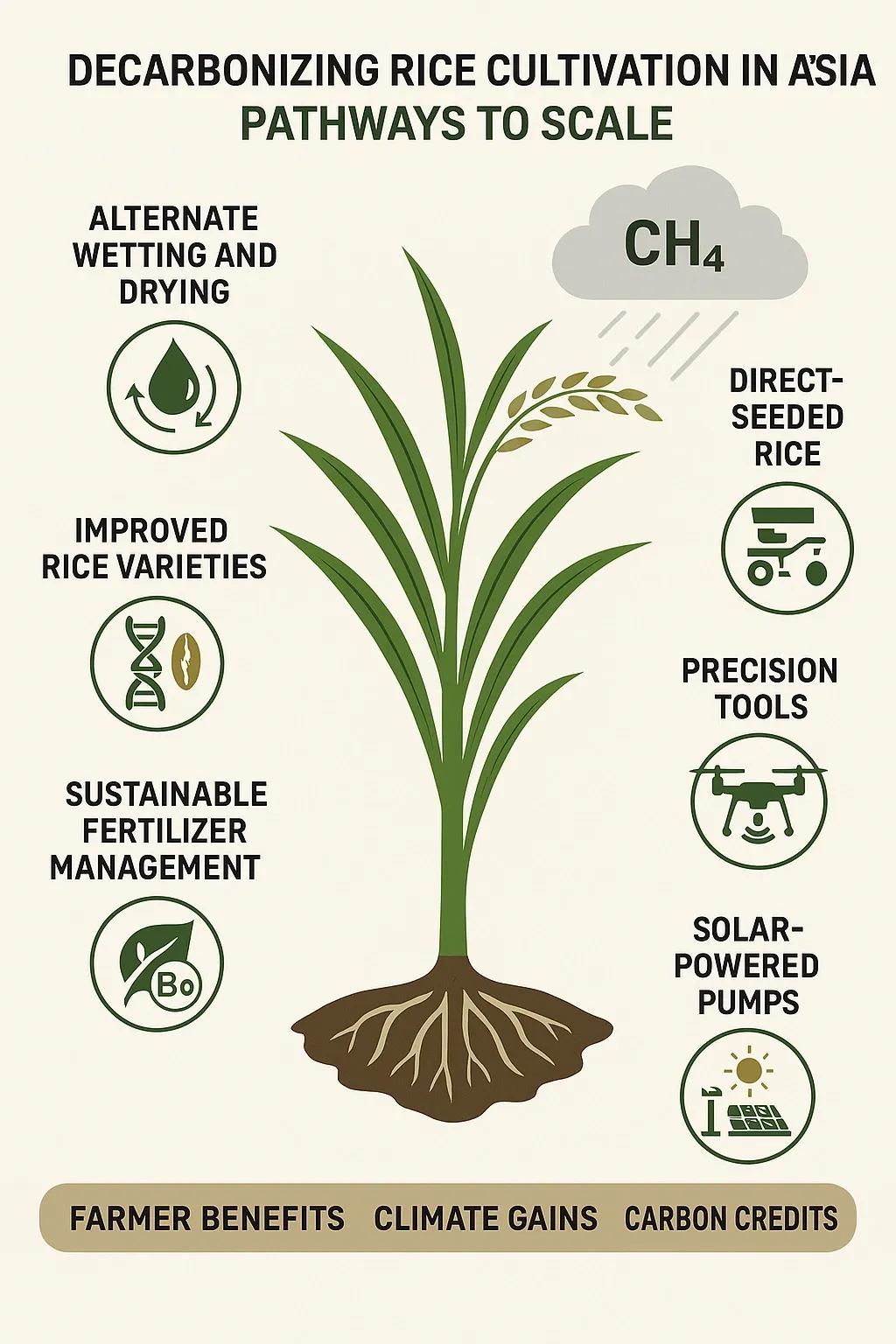
Rice is the staple food for more than half the world’s population, and Asia alone accounts for nearly 90% of global rice production and consumption. Yet, rice cultivation is also one of the most significant sources of agricultural greenhouse gas (GHG) emissions. Flooded paddy fields produce methane, a gas 25 times more potent than CO₂ over a 100-year period. As Asia continues to balance food security with climate goals, reducing emissions from rice cultivation has become a pressing challenge.
This article explores how scalable agricultural innovations, spanning field practices, biotechnology, digital monitoring, and policy frameworks, can decarbonize rice cultivation in Asia without compromising productivity.
The Carbon Problem in Rice Cultivation
Methane from Flooded Fields: Continuous flooding creates anaerobic soil conditions, ideal for methane production.
Nitrous Oxide from Fertilizers: Excessive use of nitrogen fertilizers contributes to nitrous oxide emissions.
Energy-Intensive Irrigation: Pumping and distributing water for paddy fields consumes fossil fuel-based electricity.
In total, rice accounts for about 10% of global agricultural GHG emissions, with Asia as the dominant contributor. The challenge lies in balancing yield stability with emission reductions in regions highly dependent on rice for livelihoods.
Scalable Innovations for Decarbonization
1. Alternate Wetting and Drying (AWD)
How it works: Instead of continuous flooding, fields are intermittently drained and reflooded.
Impact: Reduces methane emissions by up to 48%, while maintaining or improving yields.
Scalability: Requires low-cost field water tubes and farmer training, making it feasible in small-holder settings.
2. Direct-Seeded Rice (DSR)
How it works: Seeds are sown directly without transplanting seedlings into flooded fields.
Impact: Saves up to 30% water, cuts methane emissions drastically, and lowers labor requirements.
Scalability: Adoption depends on availability of precision seed drills and farmer willingness to transition.
3. Improved Rice Varieties
Low-Emission Varieties: Breeding or gene-editing rice varieties that release less methane from root exudates.
Climate-Resilient Traits: Varieties resistant to drought, pests, and salinity reduce the need for chemical and water inputs.
Scalability: Requires investment in seed systems and farmer extension services across Asia.
4. Precision Agriculture and Digital Tools
IoT Sensors & Drones: Track soil moisture and crop health to optimize irrigation and fertilizer use.
AI-Driven DSS (Decision Support Systems): Provide hyper-local guidance to farmers on water and fertilizer schedules.
Blockchain for Carbon Credits: Enables smallholder farmers to monetize emission reductions.
5. Sustainable Fertilizer Management
Site-Specific Nutrient Management (SSNM): Matches fertilizer application to crop needs.
Biofertilizers: Reduce dependence on synthetic nitrogen while improving soil health.
Impact: Can cut nitrous oxide emissions by 20–30%.
6. Renewable Energy for Irrigation
Solar-Powered Pumps: Replace diesel-based irrigation systems.
Scalability: Well-suited for India, Bangladesh, and Southeast Asia where small solar units are increasingly affordable.
Adoption Challenges in Asia
Smallholder Fragmentation: Over 80% of rice farmers in Asia are smallholders with limited access to capital.
Policy Misalignment: Subsidies for water and fertilizers encourage traditional practices.
Knowledge Gaps: Farmers often lack training in advanced techniques.
Market Access: Weak integration with carbon markets limits farmer incentives.
Case Study: Rize (Singapore)
Rize, a Singapore-based agritech startup, is building scalable solutions to reduce emissions in rice cultivation:
Digital Platforms: Providing farmers with real-time irrigation and fertilizer management advice.
Carbon Markets: Aggregating emission reductions from multiple farmers into tradable credits.
Partnerships: Collaborating with governments and NGOs to scale training programs.
This integrated approach demonstrates how startups can link climate finance with practical field interventions.
Benefits and ROI
For Farmers
Reduced input costs (water, fertilizer, energy).
Access to new income streams from carbon credits.
Increased climate resilience.
For Governments & Policymakers
Progress toward Nationally Determined Contributions (NDCs) under the Paris Agreement.
Food security with lower environmental costs.
Stronger rural livelihoods.
For Industry & Investors
Opportunities in agritech solutions, carbon finance, and sustainable food value chains.
Roadmap for Scaling Decarbonization
Policy Push: Shift subsidies toward water-saving and low-emission practices.
Capacity Building: Large-scale farmer training programs using local cooperatives.
Technology Access: Affordable irrigation sensors, seed drills, and solar pumps.
Carbon Finance Integration: Create transparent systems linking farmers to global carbon credit markets.
Regional Collaboration: South–South cooperation in Asia for seed systems, training, and financing.
Conclusion
Decarbonizing rice cultivation in Asia is both a necessity and an opportunity. With scalable innovations, from AWD and DSR to digital tools and carbon markets, the sector can significantly reduce emissions while boosting farmer livelihoods.
The future of rice in Asia will depend on how quickly governments, startups, and farmers can align to drive these solutions at scale. By linking climate goals with farmer incentives, Asia can lead a sustainable rice revolution that ensures food security and climate resilience.