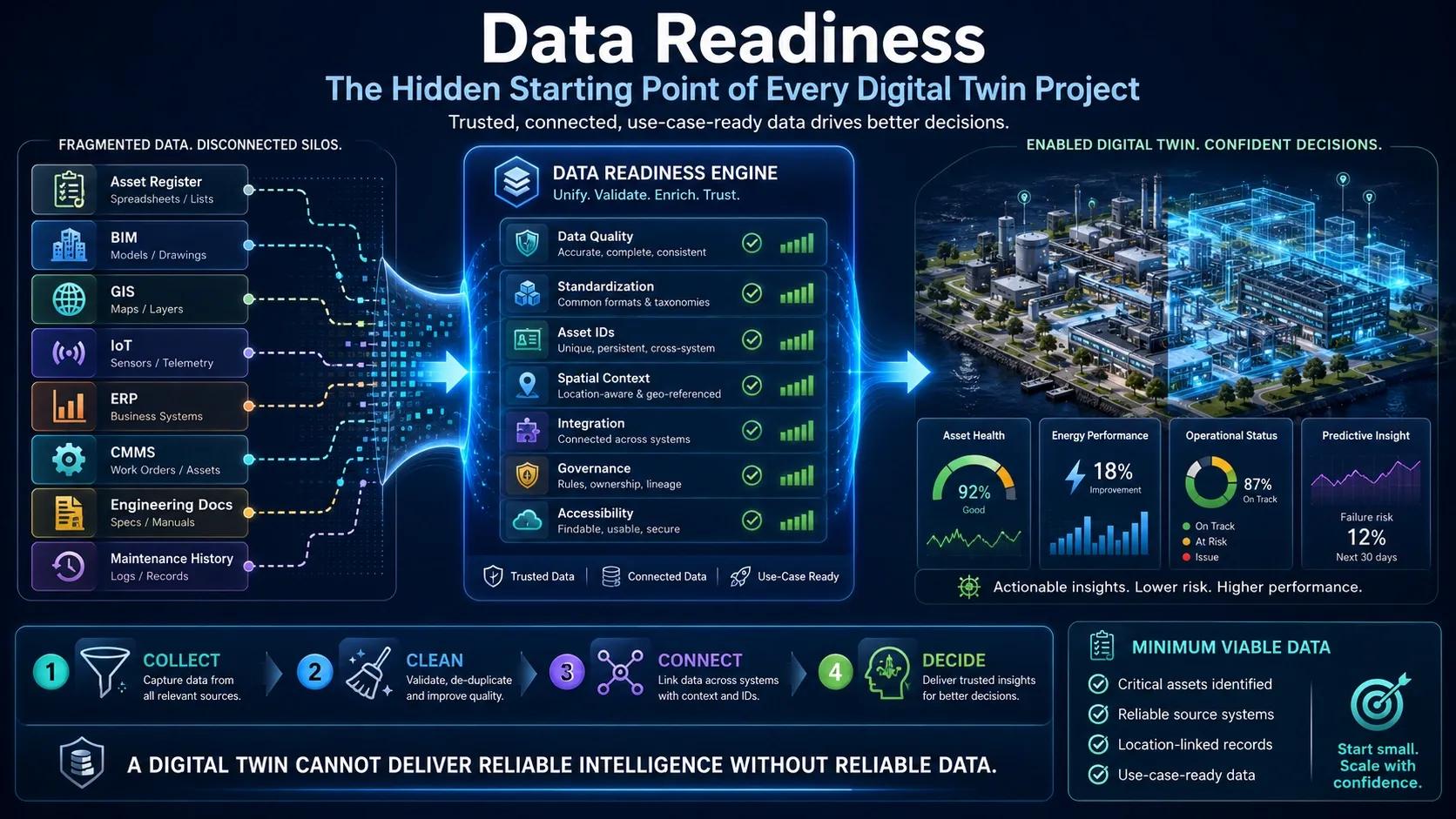
Many organizations begin their Digital Twin journey by looking at platforms, 3D models, dashboards, sensors, AI tools, or visualization environments.
These are important.
But they are not the true starting point.
The real starting point is data readiness.
A Digital Twin is only as strong as the data foundation behind it. If the data is incomplete, outdated, scattered, duplicated, or not trusted, the Digital Twin may look impressive on the surface but fail to support reliable decisions.
This is why data readiness is one of the most important, and often hidden, success factors in any Digital Twin project.
Why Data Readiness Matters
A Digital Twin is not just a digital replica.
It is a connected decision-support system.
It should help teams understand what is happening, where it is happening, why it is happening, what may happen next, and what action should be taken.
To do this, the Digital Twin needs trusted data from multiple sources.
These may include:
asset registers,
CAD drawings,
BIM models,
GIS layers,
IoT sensors,
ERP systems,
CMMS platforms,
SCADA systems,
maintenance logs,
inspection records,
documents,
drone surveys,
LiDAR scans,
satellite data,
field reports.
The problem is that in many organizations, these data sources exist in different departments, different formats, different levels of accuracy, and different stages of maturity.
The result is fragmentation.
The Digital Twin may be expected to deliver real-time intelligence, but the underlying data may still be manual, outdated, or disconnected.
That gap creates risk.
The Digital Twin Cannot Fix Bad Data Automatically
There is a common misunderstanding that once a Digital Twin platform is implemented, data problems will automatically disappear.
That is rarely true.
A platform can visualize data.
It can connect data.
It can analyze data.
It can help structure data.
But it cannot create trust where the source information itself is unclear.
If asset names are inconsistent, locations are missing, equipment IDs are duplicated, documents are outdated, sensor feeds are unreliable, and maintenance records are incomplete, the Digital Twin will inherit those problems.
The result may be a visually advanced system with weak decision confidence.
This is why data readiness must be assessed before full-scale implementation.
What Does Data Readiness Mean?
Data readiness means that the organization has enough reliable, structured, accessible, and usable data to support the selected Digital Twin use case.
It does not mean all data must be perfect.
No organization has perfect data.
But the data must be good enough for the decision the Digital Twin is expected to support.
For example, if the use case is energy optimization, the organization needs reliable energy consumption data, equipment data, occupancy information, operating schedules, and baseline performance.
If the use case is predictive maintenance, the organization needs asset condition data, historical failure data, maintenance records, sensor signals, operating parameters, and equipment hierarchy.
If the use case is road condition monitoring, the organization needs road inventory, chainage or location references, surface condition data, imagery, inspection history, maintenance records, and prioritization rules.
If the use case is port operations, the organization needs asset locations, equipment status, cargo flow, vessel movement, maintenance schedules, operational zones, and safety constraints.
Data readiness is always use-case specific.
The question is not: “Do we have all the data?”
The better question is: “Do we have the right data to improve the decision we care about?”
The Hidden Problem: Data Exists, But It Is Not Decision-Ready
Most organizations already have a lot of data.
The issue is not always lack of data.
The issue is that data is not decision-ready.
It may be:
stored in silos,
available only in spreadsheets,
not updated regularly,
not linked to asset IDs,
not connected to location,
not validated,
difficult to access,
owned by different teams,
not standardized,
not trusted by users.
This creates a situation where teams spend more time finding and cleaning data than using it for decisions.
A Digital Twin should reduce this friction. But for that to happen, data must be prepared properly.
Key Areas of Data Readiness
1. Asset Register Readiness
The asset register is often the backbone of a Digital Twin.
It tells the organization what assets exist, where they are located, how they are classified, who owns them, and how they should be managed.
A weak asset register creates weak Digital Twin intelligence.
Important questions include:
Do we have a complete list of assets?
Are assets uniquely identified?
Is asset hierarchy defined?
Are locations attached to assets?
Are critical assets marked?
Are ownership and maintenance responsibility clear?
Are asset attributes complete and updated?
For buildings, this may include HVAC systems, electrical panels, pumps, lifts, fire safety systems, rooms, equipment, and spaces.
For infrastructure, this may include roads, bridges, culverts, utilities, poles, pipelines, substations, manholes, drains, and control assets.
For manufacturing, this may include machines, production lines, inspection stations, utilities, tools, and material handling equipment.
Without asset register readiness, the Digital Twin has no reliable operational backbone.
2. Spatial and Location Readiness
A Digital Twin is not only about what exists. It is also about where it exists.
Location is critical.
This is where geospatial intelligence becomes important.
Assets must be connected to spatial context through GIS, BIM, indoor mapping, survey data, drone imagery, LiDAR scans, or other location references.
Location readiness asks:
Are assets mapped accurately?
Are coordinates available where needed?
Are building spaces linked to assets?
Are GIS layers updated?
Are BIM models georeferenced where required?
Are field observations linked to location?
Is there a common spatial reference system?
Can operational data be viewed in spatial context?
For a building, location may mean floor, room, zone, or equipment position.
For a city, it may mean ward, parcel, road segment, utility corridor, or risk zone.
For a factory, it may mean line, bay, station, zone, or machine location.
For a road, it may mean chainage, GPS position, lane, segment, or asset reference.
A Digital Twin without location intelligence is incomplete, especially for infrastructure, utilities, cities, campuses, ports, and large facilities.
3. BIM, GIS, and Engineering Data Readiness
Many Digital Twin projects depend on engineering information.
This may include BIM models, CAD drawings, GIS layers, technical documents, construction records, survey data, and as-built information.
The challenge is that these datasets are often created for design or construction, not for operations.
A BIM model may be rich in geometry but weak in operational attributes.
A CAD drawing may be useful visually but difficult to query.
A GIS layer may show location but may not contain asset condition or lifecycle details.
An as-built model may not be updated after modifications.
Questions to assess readiness include:
Are BIM models available?
Are they as-designed or as-built?
Are they updated after construction?
Do they contain useful asset attributes?
Are GIS layers linked to asset records?
Are drawings and models version controlled?
Are engineering documents traceable?
Is there a common data environment?
Can BIM and GIS data be connected meaningfully?
This is important because engineering context gives the Digital Twin its structural and operational meaning.
4. IoT and Real-Time Data Readiness
Real-time data is often seen as the most exciting part of a Digital Twin.
Sensors can provide live information on temperature, vibration, pressure, energy use, occupancy, flow, movement, air quality, machine condition, or environmental parameters.
But sensor data must be reliable.
IoT readiness asks:
What sensors are already installed?
What parameters are being monitored?
Is the data accurate?
What is the data frequency?
Is data available through APIs?
Are sensors calibrated?
Is there missing or noisy data?
Is the data linked to asset IDs and locations?
Is there a system to monitor sensor health?
Real-time data without context creates confusion.
A vibration alert is useful only if the system knows which asset is affected, where it is located, how critical it is, what the acceptable threshold is, and what action should follow.
This is where Digital Twin value begins to emerge.
5. Historical and Maintenance Data Readiness
Many predictive use cases depend on historical records.
Predictive maintenance, asset health scoring, risk analysis, and lifecycle planning require historical data.
But maintenance data is often inconsistent.
Some records may be detailed. Others may simply say “issue resolved.” Some may be in Excel. Some may be in CMMS. Some may be stored in emails or paper reports.
Questions include:
Is maintenance history available?
Are failure records structured?
Are inspection reports digitized?
Are work orders linked to assets?
Are spare parts records available?
Are downtime records reliable?
Are cost records linked to maintenance activities?
Are recurring issues easy to identify?
If historical data is weak, the Digital Twin can still begin with monitoring and diagnostics. But advanced prediction may require more data collection over time.
6. Data Governance Readiness
Data readiness is not only a technical issue.
It is also a governance issue.
Someone must own the data. Someone must validate it. Someone must update it. Someone must decide which version is trusted.
Governance readiness asks:
Who owns asset data?
Who owns spatial data?
Who owns sensor data?
Who approves changes?
Who manages data quality?
Who controls access?
Who maintains standards?
Who resolves conflicts between systems?
How often is data updated?
Without governance, the Digital Twin may become outdated soon after implementation.
A living system needs living data governance.
The Data Readiness Checklist
Before starting a Digital Twin project, organizations should ask:
Do we have a reliable asset register?
Are assets uniquely identified?
Are assets linked to location?
Are drawings, BIM models, and GIS layers updated?
Is operational data available?
Are sensor feeds reliable and accessible?
Is historical maintenance data structured?
Are data formats standardized?
Is there a common asset ID structure?
Is data ownership clearly defined?
Are data quality issues visible?
Can data be integrated across systems?
Is the data good enough for the selected use case?
Is there a process to keep the data updated?
Do users trust the data?
These questions can reveal whether the organization is ready for implementation, or whether it first needs a data preparation phase.
Start with Minimum Viable Data
The goal should not be to clean every dataset before starting.
That can delay the project unnecessarily.
A better approach is to define Minimum Viable Data for the selected use case.
For example:
For an energy optimization pilot, minimum viable data may include:
building zones,
energy meters,
operating schedules,
HVAC assets,
occupancy patterns,
baseline energy consumption.
For a predictive maintenance pilot, it may include:
critical asset list,
asset IDs,
sensor parameters,
failure history,
maintenance records,
operating thresholds.
For a road monitoring pilot, it may include:
road segment boundaries,
imagery or survey data,
condition classification rules,
maintenance history,
prioritization criteria.
This keeps the project practical.
Instead of waiting for perfect data, organizations start with the data required to prove value.
Closing Thought
Data readiness is the hidden starting point of every Digital Twin project.
It may not look as exciting as 3D visualization, AI dashboards, or real-time monitoring. But it determines whether those tools can produce reliable value.
A Digital Twin built on weak data will struggle to support strong decisions.
A Digital Twin built on trusted, connected, and use-case-ready data can become a powerful operational intelligence system.
The real question is not only whether an organization is ready to build a Digital Twin.
The deeper question is:
Is its data ready to support the decisions the Digital Twin is expected to improve?