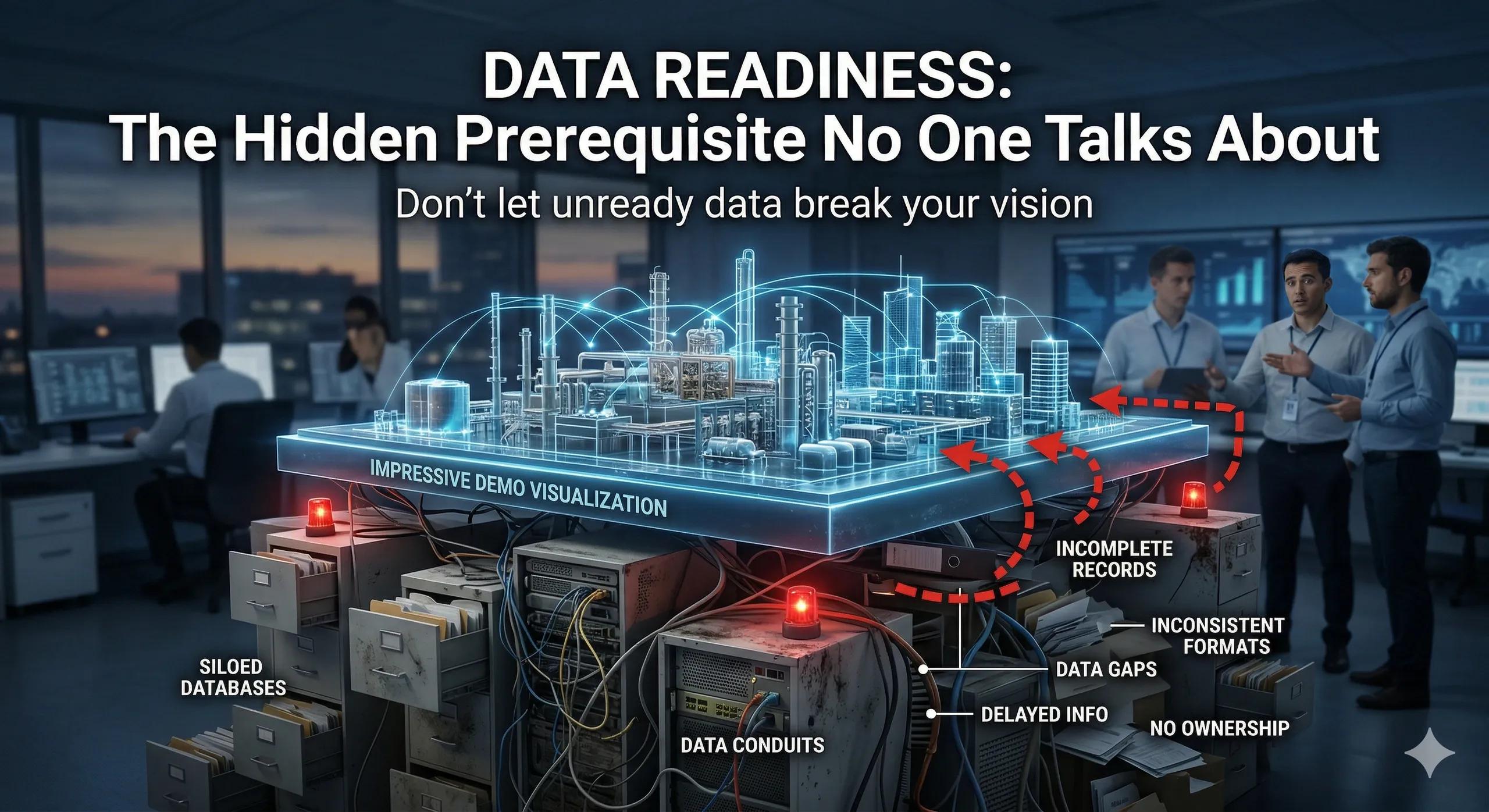
Why do many Digital Twin projects look impressive in demos but struggle in real operations?
Because the system is ready.
But the data is not .
Introduction
Organizations often focus on:
Platforms
Visualization
Integration
But overlook the most fundamental requirement:
👉 Data readiness
Without it, even the most advanced Digital Twin becomes:
Inaccurate
Delayed
Or unused
The Core Problem: Assuming Data Will “Fall Into Place”
A common assumption is:
“Once we build the system, data will start flowing correctly.”
In reality:
Data is incomplete
Stored in different formats
Not updated consistently
Not aligned across systems
👉 The result: unreliable outputs and low trust
What Data Readiness Actually Means
Data readiness is not just about having data.
It is about ensuring that data is:
1. Available
Do we have the required datasets?
Are there gaps in coverage?
2. Structured
Is the data standardized?
Are formats consistent across systems?
3. Connected
Can BIM, GIS, and IoT data talk to each other?
Are identifiers aligned?
4. Timely
Is the data updated frequently enough?
Can it support real-time or near real-time use cases?
5. Reliable
Is the data accurate?
Can users trust it for decision-making?
Why Data Issues Break Digital Twins
Even small data issues can have large impacts:
Incorrect asset IDs → wrong location mapping
Delayed sensor data → outdated insights
Missing attributes → incomplete analysis
👉 Over time, users lose confidence in the system
👉 And adoption drops
Practical Example
Scenario: Utility Network Monitoring
A system integrates:
BIM models of pipelines
GIS maps
Sensor data
But:
Asset IDs don’t match across systems
Some sensors send delayed data
Historical data is incomplete
Result:
Alerts are unreliable
Decisions are delayed
Teams revert to manual processes
👉 The Digital Twin exists but is not trusted
Where Most Organizations Go Wrong
1. No Data Audit Before Starting
Jumping into implementation without understanding data quality.
2. Treating Data as an IT Problem
Data is often seen as a technical issue, not an operational one.
3. Lack of Data Standards
Different teams use different naming, formats, and structures.
4. Ignoring Data Ownership
No clarity on who maintains and updates data.
Ask Yourself
Can your current data be trusted to support real-time decisions or is it still being validated manually?
What a Better Approach Looks Like
1. Start with a Data Audit
Identify what exists
Identify gaps
2. Define Data Standards
Naming conventions
Formats
Update frequency
3. Align Systems Early
Common identifiers across BIM, GIS, IoT
4. Establish Data Ownership
Who is responsible for maintaining what
5. Plan for Continuous Updates
Data is not static, it must evolve with operations
Indian Context
In many Indian projects:
Data is generated at scale
But not standardized or connected
This creates an opportunity:
👉 Organizations that invest in data readiness early will move faster in Digital Twin adoption
Benefits of Data Readiness
Higher system trust and adoption
More accurate insights
Faster decision-making
Reduced operational risk
Strong foundation for scaling
Conclusion
A Digital Twin is only as good as the data behind it.
Without data readiness:
Systems may function
But decisions will not improve
The real starting point is not the platform.
It is the data strategy .