Data does not create value when it is collected.
It creates value when it flows, correctly, consistently, and in time.
Introduction
In the previous article, we looked at the sensor layer , how IoT, UAVs, and LiDAR capture reality.
Now the next question is:
👉 What happens to that data after it is collected?
Because in most Digital Twin projects:
data is captured
systems are deployed
But the flow between them is weak or broken.
This is where data pipelines come in.
In Phase 2: Architecture & Technology Stack , understanding data pipelines is critical, because this is what connects the physical world to decision systems.
The Core Idea: Data Must Move with Purpose
A data pipeline is not just a technical setup.
It defines:
how data is collected
how it is transmitted
how it is processed
how it is stored
how it is delivered for use
If this flow is not designed properly: 👉 the Digital Twin becomes slow, inconsistent, or unreliable
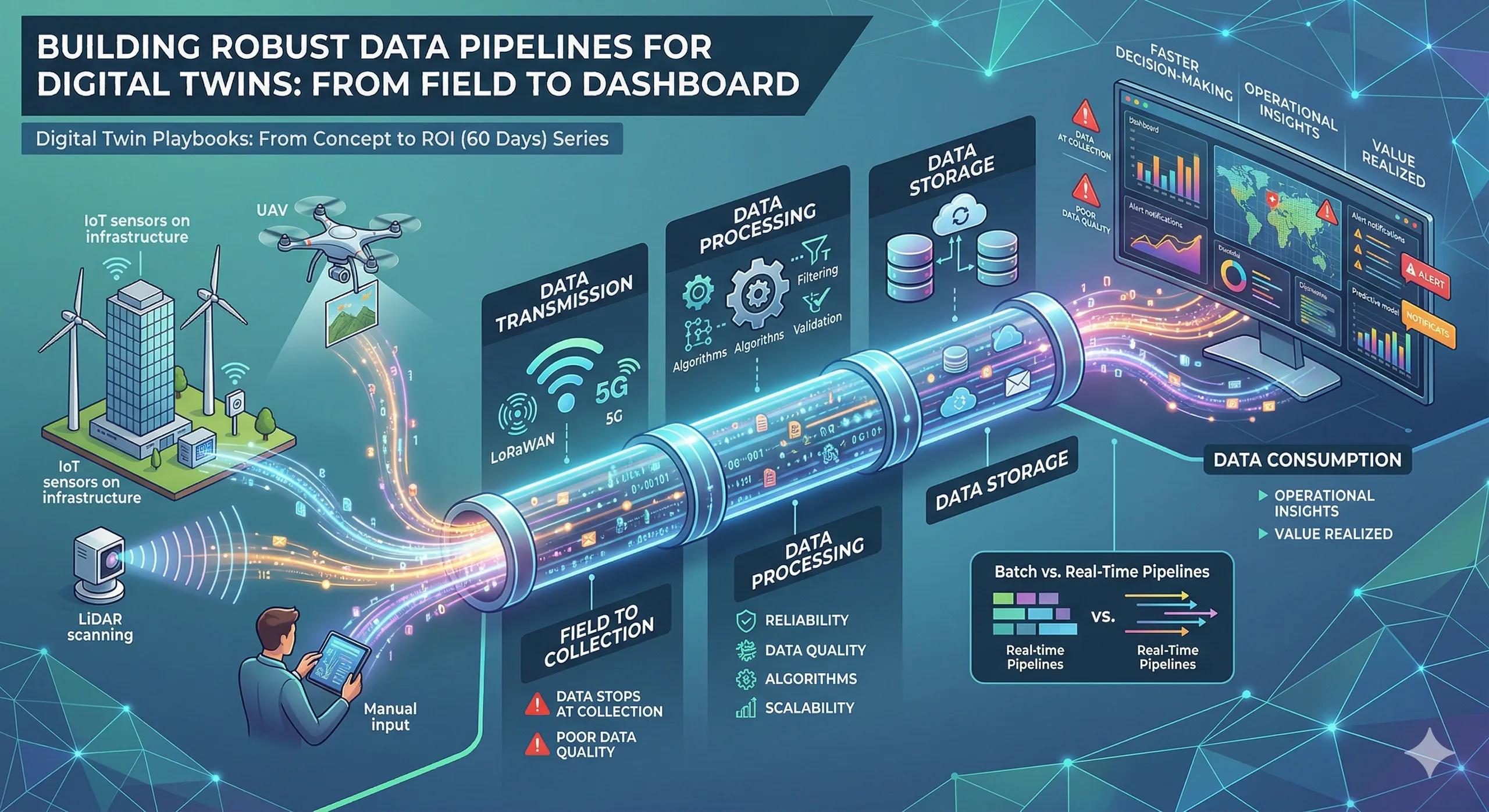
The Typical Data Flow in a Digital Twin
A simplified pipeline looks like this:
👉 Sensor → Transmission → Processing → Storage → Application
Each stage plays a critical role.
1. Data Collection (Field Layer)
This is where data originates:
IoT sensors
UAV imagery
LiDAR scans
manual inputs
At this stage: 👉 data is raw and unstructured
2. Data Transmission
Data must move from field to system.
Methods include:
MQTT / HTTP APIs
cellular (4G/5G), LoRaWAN
Wi-Fi or wired networks
Key challenge:
unreliable connectivity
latency issues
👉 If data does not reach on time, decisions get delayed
3. Data Processing
Raw data needs to be transformed.
This includes:
filtering noise
validating inputs
converting formats
enriching with context (e.g., location, asset ID)
Where this happens:
edge devices
cloud systems
👉 This step defines data quality and usability
4. Data Storage
Processed data must be stored in a structured way.
Common storage types:
time-series databases (for IoT data)
spatial databases (for GIS data)
data lakes (for large-scale storage)
👉 This enables:
historical analysis
trend detection
scalability
5. Data Consumption (Application Layer)
This is where data is used.
Examples:
dashboards
alerts
predictive models
automated workflows
👉 This is where value is realized
Where Data Pipelines Break
1. Data Stops at Collection
Sensors are deployed, but:
data is not transmitted reliably
or not integrated
👉 Result: unused data
2. Poor Data Quality
noisy inputs
missing values
inconsistent formats
👉 Result: loss of trust
3. No Real-Time Capability
delayed processing
batch-only systems
👉 Result: outdated insights
4. Disconnected Systems
BIM, GIS, IoT not linked
👉 Result: fragmented understanding
5. No Action Layer
data reaches dashboards
but no workflow is triggered
👉 Result: no impact
Practical Example
Scenario: Smart Water Network
Sensors: measure pressure and flow
Transmission: send data via cellular network
Processing: detect anomalies
Storage: maintain historical patterns
Application: alert maintenance teams
👉 Outcome: Leaks detected early, reducing water loss
Ask Yourself
Is your data flowing continuously from field to decision or stopping somewhere in between?
Batch vs Real-Time Pipelines
Not all pipelines need to be real-time.
Use Real-Time When:
safety is critical
rapid response is required
operational control depends on it
Use Batch When:
analysis is periodic
reporting is sufficient
latency is acceptable
👉 Choosing the right approach avoids unnecessary complexity
Indian Context
In India, common challenges include:
connectivity gaps in remote areas
legacy systems without APIs
fragmented data ownership
This makes pipeline design even more critical.
A well-structured pipeline:
reduces dependency on manual processes
improves reliability
supports scalable deployment
Benefits of Strong Data Pipelines
consistent data flow
improved data quality
faster decision-making
scalable architecture
higher system trust
Conclusion
A Digital Twin is only as strong as its data pipeline.
Sensors capture reality.
Models represent it.
But pipelines ensure: 👉 the right data reaches the right system at the right time
Without that flow:
insights are delayed
decisions are weakened
value is lost