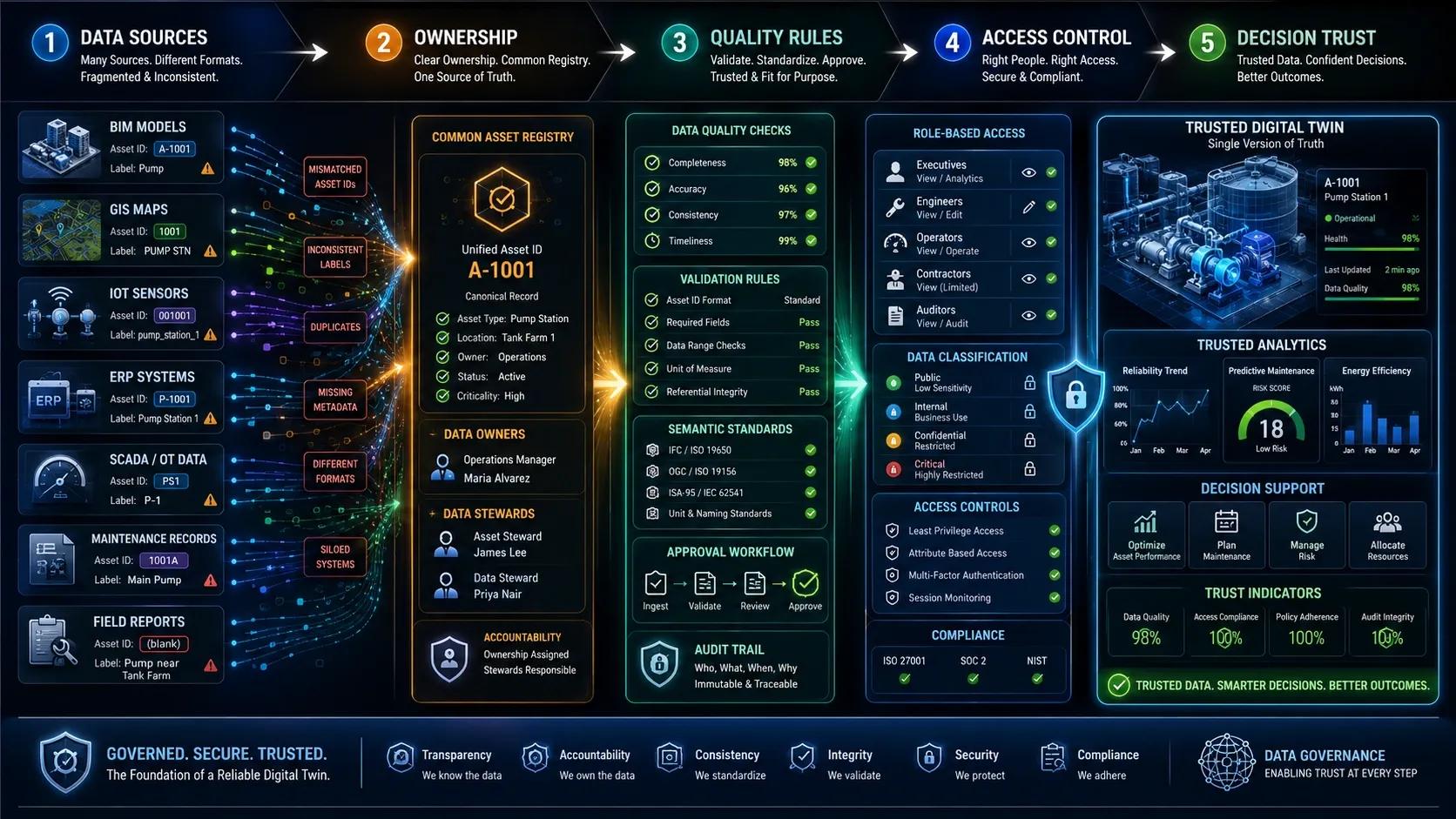
Digital Twins do not fail only because of poor data.
They fail because no one is clearly responsible for the data.
Introduction: Phase 4 Continuation
In Phase 4, we are focusing on:
👉 Operations, KPIs & ROI
So far, we discussed:
defining KPIs
measuring ROI
scaling from pilot to enterprise
operationalizing Digital Twins in daily workflows
predictive vs prescriptive decision-making
cost breakdown and adoption
Now we move to one of the most difficult but critical areas:
Data Ownership & Governance
Because a Digital Twin depends on trusted data.
But in many organizations, data is spread across:
departments
vendors
systems
project teams
field operations
legacy databases
The result?
👉 everyone uses the data, but no one fully owns its quality, meaning, and lifecycle.
The Core Problem: Data Exists, But Ownership Is Unclear
In most organizations, Digital Twin data comes from multiple sources:
BIM models
GIS layers
IoT sensors
ERP systems
maintenance records
field inspection reports
SCADA/OT systems
Each system may have its own owner.
But the Digital Twin requires all of them to work together.
This creates a major question:
👉 Who is accountable when the data is wrong?
Why Data Ownership Matters
A Digital Twin is only as reliable as the data behind it.
If ownership is unclear:
asset IDs may not match
updates may be delayed
sensor data may remain unvalidated
old records may continue to be used
decision logic may depend on incomplete information
The result is simple:
👉 users stop trusting the system.
And once trust drops, adoption drops.
The Difference Between Data Ownership and Data Governance
These two are connected but not the same.
Data Ownership
Data ownership answers:
👉 Who is responsible for the data?
This includes:
who creates it
who updates it
who validates it
who approves changes
who is accountable for errors
Data Governance
Data governance answers:
👉 How should data be managed?
This includes:
standards
access control
naming conventions
data quality rules
lifecycle management
compliance requirements
audit trails
Ownership defines responsibility.
Governance defines rules.
Digital Twins need both.
Where Governance Challenges Appear
1. Asset Identity Conflicts
The same asset may appear differently across systems.
Example:
BIM model: Pump-01
IoT system: Sensor-734
ERP system: Asset ID: EQP-1220
Maintenance system: Pump A-Block
Technically, these may refer to the same asset.
But without a common asset identity:
👉 the Digital Twin cannot connect data reliably.
2. Data Quality Issues
Common problems include:
missing values
outdated records
duplicate assets
incorrect coordinates
uncalibrated sensor feeds
inconsistent formats
Poor quality data does not just affect reports.
It affects decisions.
3. Access and Permission Gaps
Some teams need data to operate.
Others need it to plan.
External vendors may need partial access.
Without governance:
too much access creates risk
too little access slows decisions
The challenge is:
👉 right data, right user, right purpose.
4. Vendor and Platform Lock-In
Digital Twin data may sit inside:
proprietary systems
closed platforms
vendor-specific formats
This creates long-term risk.
If the organization cannot control its own data structure:
👉 scalability becomes difficult.
5. Data Lifecycle Problems
Data changes over time.
Assets are added, modified, replaced, retired.
But many organizations do not define:
how data gets updated
when old data is archived
who approves changes
how changes are audited
Without lifecycle governance:
👉 the Digital Twin slowly becomes outdated.
The Hidden Challenge: Meaning Changes Across Departments
A maintenance team may define an asset differently from a design team.
A GIS team may see it as a location-based object.
An operations team may see it as a functional component.
A finance team may see it as a capital asset.
All may be correct.
But unless these meanings are aligned:
👉 the Digital Twin becomes technically connected but semantically fragmented.
What Good Governance Looks Like
A mature Digital Twin governance model includes:
1. Common Asset Registry
One trusted reference for all critical assets.
This creates:
consistent asset IDs
ownership clarity
cross-system mapping
2. Data Stewardship Roles
Every major dataset should have a responsible owner.
Examples:
BIM data steward
GIS data steward
IoT data steward
operations data steward
Their role is to ensure quality and consistency.
3. Data Quality Rules
Define rules for:
completeness
accuracy
update frequency
validation
acceptable error limits
4. Access Control Framework
Define:
who can view
who can edit
who can approve
who can export
This protects both security and accountability.
5. Change Management Process
Every major data update should have:
approval workflow
version history
audit trail
rollback capability
6. Semantic Standards
Define what key terms mean.
For example:
asset
location
status
risk
failure
maintenance priority
This prevents confusion across teams.
Practical Example: Smart Facility
A facility Digital Twin integrates:
BIM model
HVAC sensor data
energy meters
maintenance records
The system detects abnormal energy usage.
But if asset identity is unclear:
the dashboard shows the issue
the maintenance system assigns the wrong equipment
the field team checks the wrong zone
The problem is not AI.
The problem is governance.
Where Most Organizations Go Wrong
1. Governance Starts Too Late
Many organizations define governance after deployment.
By then:
systems are already fragmented
data standards are inconsistent
ownership is unclear
2. Governance Is Treated as Documentation
Governance is not just a policy document.
It must be embedded into:
workflows
systems
approvals
validation rules
3. IT Owns Everything by Default
IT may manage systems.
But business teams understand meaning.
Good governance requires:
👉 IT + operations + domain experts working together.
4. No One Owns Data Quality
Everyone uses the data.
No one maintains it.
That is where trust fails.
Ask Yourself
Who owns the data your Digital Twin depends on?
And who is accountable when that data is wrong?
Indian Context
In India, many Digital Twin initiatives involve:
multiple vendors
government departments
consultants
contractors
operators
legacy systems
This makes governance even more important.
For large infrastructure, smart city, utility, and industrial projects:
👉 data ownership must be defined early.
Otherwise, the Digital Twin becomes difficult to scale, maintain, and trust.
Benefits of Strong Data Governance
higher trust in the system
improved adoption
reduced integration issues
better decision accuracy
lower operational risk
easier scaling
stronger compliance
Conclusion
Data is not just a technical resource.
It is an operational responsibility.
Digital Twins succeed when organizations clearly define:
who owns the data
how it is governed
how quality is maintained
how meaning is preserved
Without ownership, data becomes fragmented.
Without governance, decisions become unreliable.
And without trust, Digital Twins do not scale.