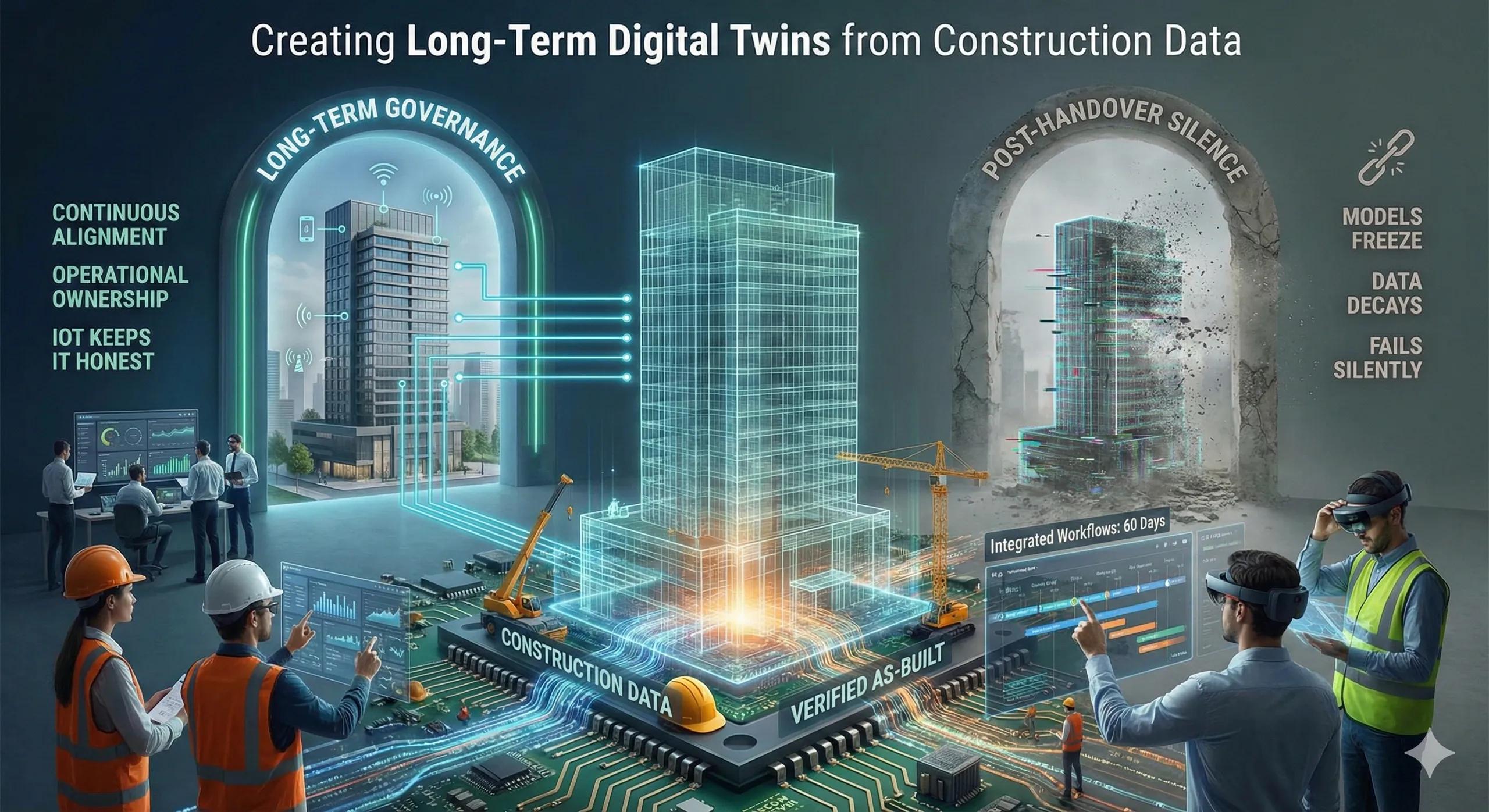
Most digital twins fail silently.
Not during construction, but after handover , when models freeze, data decays, and reality moves on.
A long-term digital twin is not created by software.
It is created by decisions made during construction about data, governance, and continuity.
1. Why Most Digital Twins Don’t Last
Common failure points:
Construction data is treated as temporary
Models are not updated after handover
Asset changes aren’t captured
Operational teams don’t trust the data
The twin becomes a snapshot, useful once, then ignored.
2. The Core Truth About Long-Term Twins
A digital twin is not a model.
It is a process of continuous alignment between reality and data.
Long-term twins require:
Verified construction data
Structured asset identity
Change tracking
Operational ownership
Without these, the twin drifts out of relevance.
3. Construction Is the Only Time You Can Get It Right
Construction is when:
Assets are visible
Decisions are documented
Deviations are known
Evidence can be captured
If data quality is weak here, no amount of FM tooling will fix it later.
4. What Construction Data Actually Matters
Not all data should survive.
Long-term twins rely on:
As-built geometry (validated)
Asset metadata (make, model, capacity)
Commissioning evidence
Location and spatial context
Change history
Excess detail becomes noise.
5. The Role of BIM in Longevity
BIM provides:
Structured data schema
Asset hierarchy
Spatial anchoring
But BIM must evolve:
From authoring tool → system of record
From drawings → verified state
Static BIM kills twins. Governed BIM sustains them.
6. IoT Keeps the Twin Honest
IoT prevents drift by:
Detecting change
Validating assumptions
Feeding operational behavior
But only if:
Sensors are mapped to assets
Thresholds are meaningful
Alerts lead to action
Otherwise, IoT becomes telemetry without memory.
7. Governance Is the Deciding Factor
Long-term twins require clarity on:
Who owns the twin
Who updates it
What triggers change
What data can be trusted
Without governance, twins degrade into archives.
8. India Context: Why Longevity Is Hard, but Critical
In Indian assets:
Ownership changes
Vendors rotate
Documentation quality varies
A durable digital twin:
Preserves institutional memory
Reduces dependency on individuals
Supports audits, upgrades, and expansion
Longevity is a resilience strategy.
9. When a Digital Twin Becomes Strategic
A long-term twin supports:
Predictive maintenance
Energy optimization
Capital planning
Risk analysis
Portfolio-level decisions
At this point, the twin is no longer a project deliverable, it’s an asset itself .
10. A Simple Longevity Rule
If the twin doesn’t know what changed last month, it won’t matter next year.
Conclusion
Long-term digital twins are built, not installed.
They survive when:
Construction data is verified
Asset identity is preserved
Change is governed
Operations own the model
Digital twins don’t fail because they are complex.
They fail because continuity was never designed .