Most organizations underestimate Digital Twin costs for one reason:
👉 they budget for technology, but not for operations, integration, and long-term evolution.
Introduction: Phase 4 Continuation
In the previous articles, we explored:
KPIs and ROI
operational workflows
predictive vs prescriptive systems
scaling challenges
Now we move to one of the most practical and misunderstood topics in Digital Twin adoption:
Where does the money actually go?
Because many organizations still assume Digital Twins are primarily:
software purchases
visualization platforms
AI systems
sensor deployments
But real-world Digital Twin programs involve far more than technology.
The true cost structure includes:
integration
data pipelines
operations
governance
cloud infrastructure
maintenance
change management
workflow redesign
continuous optimization
This is why many projects face budget overruns.
Not because the technology failed.
But because:
👉 the organization underestimated the operational ecosystem required to sustain it.
The Core Problem: Organizations Budget for the Visible Layer Only
Most initial budgets focus on:
dashboards
3D visualization
sensors
software licensing
These are visible costs.
But many hidden costs emerge later:
integration effort
cloud scaling
data cleaning
operational support
workflow integration
user adoption
ongoing maintenance
And over time:
👉 operational costs often exceed initial implementation costs.
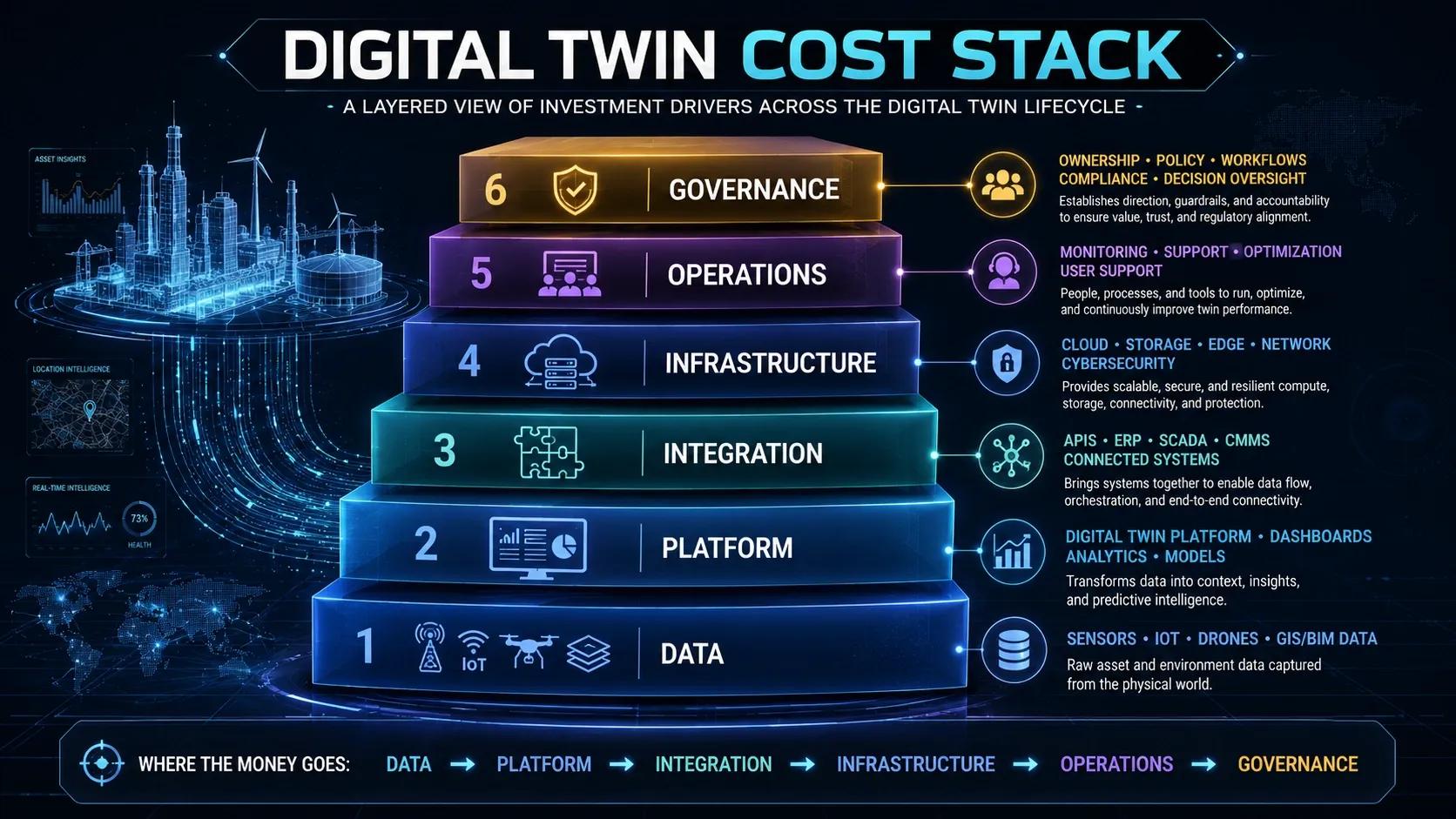
The Digital Twin Cost Stack
A mature Digital Twin program usually includes six major cost layers.
1. Data Acquisition Costs
This includes:
IoT sensors
drones/UAVs
LiDAR scanning
satellite imagery
BIM models
GIS datasets
telemetry systems
Reality
Data collection is not a one-time activity.
Many environments require:
continuous updates
calibration
validation
synchronization
Example
A city-scale Digital Twin may require:
traffic feeds
utility data
environmental sensors
mobility datasets
3D city models
The scale increases rapidly.
2. Platform & Software Costs
This includes:
Digital Twin platforms
GIS software
BIM tools
analytics engines
AI/ML frameworks
database systems
visualization engines
Reality
Organizations often underestimate:
👉 licensing scalability.
Costs rise when:
users increase
data volume grows
workflows expand
integrations multiply
3. Integration Costs
This is one of the largest hidden cost areas.
Digital Twins rarely operate alone.
They must integrate with:
ERP systems
SCADA systems
CMMS platforms
IoT infrastructure
BIM/GIS environments
APIs
operational databases
Reality
Integration complexity often determines:
👉 project success or failure.
4. Infrastructure & Cloud Costs
This includes:
cloud hosting
storage
GPU processing
networking
edge computing
backup systems
cybersecurity infrastructure
Reality
As Digital Twins mature:
👉 compute and storage requirements increase dramatically.
Especially when:
AI models scale
simulation frequency increases
real-time processing expands
5. Operational & Support Costs
This is where many organizations struggle.
Digital Twins require ongoing:
monitoring
tuning
maintenance
data governance
user support
KPI tracking
optimization
Critical Insight
A Digital Twin is not a static software deployment.
It behaves more like:
👉 a living operational system.
6. Organizational Change Costs
This is heavily underestimated.
Real adoption requires:
training
workflow redesign
operational alignment
governance structures
change management
executive coordination
Reality
Technology deployment is often easier than:
👉 changing how people work.
The Biggest Hidden Cost: Data Quality
Many organizations assume:
👉 more data = better system
But poor-quality data creates:
unreliable predictions
low trust
operational friction
decision errors
Which leads to:
👉 additional validation and correction costs.
In many projects:
👉 data cleaning becomes one of the largest long-term investments.
The Cost Maturity Curve
Stage 1: Pilot Costs
Mostly:
software
sensors
visualization
Stage 2: Integration Costs
Costs increase through:
APIs
workflow connections
operational alignment
Stage 3: Operational Costs
Continuous:
cloud usage
support
governance
optimization
Stage 4: Scaling Costs
Enterprise scaling introduces:
redundancy
cybersecurity
resilience
multi-site deployment
Where Most Budgeting Goes Wrong
1. Underestimating Integration
The dashboard may be easy.
Connecting the organization is not.
2. Treating the Project as One-Time Deployment
Digital Twins evolve continuously.
3. Ignoring Adoption Costs
Without operational adoption: 👉 ROI collapses.
4. Underestimating Data Management
Maintaining trusted data is expensive.
5. Ignoring Governance
Lack of ownership creates:
inefficiency
duplicated effort
operational drift
What Mature Organizations Do Differently
Successful organizations budget for:
lifecycle operations
continuous optimization
governance
workflow integration
scalability
operational ownership
They treat Digital Twins as:
👉 long-term operational infrastructure, not short-term innovation projects.
Ask Yourself
Is your organization budgeting for:
👉 technology deployment,
Or
👉 operational transformation?
Indian Context
In India, many Digital Twin initiatives begin with:
pilot budgets
innovation funding
smart city allocations
isolated technology procurement
But scaling requires:
operational funding models
lifecycle budgeting
integration planning
governance ownership
This is where many initiatives face financial stress.
The next maturity shift will happen when organizations budget for:
👉 operational continuity, not just implementation.
Benefits of Proper Cost Planning
realistic ROI expectations
smoother scaling
reduced operational surprises
stronger executive confidence
sustainable long-term adoption
Conclusion
The biggest misconception about Digital Twins is that they are software projects.
They are not.
They are:
👉 operational ecosystems.
And operational ecosystems require:
data
integration
governance
workflows
infrastructure
continuous optimization
The organizations that understand this early:
👉 scale faster,
👉 sustain longer,
👉 and achieve stronger ROI.