A Digital Twin does not fail only when it is built poorly.
It fails when it stops evolving.
Introduction: Phase 4 Conclusion
Over the last 10 days in Phase 4: Operations, KPIs & ROI , we focused on one central question:
👉 How does a Digital Twin create measurable business value?
We explored:
defining KPIs
measuring ROI
moving from pilot to scale
embedding Digital Twins into daily workflows
predictive vs prescriptive decision-making
cost breakdown
change management
data ownership
enterprise integration
Now we close Phase 4 with one of the most important realities:
A Digital Twin is never finished.
It must be maintained, governed, tuned, validated, and improved continuously.
Because the physical world changes.
Assets degrade.
Processes evolve.
Sensors drift.
Teams change.
Business priorities shift.
Data structures mature.
If the Digital Twin does not evolve with reality:
👉 it becomes outdated.
And once users stop trusting it:
👉 adoption declines
👉 decisions move back to old workflows
👉 ROI disappears
The Core Problem: Treating Digital Twins as One-Time Projects
Many organizations approach Digital Twins like software implementations.
They plan:
build phase
deployment phase
go-live
handover
But Digital Twins are not static software systems.
They are operational systems tied to changing physical reality.
So the real question is not:
👉 “When will the Digital Twin be completed?”
The better question is:
👉 “How will the Digital Twin stay accurate, useful, and trusted over time?”
Why Continuous Improvement Matters
A Digital Twin depends on alignment between:
physical assets
data models
sensor feeds
workflows
business rules
decision logic
user adoption
If any of these drift, the twin becomes unreliable.
For example:
a sensor is replaced but not updated
an asset is modified in the field but not reflected in the model
a workflow changes but the twin still follows old rules
a KPI changes but the dashboard still tracks outdated metrics
This is how Digital Twins slowly lose relevance.
Not suddenly.
Gradually.
The Digital Twin Lifecycle
A healthy Digital Twin follows a continuous lifecycle:
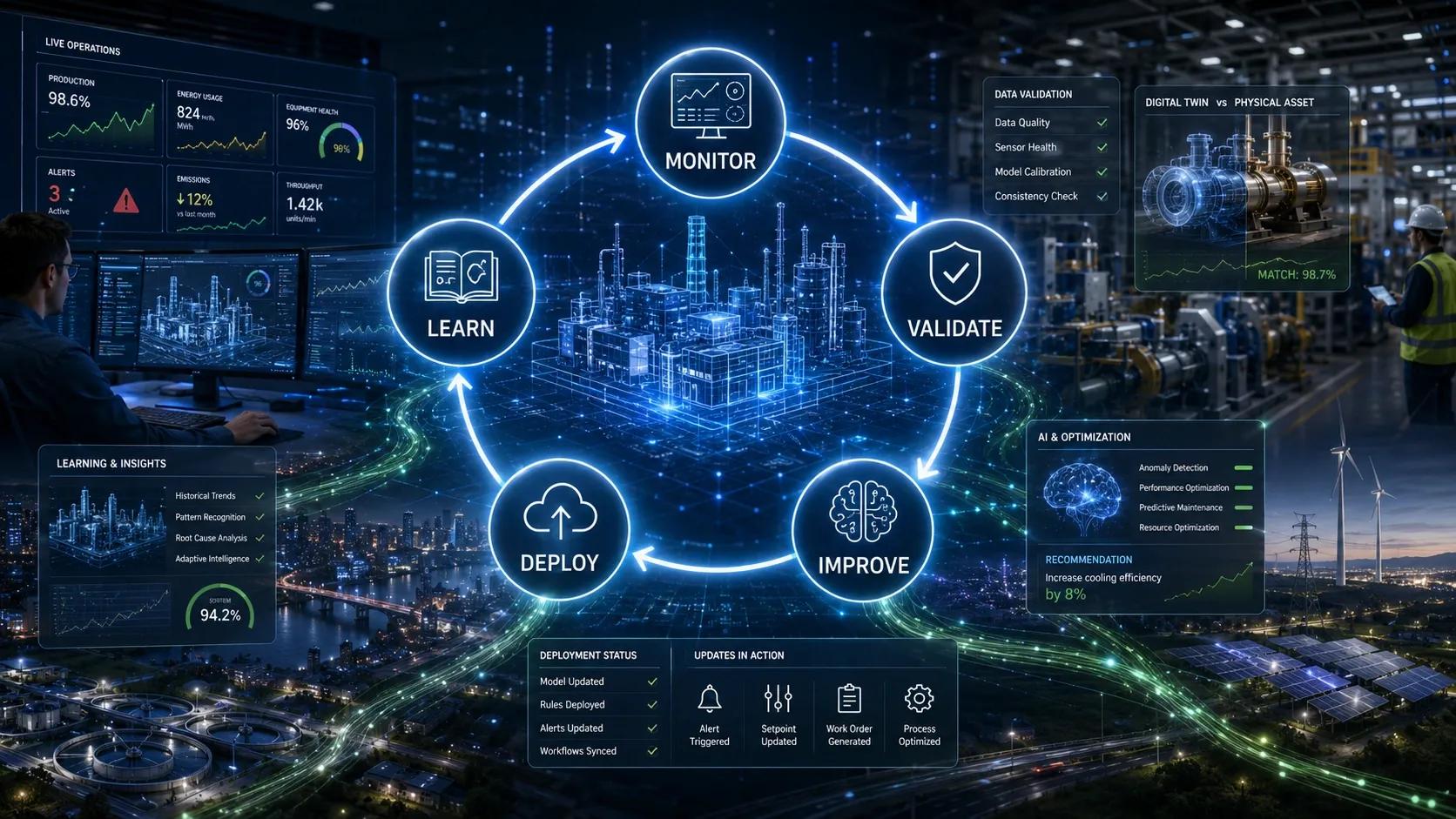
👉 Monitor → Validate → Improve → Deploy → Learn
This loop must keep running.
1. Monitor
Track performance continuously.
This includes:
data quality
system uptime
workflow usage
decision latency
KPI performance
user adoption
Monitoring should not only check whether the system is running.
It should check whether the system is still creating value.
2. Validate
Validate whether the Digital Twin still reflects reality.
Questions to ask:
Are asset records updated?
Are sensors calibrated?
Are data feeds reliable?
Are predictions still accurate?
Are workflows still relevant?
Are users trusting the system?
Validation protects decision quality.
3. Improve
Use operational feedback to improve the twin.
This may include:
updating models
refining AI algorithms
correcting data gaps
improving workflows
simplifying interfaces
adjusting KPIs
Continuous improvement is where Digital Twins become smarter over time.
4. Deploy
Improvements must be pushed back into operations.
This includes:
updated dashboards
new workflows
revised alerts
changed rules
improved integrations
Without deployment, improvement remains theoretical.
5. Learn
Every action should create learning.
A mature Digital Twin should learn from:
past failures
avoided incidents
completed work orders
operator feedback
performance outcomes
This turns operations into a learning system.
The Biggest Risk: Model Drift
One of the biggest threats to Digital Twin reliability is:
model drift
This happens when the model no longer represents real-world behavior.
Examples:
machine behavior changes over time
traffic patterns shift
environmental conditions evolve
asset degradation accelerates
maintenance practices change
If the Digital Twin is not recalibrated:
👉 predictions become weaker
👉 recommendations become unreliable
👉 users lose trust
The Second Risk: Workflow Drift
Even if data is accurate, workflows can drift.
Teams may:
bypass the system
return to manual approvals
ignore alerts
close tasks outside the platform
update records inconsistently
That is why workflow adoption must be continuously measured.
A Digital Twin is alive only when people keep working through it.
The Third Risk: Governance Drift
Governance can also weaken over time.
This happens when:
ownership becomes unclear
data stewards change
approval rules are ignored
access controls become loose
standards are not updated
When governance weakens, trust weakens.
And without trust, the Digital Twin becomes another dashboard.
What Keeps a Digital Twin Alive?
A living Digital Twin needs five ongoing disciplines:
1. Data Stewardship
Someone must own data quality.
Not once.
Continuously.
This includes:
asset updates
sensor validation
metadata management
lifecycle tracking
quality checks
2. KPI Review
KPIs should be reviewed regularly.
Because business priorities change.
A KPI that mattered during deployment may not be the most important one after scaling.
3. Model Recalibration
AI/ML models and simulations need periodic validation.
The question is:
👉 are predictions still matching real outcomes?
If not, the model must be retrained or adjusted.
4. Workflow Optimization
Daily workflows should be reviewed.
Are alerts converting into action?
Are tasks closing faster?
Are users adopting the system?
Are decisions improving?
If not, workflows need redesign.
5. Governance Review
Ownership, access, and approval structures must be maintained.
Digital Twins scale only when governance remains clear.
Practical Example: Smart Facility
A facility Digital Twin reduces energy consumption in the first 6 months.
But after one year:
occupancy patterns change
new equipment is installed
HVAC settings are modified
users return to manual overrides
If the twin is not updated:
👉 energy optimization declines.
A continuous improvement approach would:
monitor new usage patterns
recalibrate energy models
update HVAC rules
retrain users
track savings again
That is how the twin stays alive.
Where Most Organizations Go Wrong
1. No Post-Go-Live Team
After deployment, the project team moves on.
But the Digital Twin still needs ownership.
2. No Budget for Continuous Improvement
Budgets cover implementation, not evolution.
This leads to system decay.
3. No Feedback Loop
User feedback is not captured.
Operational lessons never enter the system.
4. No Data Quality Maintenance
Data is trusted at launch but not maintained afterward.
5. No KPI Refresh
The same dashboards continue even when business priorities change.
Ask Yourself
Is your Digital Twin improving over time, or slowly becoming outdated?
Indian Context
In India, many Digital Twin initiatives are still project-based.
They are funded, built, launched, and showcased.
But long-term success depends on:
operational ownership
recurring budgets
data governance
model validation
workflow adoption
continuous improvement teams
The next maturity shift is clear:
👉 Digital Twins must move from projects to operational capabilities.
That means organizations need to treat them like living systems, not finished products.
Benefits of Continuous Improvement
sustained ROI
better decision accuracy
higher user trust
lower operational drift
improved resilience
stronger adoption
long-term scalability
Conclusion
A Digital Twin is not alive because it has real-time data.
It is alive when it keeps learning, adapting, and improving.
The real success is not launch.
The real success is sustained relevance.
Because the physical world never stops changing.
So the Digital Twin must never stop improving.