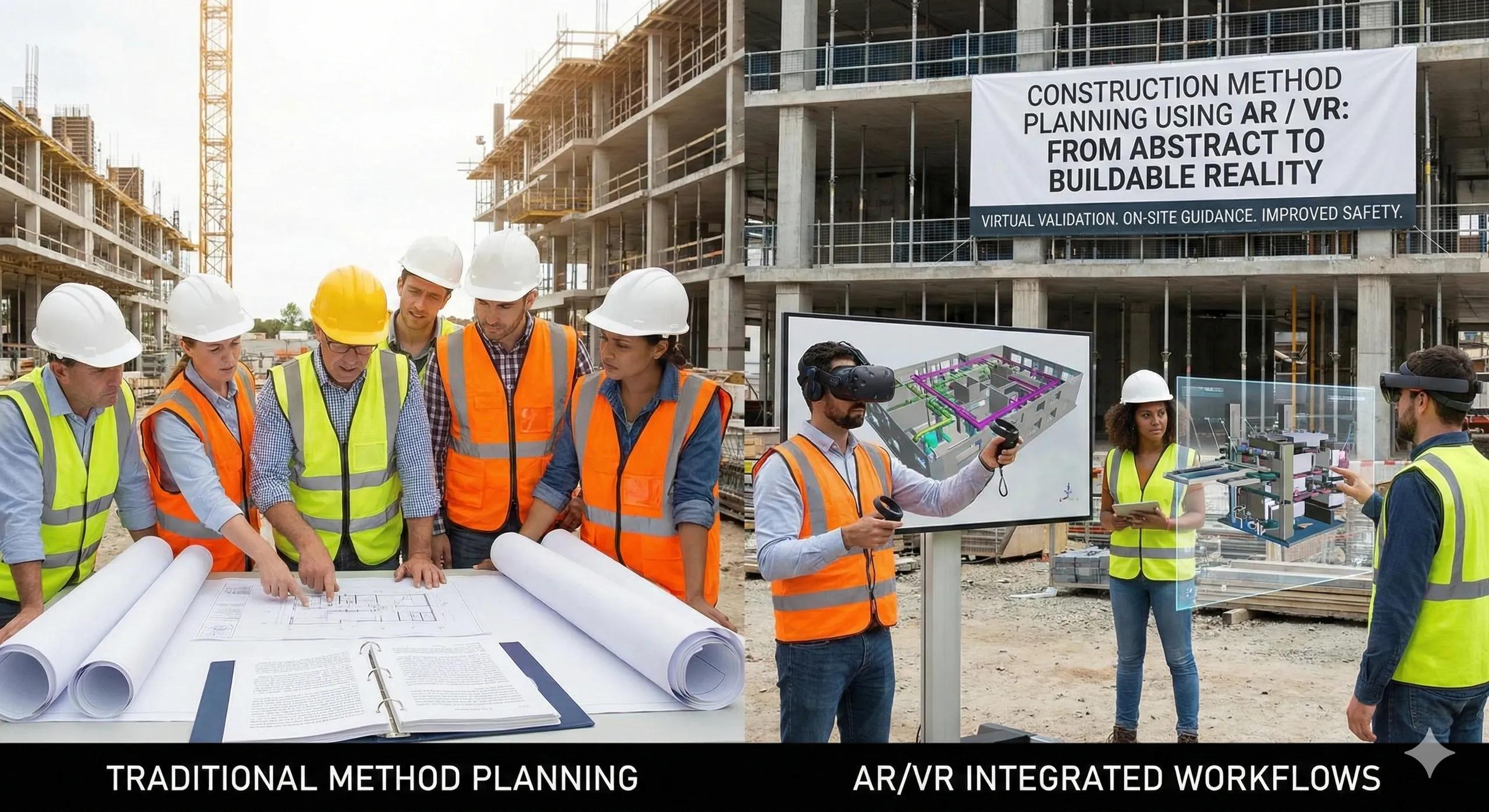
Most construction methods look logical in documents.
Many fail when people try to execute them.
The gap exists because methods are designed abstractly but executed physically .
AR and VR close this gap by allowing teams to experience construction methods before committing to them, revealing access issues, safety risks, and sequencing conflicts that are invisible in drawings and schedules.
1. Why Method Statements Often Fail on Site
Traditional method planning relies on:
Text-heavy method statements
2D drawings
Assumed access and visibility
But execution depends on:
Human movement
Line of sight
Reach, clearance, and ergonomics
Equipment maneuverability
If people can’t see the method, they can’t reliably execute it.
2. What AR and VR Add to Method Planning
AR and VR allow teams to:
Walk through construction sequences virtually
Test installation methods before site setup
Validate access, reach, and clearances
Identify unsafe postures or blind spots
Align understanding across disciplines
This turns method planning from explanation into shared experience .
3. VR for Pre-Construction Validation
VR is especially powerful for:
Complex assemblies
Dense MEP zones
Confined spaces
High-risk activities
Teams can:
Simulate step-by-step execution
Pause and discuss alternatives
Adjust sequencing safely
Errors found in VR are far cheaper than errors found on site.
4. AR for On-Site Method Guidance
AR supports execution by:
Overlaying planned methods onto the real site
Guiding crews during installation
Reducing interpretation errors
Supporting training and onboarding
AR bridges the last gap between plan and practice .
5. Method Planning Is a Human Problem First
Most failures are not technical.
They are:
Misunderstandings
Misjudged access
Poor communication
AR/VR works because it aligns human perception with technical intent.
6. Safety Benefits Are Immediate
Immersive planning helps:
Identify unsafe movements early
Test emergency scenarios
Reduce improvisation under pressure
When people rehearse safely, incidents reduce.
7. India Context: Why AR/VR Makes Sense
In Indian construction:
Skill levels vary
Language barriers exist
Complex projects are increasing
Visual and immersive methods:
Improve clarity
Reduce dependency on documentation literacy
Support faster alignment across teams
8. AR/VR Is Not About Fancy Visuals
AR/VR fails when:
Used only for presentations
Detached from real methods
Not updated with design changes
Its value lies in decision validation , not aesthetics.
9. When AR/VR Delivers the Most Value
Best use cases include:
Repetitive, high-risk tasks
Tight tolerance installations
Multi-trade coordination zones
First-time or novel construction methods
10. A Simple Immersive Planning Rule
If a method cannot be comfortably executed in VR, it will struggle even more on site.
Conclusion
Construction method planning is where design meets reality.
AR and VR:
Make methods testable
Expose hidden risks
Align teams faster
Improve safety and predictability
When teams can experience the plan, execution improves.
Without immersion, methods are theoretical.
With AR/VR, they become buildable reality .