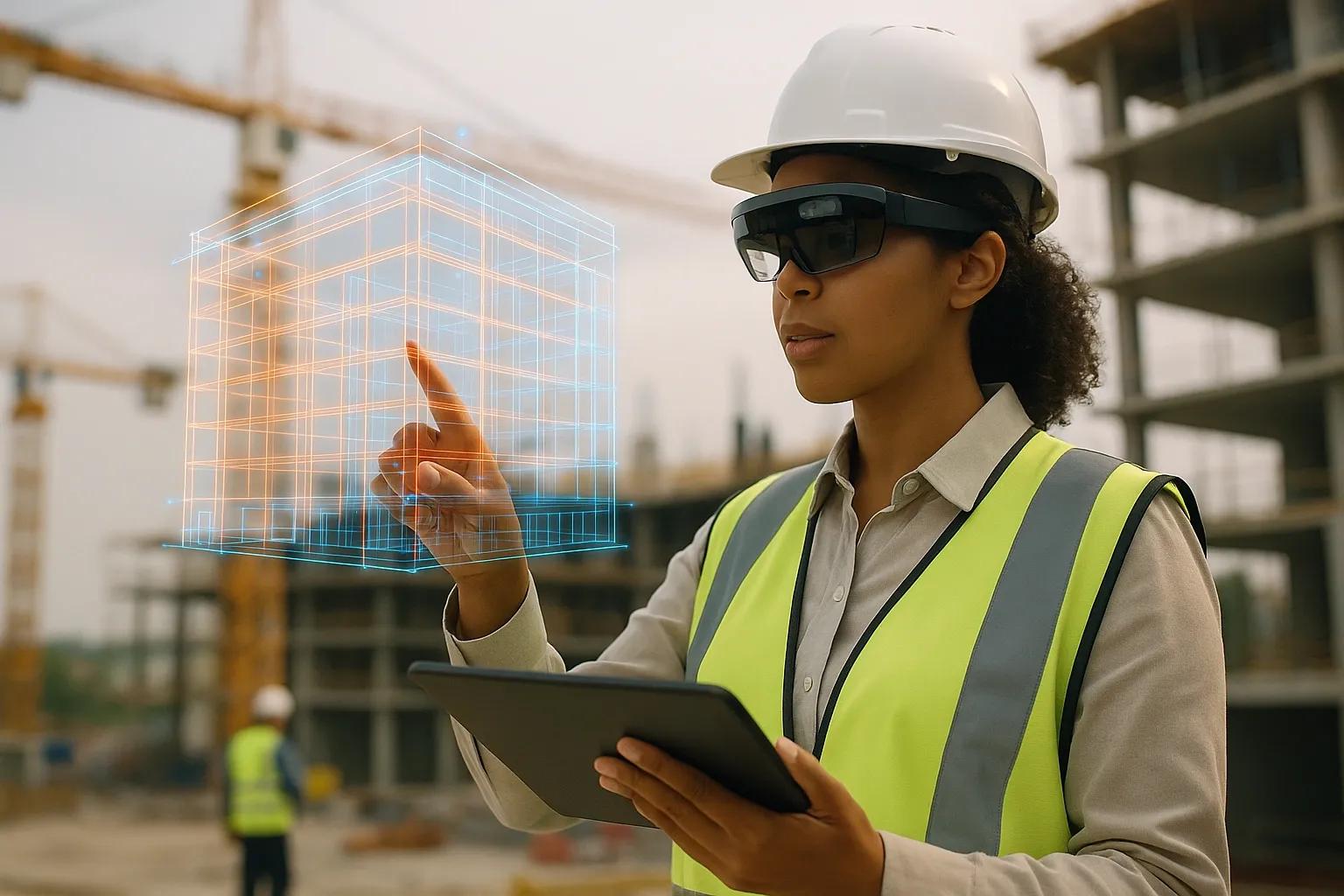
The construction industry has long been known for its slow pace of digital adoption. For decades, manual processes, fragmented workflows, and siloed data dominated the sector, making it one of the least digitized industries globally. Today, however, the sector is undergoing what can only be described as a digital renaissance . Catalyzed by artificial intelligence (AI), Building Information Modeling (BIM), and other Industry 4.0 technologies, construction is transitioning into a data-driven, technology-first ecosystem.
According to Deloitte ’s 2025 research, 68% of surveyed construction businesses are either leveraging or actively planning to adopt AI technologies . This marks a significant departure from the industry’s historically cautious approach to innovation. AI-driven applications such as predictive analytics, generative design, and autonomous equipment are now redefining how projects are planned, executed, and maintained.
Market Dynamics Driving Change
1. AI Adoption in Construction
AI is no longer a futuristic concept; it is becoming a competitive necessity. Construction companies are using AI for:
Risk management: AI models predict cost overruns and safety hazards before they occur.
Generative design: Algorithms help create multiple design alternatives, optimizing for cost, sustainability, and performance.
Predictive maintenance: Machine learning models reduce downtime by flagging potential equipment failures.
The fact that nearly 7 out of 10 companies have a defined AI adoption roadmap shows that the digital shift is accelerating faster than expected.
2. BIM Market Momentum
BIM is at the center of this digital transformation. More than a modeling tool, it has evolved into a collaborative digital ecosystem where architects, engineers, contractors, and operators work on a single source of truth.
Market growth trajectory: 2024: $7.96 billion 2028: $15.42 billion 2032: $22.08 billion (CAGR: 13.5%)
Regional split: North America: Holds 81% market share , driven by regulatory mandates and mature digital ecosystems. Asia-Pacific: Fastest-growing region at 14.5% CAGR , powered by mega infrastructure projects, smart city initiatives, and rapid urbanization.
BIM is no longer optional, it’s becoming the backbone of large-scale infrastructure and real estate projects worldwide.
3. Smart Cities and Infrastructure Investments
Asia-Pacific’s dominance is not coincidental. Countries like India, China, and Singapore are pouring billions into smart city programs . These projects demand integrated digital systems for utilities, transport, housing, and energy, creating fertile ground for BIM, AI, and digital twin applications.
For example:
India’s Smart Cities Mission drives digital-first planning for over 100 cities.
Singapore’s Virtual Singapore Project demonstrates how 3D city models can be leveraged for policy-making and urban innovation.
Implications for the Industry
Efficiency Gains
Companies adopting AI and BIM report:
20–30% reduction in project delivery timelines.
Up to 50% cost savings from improved collaboration and reduced rework.
Enhanced sustainability through optimized material use and lower emissions.
Shifting Business Models
The role of construction firms is evolving:
From builders of physical assets → to integrators of digital and physical ecosystems .
From one-time project execution → to lifecycle service providers managing assets digitally.
Future Outlook: Where Industry is Heading
Digital Twins: As BIM adoption matures, digital twins will gain momentum, offering real-time monitoring and predictive insights across construction and operations.
AI-Augmented Workforce: Human expertise will be amplified by AI-driven decision-making, not replaced.
Sustainability Integration: Climate commitments will push for carbon tracking and sustainable materials powered by digital modeling.
Global Divergence: While North America leads in scale, Asia-Pacific will dominate in growth velocity.
By 2035, the convergence of BIM, AI, IoT, and digital twins could make construction one of the most digitized industries, completely reversing its legacy reputation.
Conclusion
The construction industry’s digital renaissance is in full motion. With AI adoption accelerating, BIM markets doubling in size, and smart city programs reshaping demand, the sector is finally catching up to its peers in digital transformation. The next decade will separate leaders from laggards, those who embrace AI, BIM, and digital ecosystems will thrive, while others risk obsolescence.
The question is no longer if the industry will digitize, but how fast and how effectively organizations can ride this wave of change.