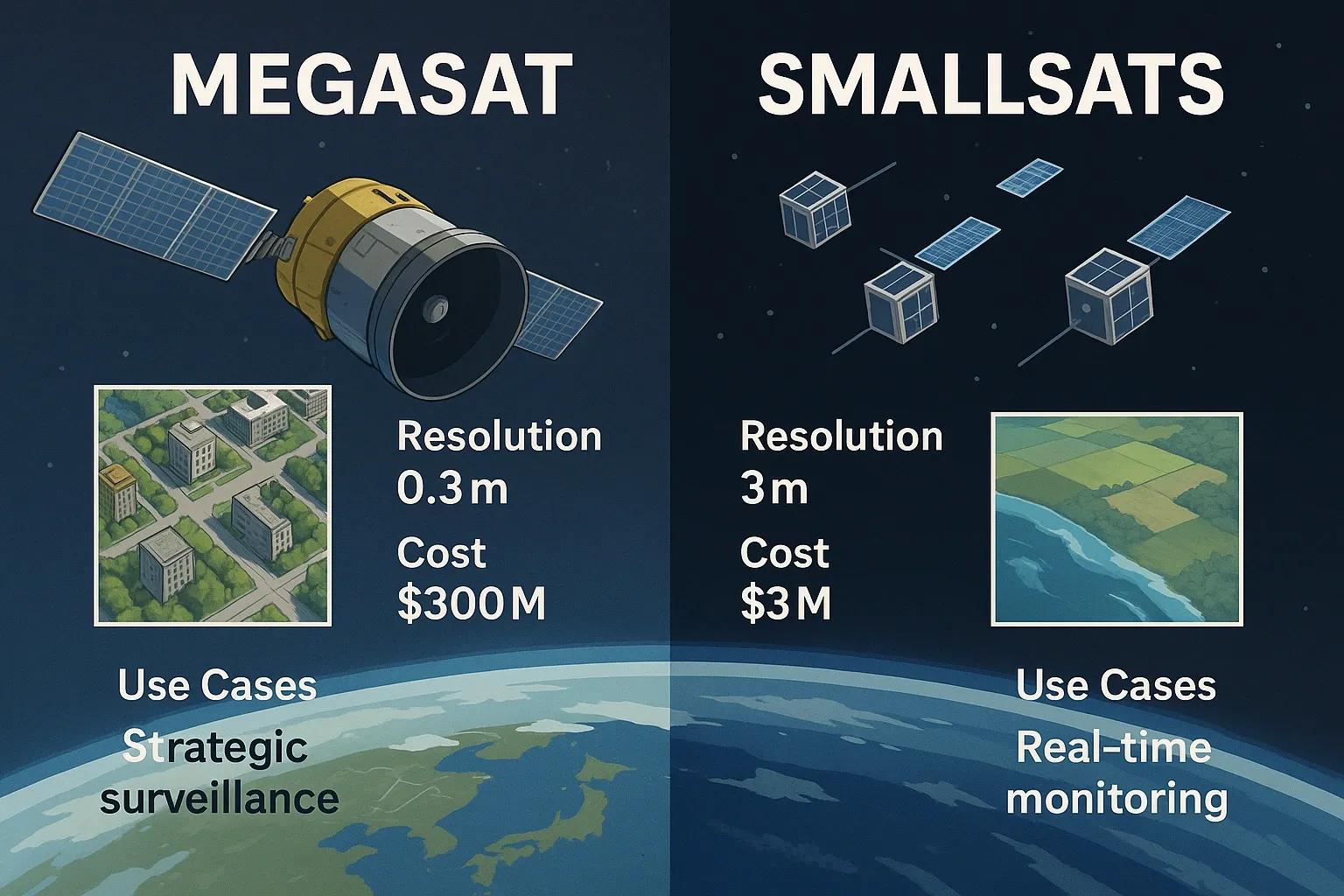
The Earth observation (EO) sector is undergoing a transformative shift. Traditionally dominated by large, high-resolution satellites, often referred to as “MegaSats”, the landscape is now being reshaped by the rise of smaller, lower-cost satellites, known as SmallSats. This evolution has triggered what many are calling a “Constellation War,” as organizations worldwide rethink trade-offs between cost, performance, revisit frequency, and agility.
This article offers a technical comparison of SmallSats and MegaSats in EO applications, detailing their core attributes, capabilities, limitations, and the future outlook of hybrid constellation strategies.
Understanding the Contenders
MegaSats: High-Resolution Workhorses
MegaSats are traditional EO satellites, typically weighing hundreds to thousands of kilograms. Built by government space agencies and large commercial entities, they are designed for precision, longevity, and exceptional image quality.
Key characteristics :
Mass: 500–2000+ kg
Spatial resolution: Sub-meter (up to 0.3 m)
Lifespan: 7–15 years
Orbit: Sun-synchronous or geostationary
Cost: $100M–$500M+ per satellite
Examples :
DigitalGlobe’s WorldView series
ESA’s Sentinel-2
ISRO’s Cartosat-2
These satellites excel in delivering ultra-high-resolution (UHR) optical and multispectral imagery, making them suitable for defense, urban mapping, cadastral surveys, and infrastructure monitoring.
SmallSats: Agile and Scalable Systems
SmallSats generally weigh under 500 kg, with many in the nanosatellite class (<10 kg). Their compact size and modular build allow batch manufacturing, frequent launches, and cost-effective deployment in large constellations.
Key characteristics :
Mass: 5–500 kg
Spatial resolution: 1–5 m (some sub-meter)
Lifespan: 1–7 years
Orbit: LEO (300–700 km)
Cost: $0.5M–$10M per satellite
Examples :
Planet Labs’ Dove and SuperDove
Satellogic’s Aleph-1
Pixxel’s Hyperspectral imaging
SmallSats offer near-daily revisits and real-time monitoring, making them ideal for agriculture, disaster response, environmental monitoring, and commercial analytics.
Comparative Analysis
1. Resolution vs. Revisit Trade-Off
MegaSats dominate in spatial resolution, essential for tasks requiring high detail, like vehicle detection or detailed land classification. However, their limited constellation size restricts temporal resolution, often offering only weekly revisits.
In contrast, SmallSat constellations sacrifice resolution but deliver high-frequency data. Planet’s constellation, for instance, achieves daily global coverage at 3–5 m resolution, supporting applications that benefit more from time-series data than image sharpness.
Feature - MegaSats - SmallSats
Spatial Resolution - 0.3–1 m - 1–5 m (some at 0.5 m)
Temporal Resolution - Days to weeks - Daily or sub-daily (via swarms)
Swath Width - Narrow (10–20 km typical) - Wide (up to 400 km)
2. Launch and Deployment Flexibility
MegaSats require specialized launch vehicles and extensive integration, making launch opportunities rare and expensive. Delays can span months or years.
SmallSats leverage rideshare missions and deploy from orbital platforms (like the ISS or Rocket Lab’s Electron), significantly reducing time-to-orbit. Companies can iterate on design rapidly, deploy upgrades incrementally, and adapt to mission needs with short lead times.
3. Cost-Efficiency and Scalability
A single MegaSat can cost hundreds of millions and take years to develop. While this cost includes high-end sensors and durable hardware, it limits scalability and responsiveness.
SmallSats can be built in months at a fraction of the cost. This affordability enables risk-taking and rapid scaling. If one fails, it’s quickly replaced. Swarm-based architecture also allows distributed data acquisition and redundancy.
Metric - MegaSats - SmallSats
Build Time - 3–7 years - 3–12 months
Total Program Cost - $300M+ (per mission) - <$100M (for full constellation)
Upgrade Cycle - Infrequent - Regular
4. Sensor Versatility and Payload Limitations
MegaSats carry large, high-end optics and multispectral or hyperspectral sensors, with better onboard processing and calibration capabilities. They also support complex instruments like SAR (Synthetic Aperture Radar), LiDAR, and atmospheric sensors.
SmallSats are constrained by size and power, limiting payload size and quality. However, advancements in miniaturization are narrowing this gap. Some SmallSats now include multispectral sensors, basic SAR payloads, and even AI-powered edge processors.
5. Use Case Suitability
MegaSats : Strategic surveillance Urban infrastructure audits Defense & intelligence National mapping programs High-precision change detection
SmallSats : Agricultural monitoring Disaster response (wildfires, floods) Carbon and crop index tracking Maritime domain awareness Insurance risk modeling
Emerging Trends: Hybrid Constellations and Interoperability
The future is not about choosing one over the other, but rather how to combine them. Hybrid constellations leverage MegaSats for baseline high-res imagery and SmallSats for rapid updates. This layered data model enhances spatial-temporal analytics for AI/ML applications in agriculture, city planning, and climate resilience.
For instance, startups like Capella Space are integrating SAR SmallSats with optical datasets from other providers, creating multisource geospatial intelligence systems. ESA’s Earthnet Programme also promotes interoperability between commercial and institutional sensors, fostering a data ecosystem that merges SmallSat agility with MegaSat precision.
Challenges and Considerations
Data Volume and Management : SmallSat constellations generate petabytes of data, demanding robust ground stations, compression, and AI-based sorting.
Calibration and Quality Assurance : MegaSats have superior onboard calibration. SmallSat data often requires post-processing corrections to match quality standards.
Orbital Congestion and Collision Risks : The rise of large constellations increases the risk of space debris and signal interference, raising regulatory and technical concerns.
Security and Sovereignty : Nations may prefer MegaSat ownership for strategic reasons, while commercial SmallSat providers often rely on subscription-based access.
Conclusion
The "Constellation War" between SmallSats and MegaSats is not a zero-sum battle but a sign of a diversifying Earth Observation industry. MegaSats will continue to dominate in precision and payload capability, while SmallSats democratize access to near-real-time geospatial insights at a lower cost and higher cadence.
For stakeholders, governments, NGOs, startups, and enterprises, the key is to align use cases with platform strengths and adopt a hybrid, data-centric strategy. As EO becomes foundational to climate action, smart cities, and sustainable development, both SmallSats and MegaSats will remain indispensable, each shaping a different but complementary orbit of impact.