Most project controls answer one question very well:
What happened?
Very few answer the harder one:
What is happening right now, and what does it mean?
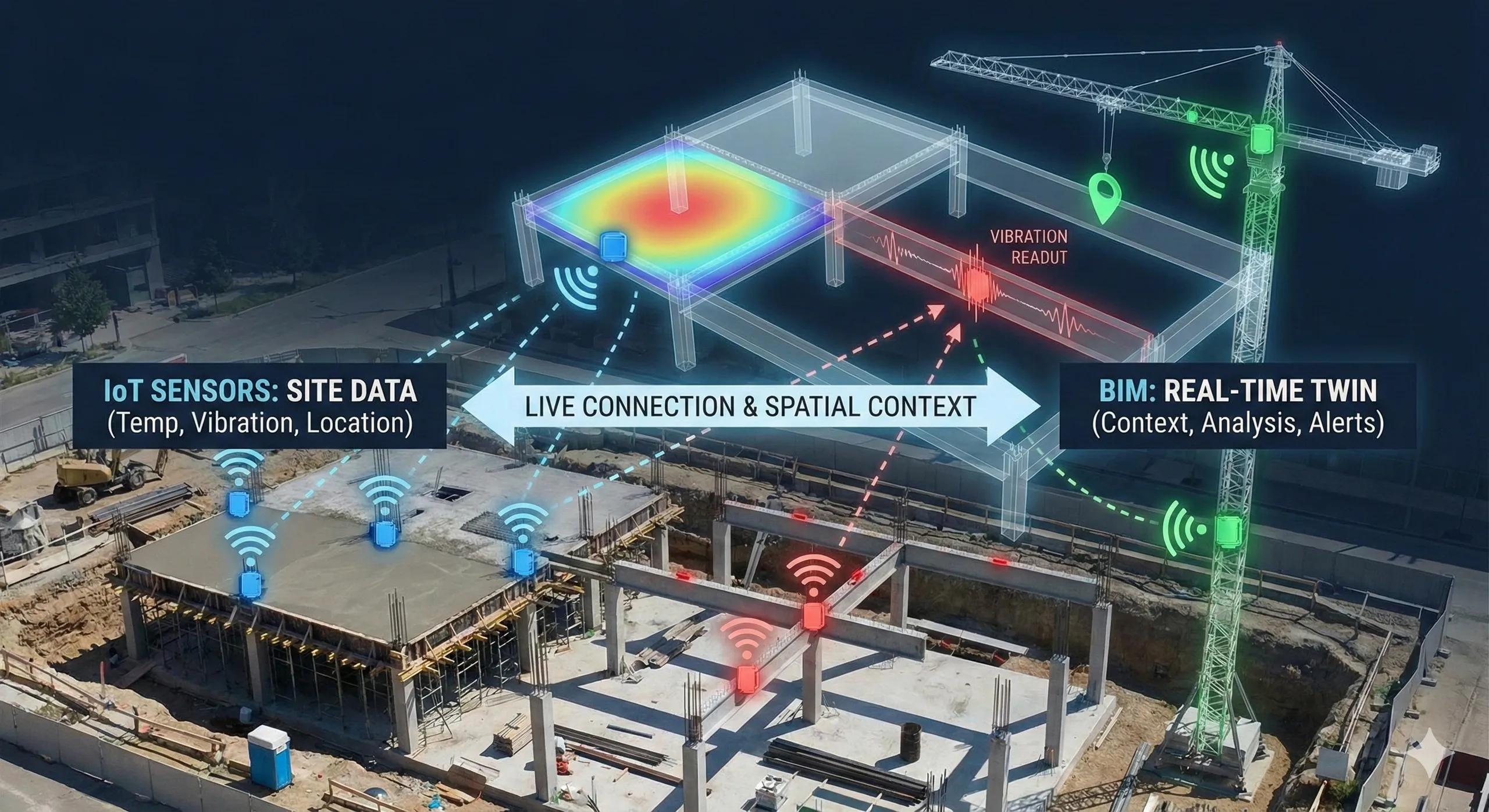
That gap exists because site data (sensors, telemetry, alerts) lives outside BIM, while BIM remains static. Connecting IoT sensors to BIM turns models into live operational twins , capable of awareness, not just representation.
1. Why Static BIM Hits a Ceiling
Traditional BIM:
Captures design intent
Supports coordination and planning
Updates periodically
But site conditions:
Change hourly
Drift from assumptions
Generate continuous signals
Without real-time inputs, BIM slowly diverges from reality.
2. What “IoT-to-BIM” Really Means
This is not about showing sensor dots on a model.
It means:
Sensors have spatial identity (where they are)
Data streams have context (what they relate to)
Thresholds trigger interpretation (what it implies)
IoT adds state to BIM, temperature, vibration, occupancy, load, movement, moisture, progress.
3. Common Sensors That Add Immediate Value
High-impact, low-friction sensors include:
Concrete maturity and temperature sensors
Vibration and tilt sensors
Environmental sensors (dust, noise, heat)
Equipment telemetry (cranes, lifts)
Access and presence sensors
The goal is decision relevance , not sensor density.
4. Why Spatial Context Changes Everything
A temperature spike in isolation is noise.
The same spike on a specific pour, at a specific time, in a specific zone is intelligence.
By anchoring sensor data to BIM elements:
Alerts become actionable
False positives reduce
Root causes surface faster
Context turns signals into insight.
5. Real-Time Monitoring vs Real-Time Decisions
Streaming data is easy.
Making sense of it is hard.
Effective setups:
Define what “normal” looks like
Flag deviations that matter
Route alerts to owners who can act
Real-time monitoring without response pathways creates alarm fatigue.
6. Use Cases That Actually Work on Site
IoT-to-BIM delivers most value when used for:
Concrete curing validation
Early detection of structural movement
Environmental compliance
Equipment utilization and safety
Progress verification in critical zones
Not everything needs to be live, only what changes outcomes.
7. Data Governance Is the Real Challenge
Key questions teams must answer:
Who owns the sensor data?
How long is it retained?
What is the trusted source?
How is it audited later?
Without governance, live data becomes unreliable evidence .
8. India Context: Practical Constraints and Opportunities
In India:
Power and connectivity vary
Sites are dense and dynamic
Cost sensitivity is high
Successful deployments:
Start with battery-powered sensors
Use cellular or LPWAN selectively
Focus on a few critical workflows
Incremental adoption beats ambition.
9. From Dashboards to Digital Twins
Dashboards show numbers.
Digital twins show cause and consequence .
When sensor data is spatially linked:
Trends become visible
Anomalies become explainable
Decisions become defensible
This is the shift from monitoring to situational awareness .
10. A Simple IoT Rule
If sensor data isn’t tied to a decision, it’s just telemetry.
Conclusion
Connecting IoT sensors to BIM:
Grounds models in reality
Reduces lag between issue and action
Improves safety, quality, and confidence
The future of BIM is not more detail.
It’s more awareness .
When BIM listens to the site, digital twins stop being silent, and start being useful.