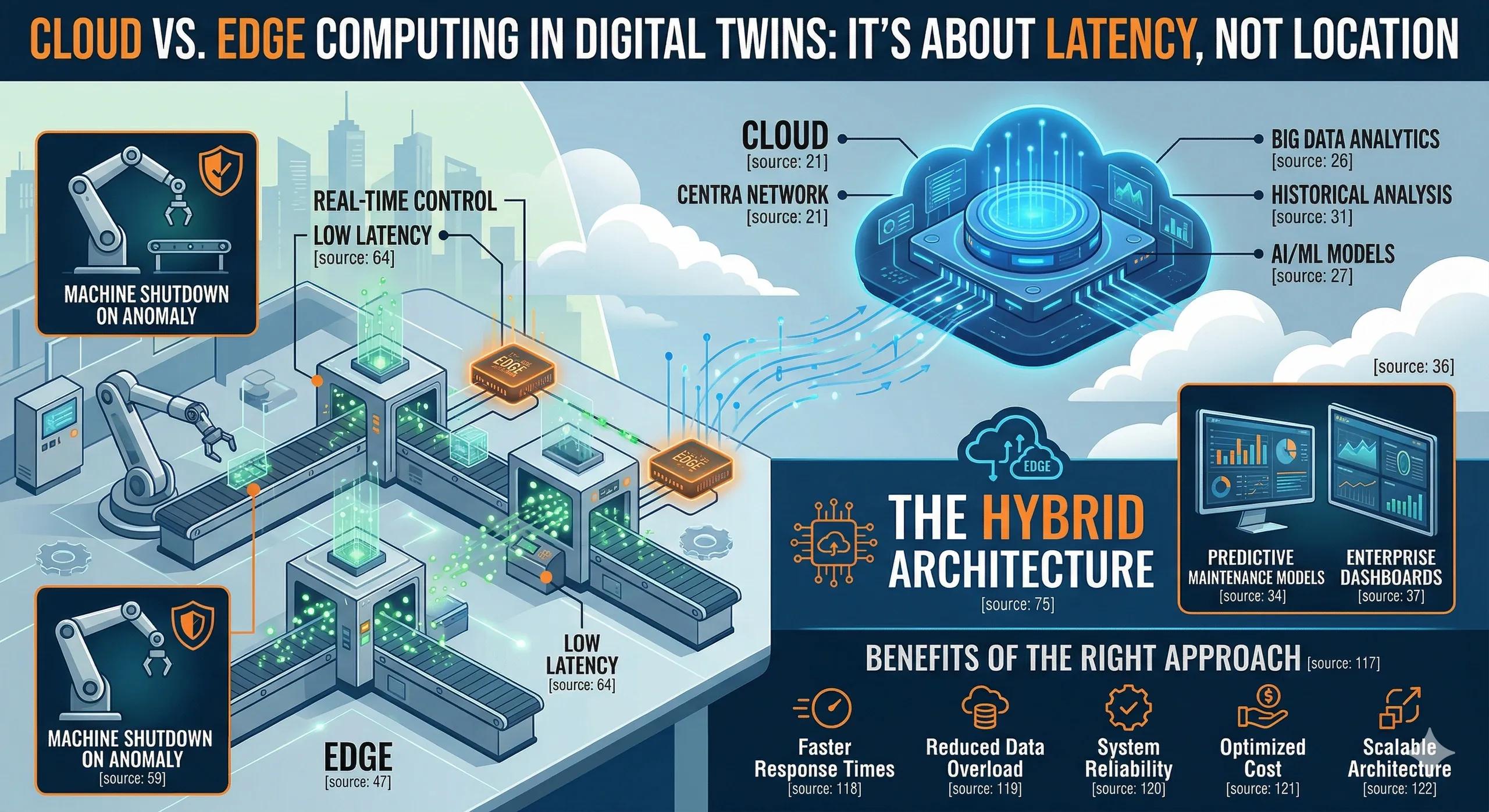
Should your Digital Twin run in the cloud or closer to the asset, at the edge?
The answer is rarely one or the other.
Introduction
So far in Phase 2, we have covered:
sensor layer (IoT, UAVs, LiDAR)
data pipelines
integration across BIM, GIS, and IoT
Now we move to a critical architectural decision:
👉 Where should data be processed?
Because in Digital Twin systems:
some decisions require instant response
others depend on large-scale analysis
This is where the choice between cloud and edge computing becomes important.
The Core Idea: It’s About Latency, Not Location
Cloud vs Edge is often misunderstood as:
centralized vs decentralized
But the real distinction is:
👉 How quickly do you need to act on the data?
What is Cloud Computing in Digital Twins?
Cloud computing means:
👉 data is transmitted to centralized servers for processing
Typical capabilities:
large-scale data storage
advanced analytics
AI/ML models
cross-site aggregation
Use cloud when:
decisions are not time-critical
you need historical analysis
you want to scale across multiple assets or locations
Examples:
predictive maintenance models
long-term energy optimization
city-level Digital Twins
enterprise dashboards
Strengths:
scalability
high processing power
centralized control
easier integration across systems
Limitations:
latency (delay in response)
dependency on connectivity
data transfer costs
What is Edge Computing in Digital Twins?
Edge computing means:
👉 data is processed close to where it is generated
Typical capabilities:
real-time decision-making
local data filtering
immediate alerts
Use edge when:
response time is critical
connectivity is unreliable
safety or control depends on instant action
Examples:
machine shutdown on anomaly
safety alerts in industrial plants
traffic signal control
autonomous systems
Strengths:
low latency
reduced dependency on network
faster response
Limitations:
limited processing capacity
harder to scale
requires distributed infrastructure
Cloud vs Edge: A Simple Comparison
Aspect - Cloud - Edge
Processing Location - Centralized - Near asset
Latency - Higher - Low
Scalability - High - Limited
Connectivity Dependency - High - Low
Use Case - Analytics, planning - Real-time control
The Reality: It’s Not Either/Or
Most effective Digital Twin systems use:
👉 a hybrid architecture
How it works:
Edge: handles real-time actions
Cloud: handles analysis, learning, and optimization
Practical Example
Scenario: Smart Manufacturing
Edge: detects machine anomaly → triggers shutdown instantly
Cloud: analyzes historical data → predicts future failures
👉 Outcome:
immediate risk mitigation
long-term optimization
Where Organizations Go Wrong
1. Over-Reliance on Cloud
sending all data to cloud
ignoring latency
👉 leads to delayed decisions
2. Over-Engineering Edge
deploying complex systems locally
without clear need
👉 increases cost and complexity
3. No Clear Data Strategy
unclear what data stays local
what moves to cloud
👉 creates inefficiencies
4. Ignoring Connectivity Constraints
assuming stable internet everywhere
👉 system fails in real-world conditions
How to Decide: Cloud or Edge?
Ask:
👉 How fast does the decision need to happen?
If seconds matter → Edge
If insights matter → Cloud
Ask Yourself
Is your Digital Twin designed for: 👉 speed of response or 👉 depth of analysis?
Indian Context
In India:
connectivity varies across regions
industrial and infrastructure environments are diverse
This makes hybrid architectures more practical.
Examples:
edge for plant-level control
cloud for enterprise-level insights
Benefits of the Right Approach
faster response times
reduced data overload
better system reliability
optimized infrastructure cost
scalable architecture
Conclusion
Cloud and edge are not competing choices.
They are complementary layers in a Digital Twin architecture.
The real goal is: 👉 placing the right computation at the right location for the right decision