Cloud Digital Twins represent a transformative leap in how infrastructure, such as bridges, roads, and buildings, is managed for safety, efficiency, and cost savings. By leveraging cloud technologies, IoT sensor networks, and advanced modeling, these twins deliver real-time, actionable visibility into asset conditions and operational risks.
Why Digital Twins Matter
Digital twins address critical O&M pain points:
Safety and Uptime: Continuous sensor-driven monitoring enables stakeholders to detect anomalies and prevent failures before they occur, reducing downtime and improving life-cycle asset reliability.
Cost Reduction: Data-driven condition-based maintenance helps avoid costly emergency repairs, optimize schedules, and prolong asset life with lower expenditure.
Staffing Solutions: Automated monitoring bridges skill gaps, enabling fewer staff to oversee more assets through intelligent alerting and remote decision support.
Core Digital Twin Concepts
Modern cloud digital twin systems are built on several foundational layers:
BIM and GIS Integration : Combining Building Information Modeling (BIM) for design and construction data with Geographic Information System (GIS) layers provides both spatial context and asset detail.
Live Twin State : Real-time event tracking—connects live sensor telemetry to virtual representations of assets, tying behavior directly to physical events.
Span Layer Links : Infrastructure is mapped so that bridges, roads, or building nodes are interconnected with their sub-elements and sensors, ensuring hierarchical relationships and traceability.
Asset Graph Structure
Digital twins model assets as interconnected graphs:
Bridge Node: Top-level asset representing the entire structure.
Span Element: Subcomponent holding distributed sensors (tilt, acceleration, temperature, vibration, etc.).
Rules Engine: Processes incoming telemetry, evaluating it against predefined thresholds to generate work orders and state transitions (e.g., Ok → At-risk → Mitigated).
Telemetry and Rules Management
Cloud digital twins ingest high-frequency time-series data streams:
Sensor Clusters: Individual sensors log tilt, acceleration, temperature, etc., monitored continuously for rapid anomaly detection.
Automated Thresholds: Dynamic and static threshold bands trigger events, minimize false positives via rolling averages and hysteresis logic.
Work Order Lifecycle: Proactive alerts convert into tasks through automated ticketing, with accountability maintained from creation to closure.
Cloud-First Architecture
A robust architecture underpins digital twin deployments:
Reference Architecture : Survey-grade drones (RTK/PPK), ground control points (GCPs), static sensors, and facade meshes serve as primary data sources.
Ingest Gateways : Multi-protocol connectivity (LoRaWAN, LTE, 5G) funnels sensor data securely into cloud time-series stores.
Visualization : Asset relationships are modeled using 2D maps and photogrammetric 3D meshes, facilitating intuitive oversight and inspection.
Minimal Models : Properties are added on-demand for agility, preventing unnecessary model bloat while allowing flexible, scalable deployment.
Standards for Interoperability
Cloud digital twins are powered by open standards and protocols:
OGC SensorThings : Provides a uniform telemetry data exchange schema for cross-platform interoperability (Things, Sensors, Datastreams, Observations).
3D Tiles : Enables web-scale visualization of photogrammetry, LiDAR, and mesh data directly in browsers.
IFC 4.3 : Supports linear infrastructure identification and chainage systems, essential for consistent asset tracking.
Stable Asset IDs : Every sensor is mapped to a uniquely named asset node, ensuring traceable, auditable data chains.
Intelligent Alerting and Workflows
Next-generation digital twin platforms incorporate advanced decision logic:
Alert Design : Multi-level severity (Info, Warn, Critical) supports precise notification routing and escalation paths.
Anomaly Detection : Algorithms such as z-score and median absolute deviation provide robust detection and intelligent escalation triggers.
Threshold Management : Combination of static and rolling thresholds, with hysteresis and minimum duration filters, reduces nuisance alarms.
Decision Trees and Automated Actions : Fault verification and automated response workflows enable direct intervention (inspect, restrict access, etc.), with closed-loop feedback on action outcomes.
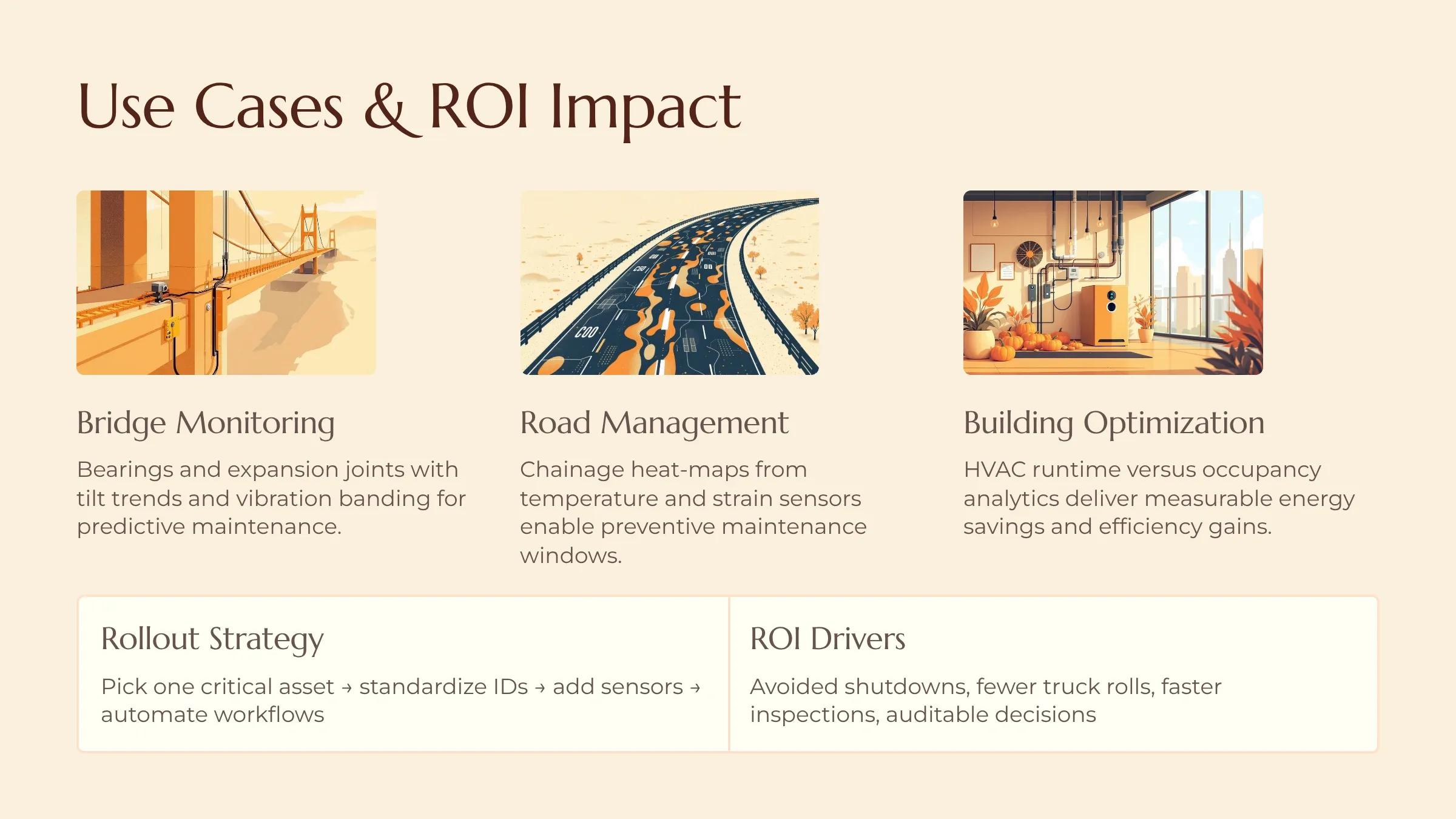
Real-World Use Cases and ROI
Cloud digital twins deliver substantial ROI across asset classes:
Bridge Monitoring: Bearings and expansion joints tracked for tilt and vibration oscillations enable preventive maintenance, avoiding unscheduled closures.
Road Management: Temperature and strain sensors generate chainage heat-maps, supporting the precise scheduling of repair windows.
Building Optimization: Using occupancy analytics with HVAC runtime data unlocks measurable efficiency gains and energy savings.
Implementation Strategy
Successful rollout hinges on focused, standardized deployment:
Identify a critical asset and standardize its asset ID system.
Deploy sensors at pivotal locations and automate alerting workflows for key events.
Use staged automation for work orders, inspections, and reporting to deliver auditable, continuous improvements.
Future Trends and Challenges
Critical challenges and trends guiding the next wave:
Integration with edge computing for latency-sensitive AI analytics.
Enhanced security and data governance for growing sensor networks.
Expansion of standards for seamless multi-vendor interoperability.
Merging digital twins with virtual/augmented reality for holistic operational training and remote intervention.
Conclusion
Cloud digital twins offer a paradigm shift for O&M professionals, providing continuous visibility, predictive analytics, and operational intelligence that drives safer, leaner, and smarter infrastructure stewardship.