Climate Risk Is Not Uniform
Climate change is often discussed using global statistics.
Average temperature rise.
Global carbon emissions.
Sea-level increase.
But climate risk does not occur evenly across the planet.
Floods affect specific river basins.
Heatwaves intensify in certain urban regions.
Cyclones repeatedly strike particular coastlines.
Drought persists in defined watersheds.
In other words, climate risk is not only environmental.
It is geographic .
Understanding that geography is becoming essential for long-term investment decisions.
The Shift in How Investors Evaluate Risk
Traditionally, investment decisions focused on variables such as:
market demand
operational cost
labor availability
regulatory environment
Today, another dimension is becoming equally important:
location resilience.
Investors increasingly evaluate whether an asset can remain operational under future climate conditions.
Two factories may have identical financial performance today.
But if one sits in a flood-prone basin while the other is in a stable region, their long-term risk profiles are very different.
Climate Exposure Is Spatial
Climate risks appear in different forms depending on location.
Examples include:
Flood Exposure
River basins and coastal zones face increasing flood frequency.
Heat Stress
Urban regions with dense construction often experience stronger heat island effects.
Water Scarcity
Industries in drought-prone watersheds face operational uncertainty.
Storm and Cyclone Risk
Coastal infrastructure may face repeated disruptions.
Each of these risks is tied to geographic context , not just global climate trends.
Why Location Resilience Matters for Infrastructure
Infrastructure assets are designed for long life cycles.
Power plants, highways, ports, and industrial facilities may operate for 30–70 years.
If climate conditions change during that time, infrastructure performance can degrade.
For example:
roads deteriorate faster under extreme heat
ports face flooding from sea-level rise
energy systems struggle during heat-driven demand spikes
Infrastructure planning therefore increasingly requires climate-aware spatial analysis .
Climate Geography and Capital Allocation
Large-scale investments are beginning to incorporate climate geography into decision models.
Key questions now include:
Is this location exposed to long-term climate stress?
How will extreme weather affect operations?
Are supply chains resilient to regional climate events?
Will insurance and regulatory conditions change in this location?
These questions connect climate science with capital strategy .
The Role of Geospatial Intelligence
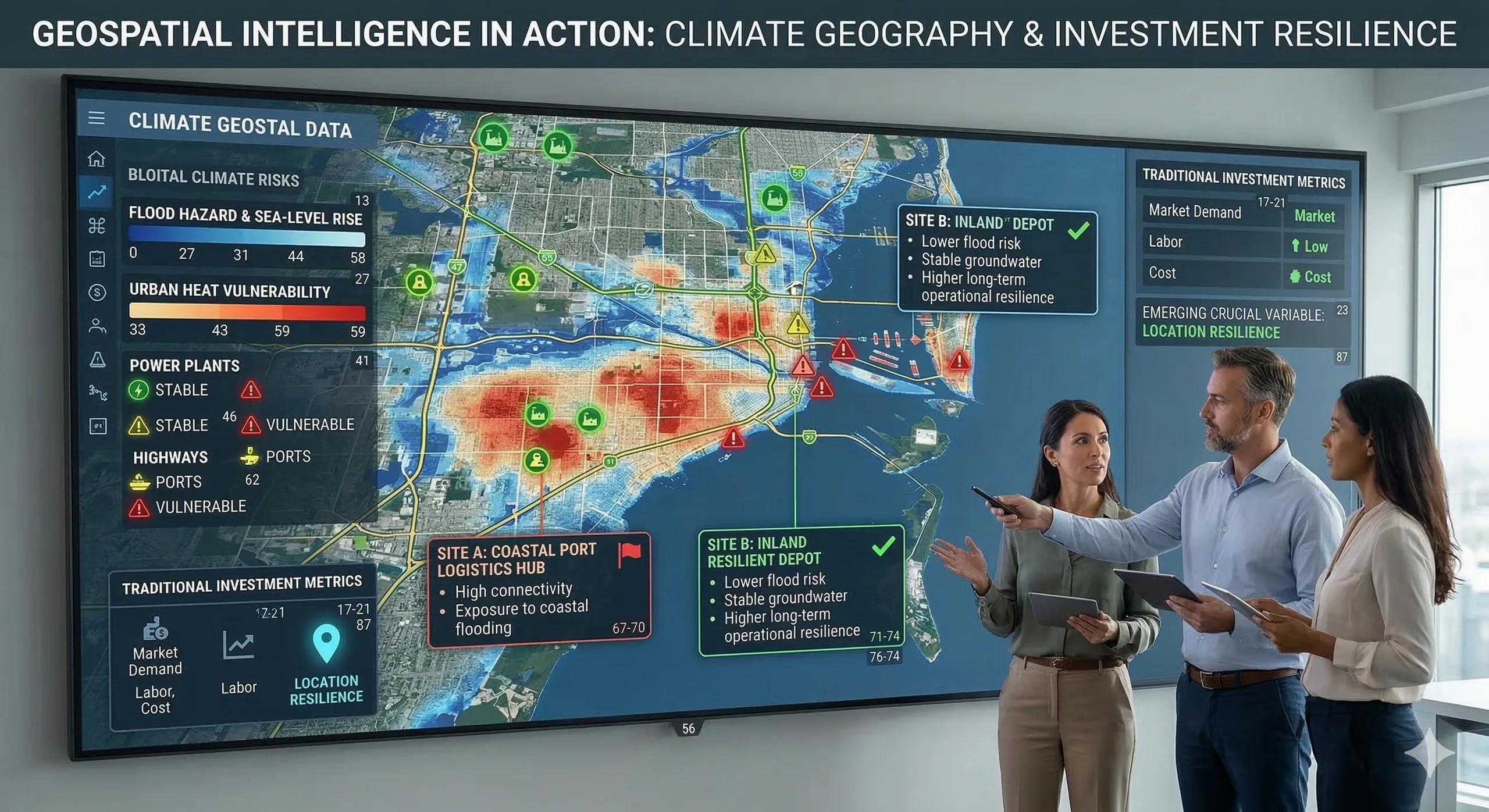
Geospatial analytics allows organizations to combine multiple datasets to understand climate exposure.
Typical layers include:
flood hazard maps
heat vulnerability indices
drought projections
land-use patterns
infrastructure networks
When these layers are analyzed together, planners can evaluate future location resilience .
This allows investors and policymakers to compare locations not only by cost or market potential, but also by long-term environmental stability.
Climate Geography in Practice
Imagine two logistics hubs under consideration for development.
Site A:
located near a major port
strong infrastructure connectivity
but exposed to coastal flooding
Site B:
slightly farther from the port
lower flood exposure
stable groundwater availability
Traditional models might favor Site A due to proximity.
Climate geography may reveal that Site B offers greater long-term operational resilience.
The Monetization Bridge
As climate exposure becomes a major investment variable, organizations are adopting geospatial platforms and digital twin environments to integrate climate projections, infrastructure data, and economic activity into unified planning systems. These tools allow governments, developers, and investors to simulate climate scenarios and evaluate which locations remain viable over decades of operation.
Looking Ahead
Over the next two decades, climate geography will increasingly shape decisions about:
infrastructure placement
industrial investment
insurance models
urban expansion
supply chain diversification
Location resilience will become a core parameter in economic planning.
Closing Insight
Climate does not affect balance sheets directly.
It affects locations .
And when locations experience environmental stress, the financial consequences follow.
Understanding climate geography allows decision-makers to anticipate those impacts before they materialize.