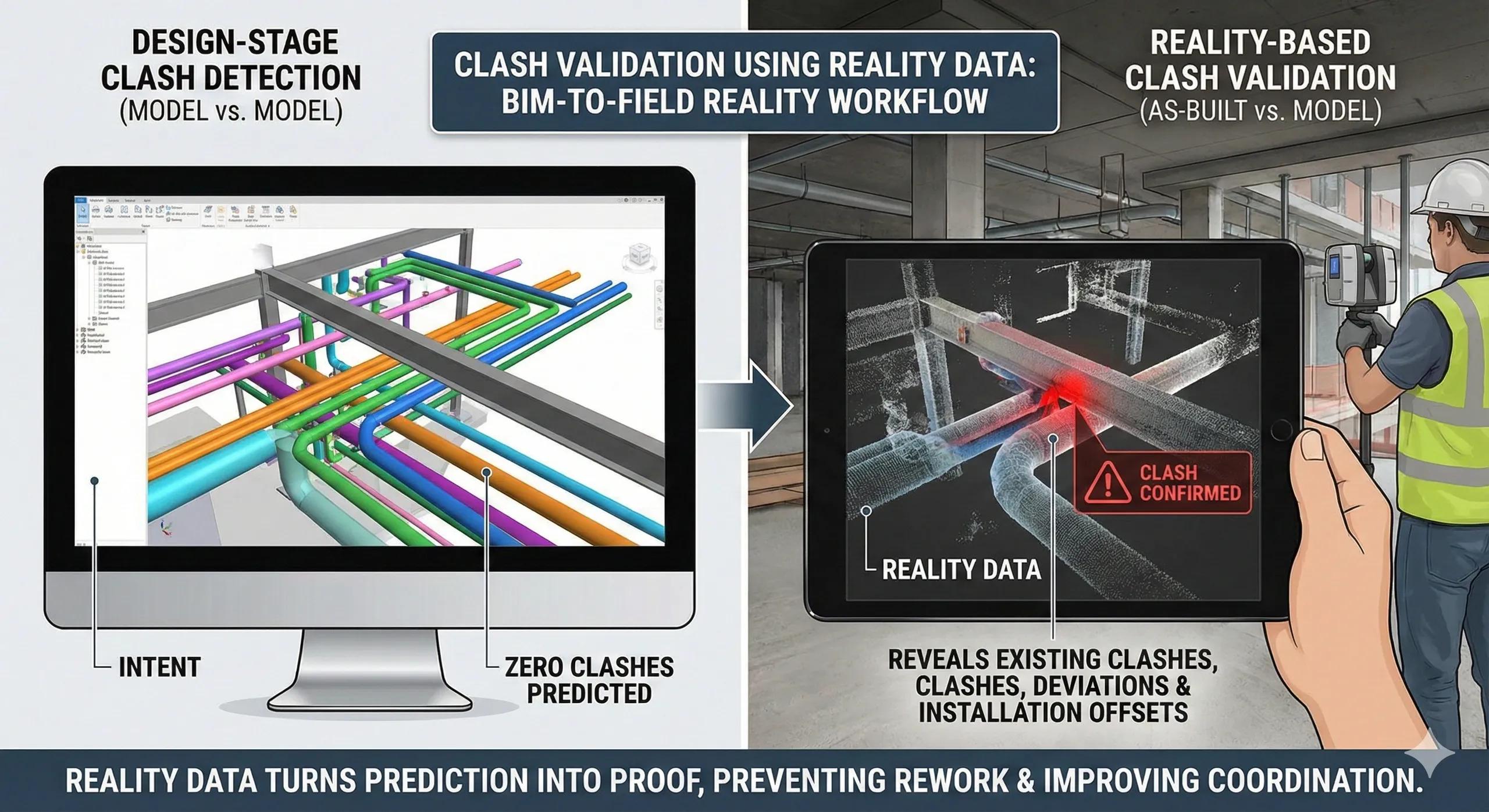
Most construction teams believe they are “doing clash detection” because their BIM models show zero clashes. And yet, clashes still appear on site, during installation, commissioning, or fit-out, when changes are expensive and disruptive.
The problem is not BIM.
The problem is that design-stage clash detection and construction-stage clash validation are not the same thing .
This is where reality data , point clouds, scans, and site captures, becomes essential. Reality data doesn’t predict clashes. It reveals the ones that already exist .
1. Why Design Clash Detection Isn’t Enough
Traditional clash detection compares:
Model vs model
Intent vs intent
It assumes:
Geometry is installed as designed
Tolerances behave predictably
Sequences are followed exactly
On real sites, none of this holds true.
Reality introduces:
Installation offsets
Trade-driven rerouting
Tolerance stacking
Temporary fixes that become permanent
Design models stay clean.
Clashes move to the field.
2. Clash Detection vs Clash Validation
A critical distinction:
Clash Detection asks: Could this clash happen if everything is built as designed?
Clash Validation asks: Has a clash already happened in reality?
Clash validation is a construction control activity , not a design coordination task.
3. Why Reality Data Changes the Game
Reality data:
Captures actual installed geometry
Exposes cumulative deviations
Reflects sequence-driven conflicts
Reveals clearance loss invisible in models
This makes clash validation:
Objective
Defensible
Actionable
You are no longer arguing over design assumptions, you are reacting to measured conditions.
4. What Should Be Validated Using Reality Data
Not every clash needs reality validation. Focus on high-risk interfaces :
MEP vs structure in congested zones
MEP vs ceiling systems
Equipment access and maintenance clearances
Penetrations and sleeves
Late-stage trade overlaps
Validating everything creates noise.
Validating interfaces creates value.
5. How Reality-Based Clash Validation Works
A practical workflow:
Capture as-built reality (scan / point cloud)
Register and georeference accurately
Classify relevant elements
Compare installed geometry against: Approved BIM geometry Clearance envelopes
Flag violations , not just proximity
The output is not a heat map, it’s a decision list .
6. Why Heat Maps Alone Are Dangerous
Heat maps look impressive but often fail in practice because:
They exaggerate noise
They lack tolerance context
They don’t indicate responsibility
They don’t trigger actions
Reality-based clash validation must answer:
Is this within tolerance?
Does it block another trade?
Does it affect safety or access?
If it doesn’t answer these, it’s visual theatre.
7. Timing Matters More Than Accuracy
The value of clash validation depends on when it’s done.
Best windows:
Before downstream trades mobilize
Before ceiling closures
Before commissioning
A ±10 mm check today is more valuable than a ±2 mm check next month.
8. Responsibility Clarity Through Reality
Reality data removes ambiguity:
What is installed
Where it is installed
How far it deviates
This shifts coordination meetings from:
“The model says…” to “The site condition shows…”
That change alone saves time and friction.
9. India Context: Why Reality Validation Matters More
Indian projects amplify clash risk due to:
High site variability
Late design changes
Dense MEP installations
Cost sensitivity to rework
Reality-based clash validation works best when:
Used selectively
Focused on high-risk zones
Positioned as risk prevention , not fault finding
10. A Simple Clash Validation Rule
Before running any clash check, ask:
If this clash is confirmed today, what action will follow tomorrow?
If there is no clear action, the validation is premature.
Conclusion
Design-stage clash detection predicts problems.
Reality-based clash validation prevents them from escalating .
When used correctly:
Rework drops
Coordination improves
BIM regains credibility
Reality capture earns ROI
When ignored:
Clean models coexist with messy sites
Issues surface too late
Digital workflows lose trust
In BIM-to-field execution, clashes don’t matter until they exist, and reality data is how you prove they do .