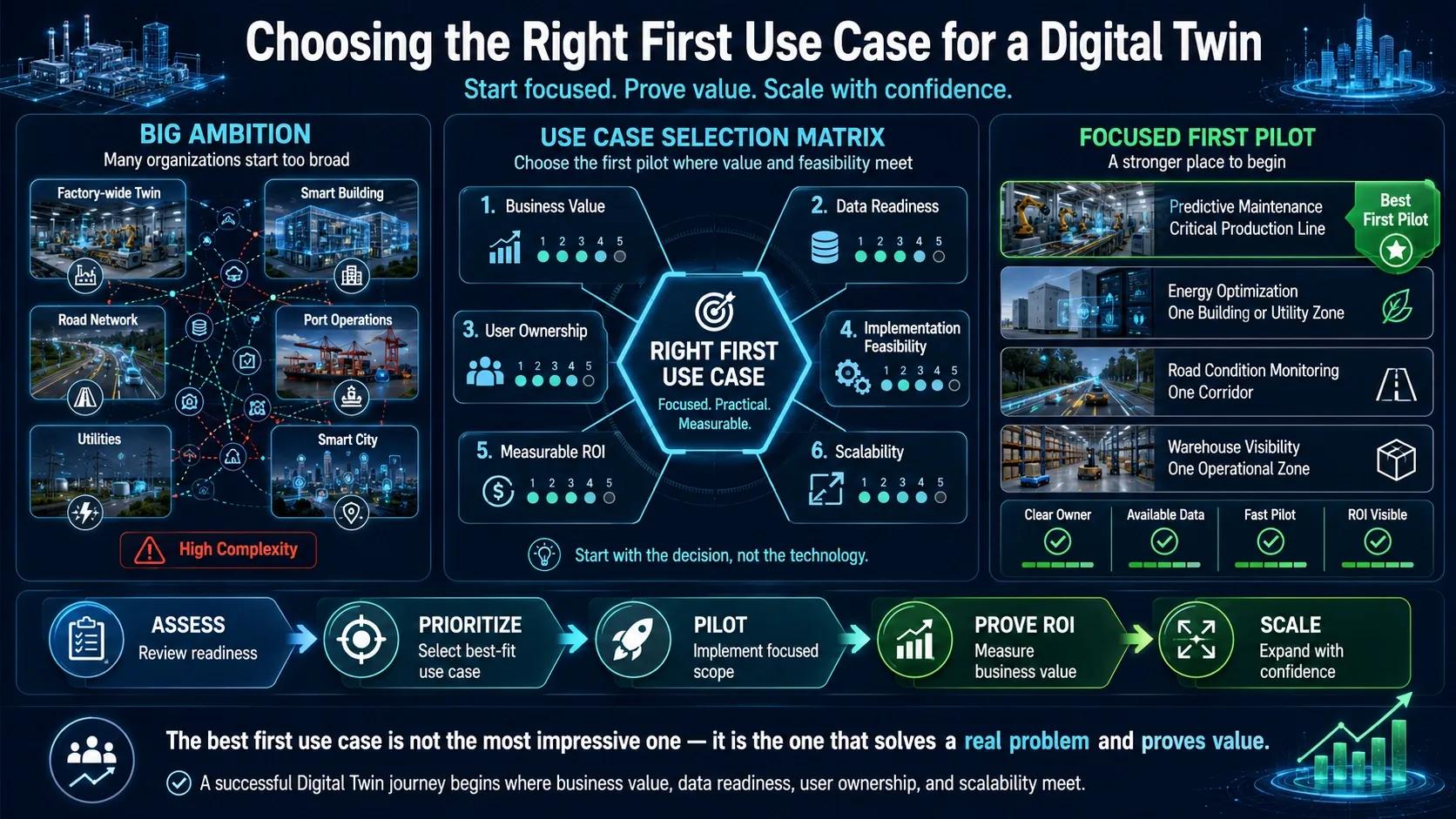
Many Digital Twin projects begin with a large ambition.
Organizations want real-time monitoring, predictive analytics, 3D visualization, asset intelligence, automation, AI, and better decision-making across the enterprise.
The vision is valid.
But the starting point should not be too large.
A Digital Twin journey should begin with the right first use case .
This matters because the first use case sets the tone for everything that follows. If it is too broad, too complex, poorly defined, or disconnected from business value, the project may struggle. But if the first use case is focused, measurable, and operationally relevant, it can build confidence, prove value, and create a clear path for scaling.
The first Digital Twin use case should not try to solve everything.
It should solve something important enough to matter and focused enough to implement.
Why the First Use Case Matters
A Digital Twin is not just a technology project. It is a business and operational transformation project.
The first use case helps answer important questions:
Can the organization connect its data?
Can teams use the system in daily workflows?
Can the Digital Twin improve a real decision?
Can value be measured?
Can the model be scaled to other assets, sites, or processes?
This is why the first use case should be selected carefully.
A weak use case creates confusion.
A strong use case creates momentum.
The goal of the first use case is not to build the most advanced Digital Twin. The goal is to prove that a Digital Twin can improve a meaningful decision.
Start with the Decision, Not the Technology
Many organizations start by asking:
“What can this platform do?”
A better question is:
“Which decision do we need to improve first?”
This shift changes the entire approach.
For example, instead of saying:
“We want a Digital Twin for our factory.”
The organization can ask:
“Can we reduce unplanned downtime on our most critical production line?”
Instead of saying:
“We want a Digital Twin for our building.”
It can ask:
“Can we reduce energy consumption while improving comfort and maintenance response?”
Instead of saying:
“We want a Digital Twin for our road network.”
It can ask:
“Can we prioritize road maintenance based on condition, risk, and budget?”
The Digital Twin becomes more useful when it is linked to a specific operational decision.
What Makes a Good First Use Case?
A good first use case should meet five conditions.
1. It Solves a Real Business Problem
The use case should address a problem that people inside the organization already recognize.
It should not be chosen only because it looks innovative.
A good use case is connected to one or more business priorities:
cost reduction,
downtime reduction,
energy savings,
safety improvement,
faster inspections,
better asset utilization,
improved compliance,
reduced rework,
better planning,
improved service reliability.
The problem should have visible impact.
If nobody feels the pain, nobody will care about the solution.
2. The Data Is Available or Can Be Made Available
The right first use case should not depend on data that is impossible to access.
It does not require perfect data. But it does require minimum viable data.
For example:
A predictive maintenance use case may need asset IDs, failure history, sensor readings, work orders, and maintenance schedules.
An energy optimization use case may need meter data, equipment schedules, occupancy patterns, HVAC information, and baseline consumption.
A road condition use case may need georeferenced imagery, road inventory, condition categories, segment references, and maintenance records.
A warehouse visibility use case may need asset movement data, zone layouts, inventory flow, IoT or RFID inputs, and operational rules.
If the data gap is too large, the first use case may become slow and expensive.
A better starting point is where data is already partially available and can be improved during the pilot.
3. The Users Are Clearly Identified
A Digital Twin use case must have users.
These users may include operations teams, maintenance engineers, facility managers, asset managers, safety teams, planners, project teams, city officials, plant heads, or leadership teams.
The use case should clearly define:
Who will use the Digital Twin?
What decision will they make?
How often will they use it?
What action will follow?
What current workflow will change?
What report or manual task will reduce?
If the user is unclear, adoption will be weak.
A Digital Twin should not become another dashboard that nobody owns.
It should become part of how teams work.
4. The Outcome Can Be Measured
The first use case should have measurable outcomes.
This is important because the first pilot must prove value.
Possible metrics include:
reduction in downtime,
reduction in inspection time,
reduction in energy consumption,
faster issue detection,
improved maintenance response time,
lower operating cost,
better asset utilization,
improved compliance reporting,
reduction in manual effort,
improved safety response,
fewer repeat failures,
faster decision-making.
Without measurable outcomes, it becomes difficult to justify the next phase.
The first use case should generate evidence, not just interest.
5. It Can Be Scaled
The first use case should be focused, but not isolated.
It should create a repeatable model.
For example:
A pilot on one production line should later scale to other lines.
A pilot on one building should later scale to a campus.
A pilot on one road corridor should later scale to a road network.
A pilot on one utility zone should later scale to other service areas.
A pilot on one port asset group should later scale to wider operations.
A good first use case creates a foundation for future expansion.
It tests the data model, integration approach, workflow design, governance structure, and ROI logic.
Use Case Selection Matrix
Organizations can evaluate possible Digital Twin use cases using a simple matrix.
Evaluation Factor - Key Question
Business Value - Will this use case solve an important problem?
Data Readiness - Is the required data available or achievable?
User Ownership - Is there a team ready to use and own it?
Implementation Feasibility - Can it be delivered in a focused pilot?
Measurable ROI - Can success be measured clearly?
Scalability - Can it expand after the pilot?
Each use case can be scored from 1 to 5.
Score - Meaning
1 - Weak fit
2 - Limited fit
3 - Moderate fit
4 - Strong fit
5 - Excellent fit
The best first use case is usually not the one with the highest ambition.
It is the one with the best balance of value, feasibility, data readiness, user ownership, and scalability.
Example: Choosing Between Three Use Cases
Let us consider a manufacturing organization evaluating three Digital Twin use cases:
Full factory-wide Digital Twin
Predictive maintenance for one critical production line
Energy monitoring for one utility area
The full factory-wide twin may sound impressive, but it may require significant data integration, multiple stakeholders, complex workflows, and high investment.
Predictive maintenance for one critical production line may be more focused. If downtime is costly and sensor or maintenance data is available, this can be a strong first use case.
Energy monitoring for one utility area may also be practical if energy cost is high and meter data is available.
The right decision depends on the score.
If the predictive maintenance use case has strong business value, clear users, measurable downtime reduction, and available data, it may be the best first pilot.
This approach prevents the organization from starting too broad.
Sector-Wise Examples of Good First Use Cases
Manufacturing
Good first use cases may include:
predictive maintenance for critical machines,
quality inspection for one production line,
energy optimization for high-consumption equipment,
production bottleneck monitoring,
inventory movement visibility,
safety zone monitoring.
Buildings and Campuses
Good first use cases may include:
HVAC performance monitoring,
energy optimization,
space utilization,
asset maintenance tracking,
indoor asset mapping,
fire and safety system monitoring.
Roads and Infrastructure
Good first use cases may include:
road condition monitoring for one corridor,
bridge asset inspection,
pavement maintenance prioritization,
drainage risk mapping,
construction progress tracking,
safety hotspot identification.
Ports and Logistics
Good first use cases may include:
equipment movement tracking,
berth and yard visibility,
asset maintenance monitoring,
cargo flow optimization,
energy and emissions tracking,
safety and restricted-zone monitoring.
Utilities
Good first use cases may include:
fault detection in one service area,
pipeline or network asset mapping,
leak detection,
transformer health monitoring,
outage response planning,
vegetation risk monitoring.
Smart Cities
Good first use cases may include:
flood-prone zone monitoring,
traffic congestion analysis,
solid waste route optimization,
streetlight asset management,
utility corridor mapping,
emergency response planning.
Avoid These First Use Case Mistakes
Mistake 1: Starting Too Broad
Trying to build everything in the first phase increases risk.
A focused pilot is better than an enterprise-wide implementation with unclear outcomes.
Mistake 2: Choosing a Use Case Only for Visual Appeal
A visually impressive use case may help in presentations, but it may not create operational value.
The first use case must improve a real decision.
Mistake 3: Ignoring Data Gaps
If the required data is not available and cannot be prepared quickly, the use case may slow down.
Data readiness should guide use case selection.
Mistake 4: No Clear Owner
A use case without an owner will struggle after deployment.
Every use case needs a business owner, technical owner, data owner, and user group.
Mistake 5: No ROI Logic
If success cannot be measured, the pilot may be difficult to justify.
ROI does not need to be complex, but it must be defined.
The Right First Use Case Creates Confidence
The first Digital Twin use case should create visible confidence inside the organization.
It should help teams say:
“We solved a real problem.”
“We used available data effectively.”
“We improved a decision.”
“We measured value.”
“We now know how to scale.”
That confidence is important.
It turns Digital Twin adoption from a concept into a repeatable implementation model.
Once the first use case proves value, the organization can expand to more assets, processes, departments, and locations.
Closing Thought
Choosing the right first use case is one of the most important decisions in a Digital Twin journey.
The first use case should not be selected because it looks impressive.
It should be selected because it is valuable, feasible, measurable, and scalable.
A Digital Twin should start where business value, data readiness, user ownership, and implementation feasibility meet.
That is where pilots succeed.
That is where confidence builds.
That is where the journey from concept to ROI truly begins.