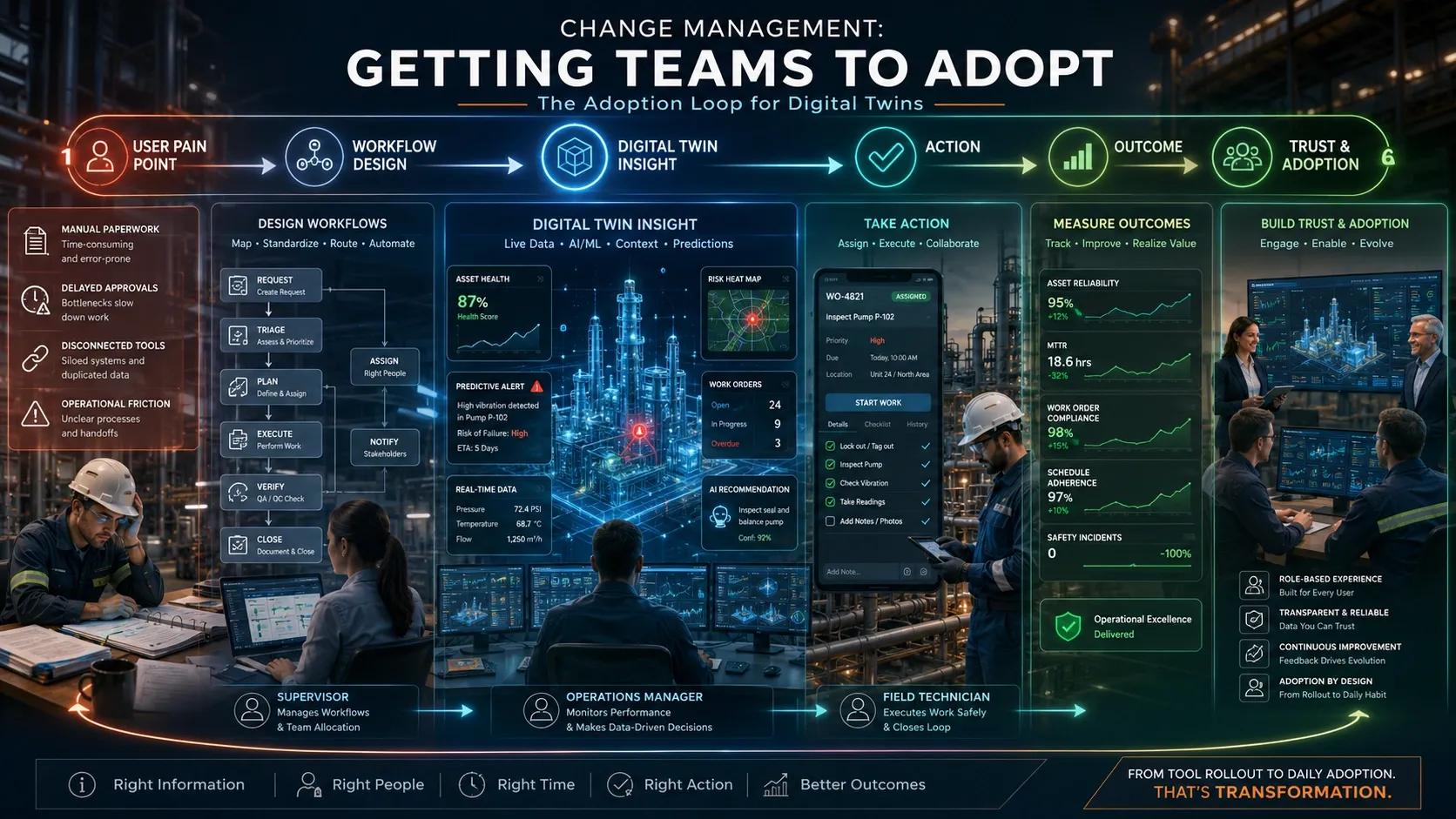
Digital Twin adoption does not fail because people dislike technology.
It fails because the technology changes how people are expected to work.
Introduction: Phase 4 Continuation
In Phase 4, we are focusing on:
👉 Operations, KPIs & ROI
So far, we discussed:
defining KPIs
measuring ROI
moving from pilot to scale
embedding Digital Twins into workflows
predictive vs prescriptive decisions
understanding the real cost stack
Now comes one of the most underestimated parts of Digital Twin success:
Change Management
Because even the best Digital Twin platform will fail if teams do not trust it, use it, and make decisions through it.
Technology deployment is only one side of the transformation.
The other side is:
👉 human adoption
The Core Problem: Adoption Is Treated as Training
Many organizations think adoption means:
conducting user training
giving login access
sharing dashboards
preparing user manuals
But adoption is much deeper.
Adoption means:
👉 people change how they make decisions.
That is difficult.
Because Digital Twins often challenge existing habits, authority structures, reporting methods, and daily workflows.
Why Teams Resist Digital Twins
Resistance is not always due to lack of skill.
It often comes from practical concerns.
1. Fear of Losing Control
When systems start recommending actions, teams may feel:
👉 “Will this replace my judgment?”
This is especially common among field teams and experienced operators.
2. Lack of Trust in Data
If users see wrong data once, trust drops quickly.
A Digital Twin must be reliable, or teams return to old methods.
3. Workflow Disruption
If the Digital Twin adds extra steps instead of simplifying work:
👉 adoption becomes weak.
People do not adopt tools that make their day harder.
4. No Clear Ownership
If teams do not know:
who acts on alerts
who approves actions
who validates outcomes
then the system becomes another dashboard.
5. Leadership Uses It, Field Teams Don’t
Many Digital Twins are built for executive visibility.
But value is created when operators, engineers, supervisors, and field teams use them daily.
The Adoption Shift: From Tool Rollout to Behavior Change
Successful Digital Twin adoption is not about:
👉 “Here is a new platform.”
It is about:
👉 “Here is a better way to make decisions and execute work.”
That means organizations must redesign:
roles
workflows
decision rights
escalation paths
review mechanisms
accountability structures
Without this, adoption remains superficial.
Five Steps to Improve Adoption
1. Start with Real User Pain Points
Do not begin with the platform.
Begin with:
what slows teams down
where decisions get delayed
where manual coordination happens
where repeated failures occur
If the Digital Twin solves real daily problems, adoption becomes easier.
2. Involve Users Early
Field engineers, operators, planners, and supervisors should not be introduced only after deployment.
They should be involved during:
requirement discovery
workflow design
dashboard design
validation
rollout
This builds trust and ownership.
3. Make the System Role-Based
Different users need different outputs.
Field team: task and location
Supervisor: status and escalation
Operations head: risk and priority
CXO: KPI and ROI
If everyone sees the same dashboard, adoption drops.
4. Connect Insights to Workflows
Adoption improves when the system helps users act.
Example:
alert detected
task created
owner assigned
action tracked
result recorded
This reduces manual coordination and makes the system useful.
5. Measure Adoption as a KPI
Adoption should not be assumed.
It should be measured.
Examples:
active workflow usage
number of decisions made through the twin
alert-to-action closure time
reduction in manual follow-ups
field task completion rate
repeat issue reduction
If adoption is not measured, it becomes invisible.
Practical Example: Facility Operations
A Digital Twin detects abnormal energy usage in a building.
If adoption is weak:
the alert remains on a dashboard
someone notices it later
action depends on manual follow-up
If adoption is strong:
the alert is assigned to the right team
action is tracked
correction is recorded
energy savings are measured
learning feeds back into the system
That is real adoption.
Not viewing the system.
Working through it.
Where Most Change Management Fails
1. Training Happens Too Late
Teams are trained after the system is ready.
By then, design decisions are already fixed.
2. Adoption Is Not Owned
No one is responsible for user behavior change.
IT owns deployment.
Operations owns execution.
But adoption sits between them.
3. Leadership Pushes Usage Without Workflow Fit
Mandating usage does not create adoption.
The system must genuinely improve work.
4. Early Success Is Not Communicated
When teams see measurable results, trust increases.
But many organizations fail to share:
time saved
downtime avoided
cost reduced
issues resolved
Ask Yourself
Are your teams using the Digital Twin because they have to, or because it helps them work better?
Indian Context
In India, Digital Twin adoption often faces practical challenges:
diverse user maturity
field-heavy operations
legacy workflows
manual approvals
fragmented accountability
This makes change management even more important.
For Indian infrastructure, utilities, manufacturing, and smart city projects, success depends not only on platforms.
It depends on:
👉 whether people trust the system enough to use it in daily decisions.
Benefits of Strong Change Management
higher adoption
faster decision-making
better workflow compliance
reduced resistance
stronger ROI
improved accountability
long-term system sustainability
Conclusion
Digital Twin success is not only a technology outcome.
It is a people-and-process outcome.
The real challenge is not:
👉 can the system generate insight?
The real challenge is:
👉 will teams trust it, use it, and act through it?
Because adoption is where ROI becomes real.
A Digital Twin becomes valuable only when it becomes part of how people work every day.