Carbon markets were built around a simple unit: one credit represents one ton of carbon dioxide equivalent reduced, avoided or removed.
That unit makes carbon outcomes tradable. But it does not automatically make them trustworthy.
Two credits may carry the same nominal value while resting on very different foundations. One may have a traceable project boundary, current monitoring data, documented interventions and independent verification. Another may depend heavily on assumptions, incomplete field records or evidence collected too far from the claimed outcome.
For buyers, investors and regulators, the important question is therefore changing.
It is no longer only:
How many credits were generated?
It is also:
What evidence supports each credit and how strong is that evidence?
Issuance volume does not reveal integrity
More than 30 million voluntary carbon credits were reportedly issued in July 2026. At the same time, market analysis pointed to improving integrity among some newly issued credits, particularly those from stronger project categories.
These are two different signals.
Issuance volume indicates market activity. It does not tell a buyer whether the underlying climate outcome is credible, durable or correctly attributed.
A carbon registry can record:
- project name;
- methodology;
- vintage;
- issued quantity;
- verification body;
- retirement status.
But that record may not reveal the complete evidence chain behind the claim.
Where exactly did the intervention occur?
Was the project boundary maintained throughout the monitoring period?
Which observations came from satellites, field teams, sensors or administrative records?
Did the reported practice change actually occur?
What uncertainty sits behind the calculation?
Could the claimed benefit be reversed?
A credit count cannot answer these questions. The supporting evidence must.
MRV should preserve the path from action to outcome
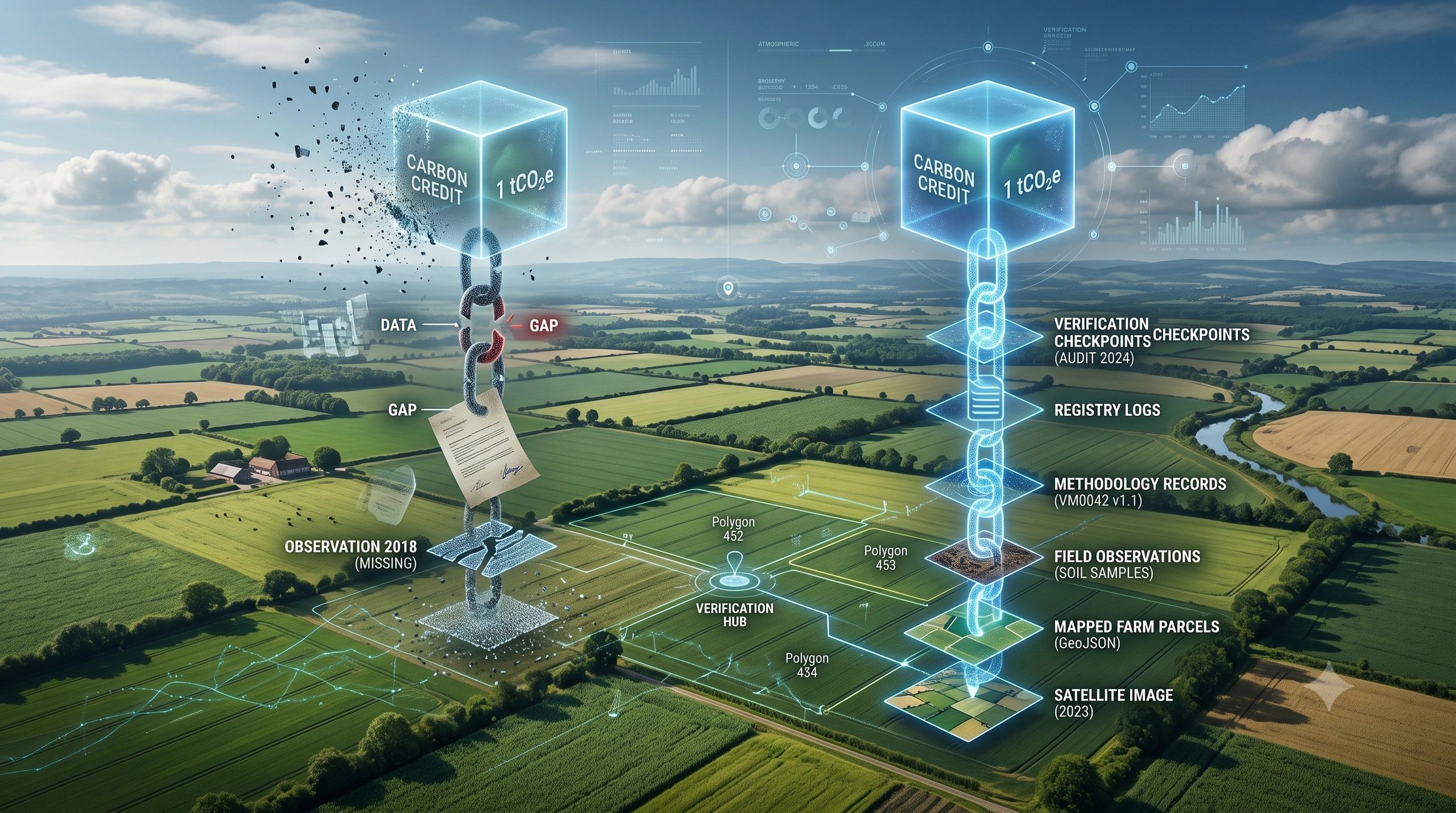
Carbon MRV is often described as a process of measurement, reporting and verification. Operationally, however, it is better understood as a connected chain:
Location → baseline → intervention → observation → estimation → verification → credit
Weakness at any stage affects the final claim.
Consider a rice-methane project.
The project may encourage farmers to change irrigation practices so that fields are not continuously flooded. Satellite observations, AI-supported analysis and field activities can then help determine whether the intervention occurred and estimate its effect on methane emissions.
The commercially meaningful product is not a satellite image or a farm dashboard. It is a defensible claim that a specific practice changed at a specific place, during a specific period, with a measurable climate result.
India-focused Mitti Labs illustrates the growing commercial interest in this model. The company reportedly raised $9.5 million to expand methane-reduction programmes involving more than 100,000 small farms.
The investment signal matters. But the larger lesson is that climate finance follows when geospatial monitoring connects with behavioral change, field verification and an accountable payment outcome.
A map can show change without proving a carbon result
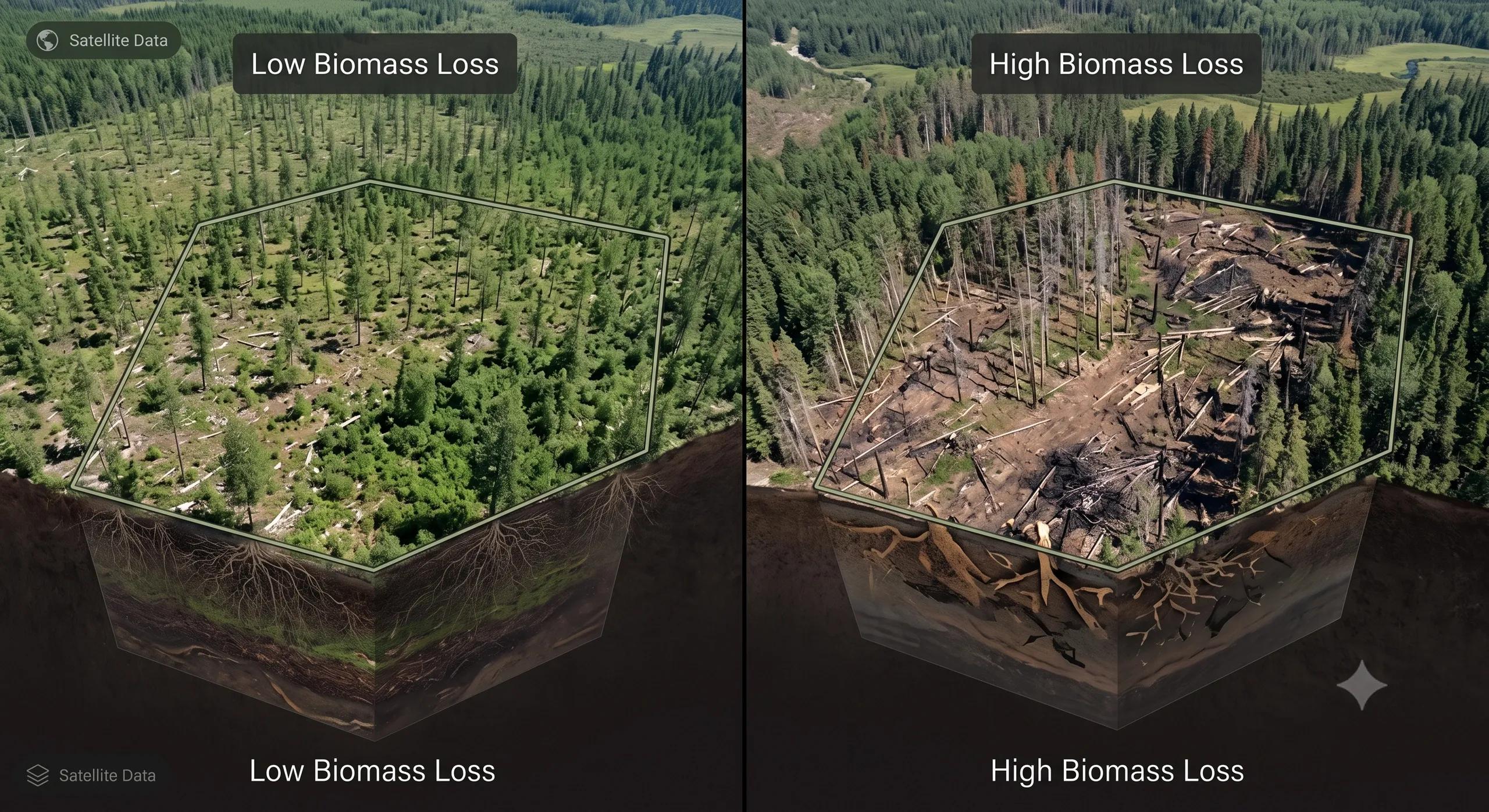
Earth observation is becoming central to carbon projects because it can provide repeated, consistent coverage across large or inaccessible areas.
It can help identify:
- land-cover change;
- crop cycles;
- vegetation condition;
- water-management patterns;
- fire or disturbance events;
- possible reversal;
- whether reported activity is spatially plausible.
But remote sensing does not independently establish every part of a carbon claim.
An observed change must still be interpreted through a methodology. The analysis may require field measurements, emission factors, sampling assumptions and uncertainty calculations. Someone must also verify that the intervention caused the claimed result and that the same outcome was not counted elsewhere.
This is why the distinction between detection, estimation and verification matters.
Detection identifies an observable condition or change.
Estimation translates evidence into a calculated carbon outcome.
Verification tests whether the calculation and its supporting evidence satisfy the applicable rules.
Treating these as one step creates false confidence.
Every claim needs a Carbon Evidence Quality Record
The next generation of MRV platforms should create more than a carbon result. They should create an evidence record beside it.
A Carbon Evidence Quality Record could preserve:
- physical source of the claim;
- project and monitoring boundaries;
- baseline version;
- methodology and calculation version;
- intervention history;
- satellite observations and acquisition dates;
- field records and sensor evidence;
- verification status;
- uncertainty;
- leakage and reversal risk;
- unresolved exceptions;
- evidence freshness.
This would not replace existing standards, registries or verification bodies. It would help organize the information those systems and institutions need.
The record should also show how the claim changed over time.
If a farm parcel was included in one monitoring period but excluded from the next, the reason should remain visible. If the methodology changed, the platform should preserve which version governed each calculation. If a fire, flood or land-use change threatened permanence, the event should be linked to the affected credits.
The objective is not to produce a perfect confidence score.
It is to let an authorized reviewer trace the claim from the financial unit back to the physical intervention and the observations supporting it.
Evidence quality must influence decisions
An evidence record becomes valuable only when it changes what happens next.
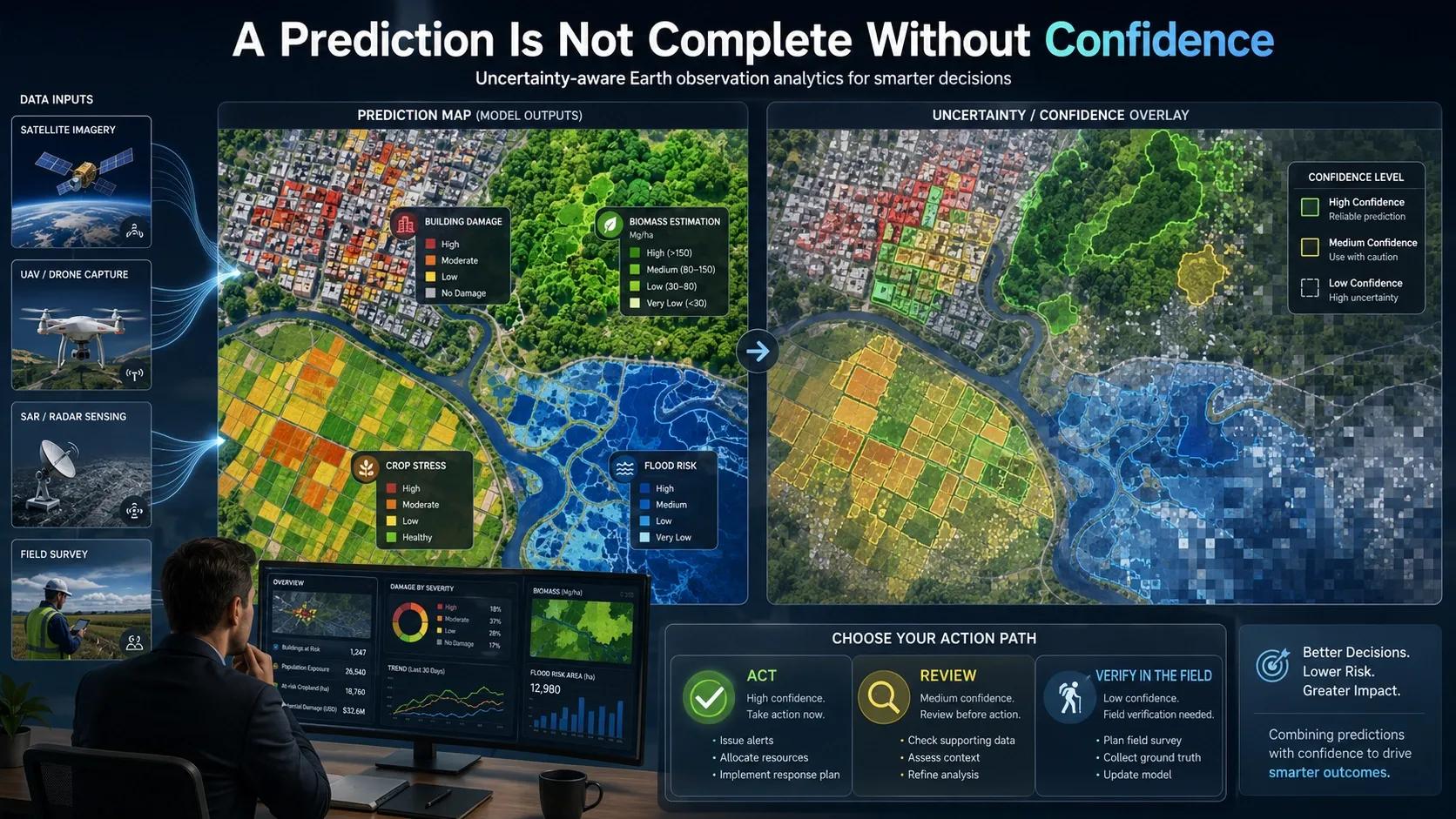
A practical MRV workflow could classify claims into three operational states:
- Proceed: Evidence meets the required conditions.
- Review: The claim is plausible, but an exception or uncertainty requires examination.
- Hold: Essential evidence is missing, outdated or contradictory.
The classification should then determine whether a claim can advance to verification, issuance, financing or purchase.
For example, a project may show strong satellite evidence of an irrigation change but lack complete farmer records for part of the monitoring period. The system should not silently combine the available and unavailable evidence into one apparently precise result.
It should isolate the affected parcels, explain the gap and request the appropriate review.
This protects both integrity and efficiency. Reviewers can focus on exceptions instead of manually reconstructing the entire project history.
Evidence quality will become a commercial differentiator
Better evidence is sometimes treated as an additional compliance cost. In practice, it can improve the commercial position of a carbon project.
A traceable evidence chain can support:
- faster due diligence;
- lower verification effort;
- clearer risk pricing;
- stronger buyer confidence;
- better access to climate finance;
- more credible outcome reporting;
- earlier detection of reversal or over-crediting risk.
It may also allow buyers to compare credits on more useful dimensions than project category and price.
Two credits can represent the same claimed quantity while differing significantly in observation frequency, field validation, uncertainty, permanence and evidence freshness. Those differences should be visible before procurement not discovered during a later controversy.
From commodity units to evidence-backed outcomes
Carbon markets still need quantity. Projects must calculate results, credits must be issued, and buyers need standardized units.
But quantity alone will not build confidence.
As scrutiny increases, the more valuable MRV systems will be those that can answer five questions clearly:
- What changed?
- Where and when did it change?
- What intervention produced the change?
- Which evidence supports the calculation?
- What uncertainty or unresolved risk remains?
The market is moving toward carbon outcomes that can be inspected, challenged and traced not merely counted.
A carbon credit may remain the unit that is traded. But evidence quality will increasingly determine whether that unit is trusted, financed and purchased.