Many organizations understand the value of Digital Twins.
They see the potential for real-time asset visibility, predictive maintenance, energy optimization, operational intelligence, better planning, and improved decision-making.
But once the discussion moves from concept to implementation, one question quickly appears:
How should we budget for a Digital Twin?
This is where many organizations hesitate.
Should a Digital Twin be treated as a one-time capital investment?
Should it be planned as an ongoing operational expense?
Should the organization buy a platform, build a custom solution, or start with a focused pilot?
Should sensors, BIM models, GIS integration, cloud, analytics, and support be budgeted separately or as one program?
These questions are important because a Digital Twin is not just a software purchase.
It is a connected operational system.
That means budgeting must cover not only the platform, but also data preparation, integrations, hardware, workflows, governance, training, support, and continuous improvement.
A Digital Twin Is Not a Single Cost Item
One common mistake is to budget a Digital Twin as if it is only a software platform.
In reality, a Digital Twin budget usually includes multiple cost layers.
These may include:
discovery and readiness assessment,
asset data preparation,
BIM, GIS, or engineering model updates,
IoT sensors and edge devices,
cloud or on-prem infrastructure,
platform licensing or custom development,
system integrations,
dashboards and visualization,
AI or analytics models,
cybersecurity and access control,
user training,
support and maintenance,
governance and data updates,
scaling to more assets, sites, or workflows.
When these elements are not considered early, the initial budget may look attractive but the real implementation cost appears later.
This is why organizations need a structured approach to CapEx and OpEx planning.
What Is CapEx in a Digital Twin Project?
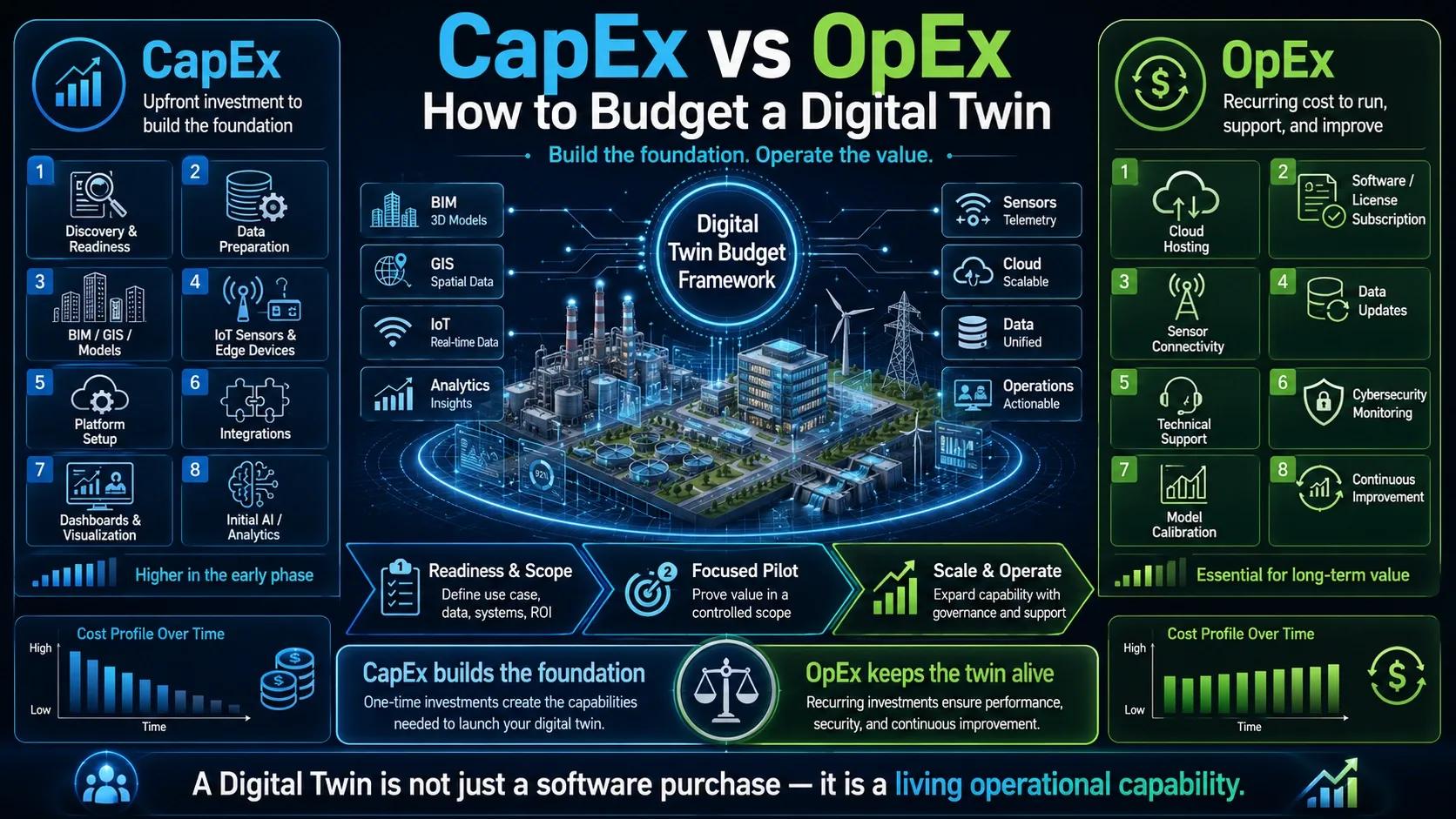
CapEx, or capital expenditure, refers to the upfront investment required to create the Digital Twin foundation.
In a Digital Twin project, CapEx may include:
initial consulting and solution design,
site surveys and asset mapping,
BIM or 3D model creation,
GIS data development,
IoT sensor installation,
gateways and edge hardware,
platform setup,
custom application development,
integration with existing systems,
initial cloud architecture setup,
dashboard configuration,
AI model development,
cybersecurity setup,
pilot implementation.
CapEx is usually higher during the initial phase because the organization is building the foundation.
This includes the physical-to-digital connection, data model, visualization layer, integration layer, and first operational workflows.
For example, if a factory wants a Digital Twin for predictive maintenance, the CapEx may include sensor installation, edge devices, equipment mapping, asset hierarchy creation, dashboard setup, and integration with maintenance systems.
If a city wants a Digital Twin for flood monitoring, CapEx may include geospatial data preparation, terrain models, sensor deployment, hydrological modelling, dashboard configuration, and integration with emergency response workflows.
CapEx builds the first working system.
What Is OpEx in a Digital Twin Project?
OpEx, or operational expenditure, refers to the recurring cost of running, maintaining, and improving the Digital Twin.
This may include:
cloud hosting,
software subscriptions,
platform licensing,
data storage,
API usage,
sensor connectivity,
device maintenance,
data updates,
technical support,
cybersecurity monitoring,
model calibration,
analytics refinement,
user support,
reporting,
system administration,
continuous improvement.
A Digital Twin is a living system. It cannot be treated as a one-time implementation and forgotten.
Assets change.
Sensors need calibration.
Data needs updating.
Workflows evolve.
Users request improvements.
New integrations may be required.
Security must be maintained.
ROI must be tracked.
This makes OpEx an essential part of the Digital Twin budget.
If OpEx is ignored, the Digital Twin may slowly become outdated, underused, or unreliable.
Why the CapEx vs OpEx Split Matters
The CapEx and OpEx split affects how organizations approve, implement, and scale Digital Twin projects.
Some organizations prefer CapEx because they want to build long-term assets. Others prefer OpEx because they want flexibility, lower upfront cost, and subscription-based adoption.
In practice, most Digital Twin projects need a hybrid model.
CapEx is needed to build the foundation.
OpEx is needed to keep the system useful.
The challenge is to avoid two extremes.
The first extreme is heavy upfront investment without a clear ROI pathway.
This can happen when organizations attempt a large enterprise-wide Digital Twin from the beginning. The project becomes expensive before value is proven.
The second extreme is very low upfront investment with no serious data, integration, or governance foundation.
This can produce an attractive demo, but it may not scale.
The right approach is to balance initial investment with recurring operational funding.
Start with a Pilot Budget, Not an Enterprise Budget
For most organizations, the best starting point is a focused pilot budget.
A pilot should be designed to prove value within a controlled scope.
This may involve:
one facility,
one production line,
one asset class,
one road corridor,
one port zone,
one utility service area,
one campus,
one high-value operational decision.
The pilot budget should answer three questions:
What minimum foundation is required?
What value can be proven?
What will be required to scale?
This keeps the project practical.
A pilot should not be too small to be meaningless.
It should not be too large to become risky.
It should be large enough to test data, integration, workflows, user adoption, and ROI.
Typical Budget Buckets for a Digital Twin Pilot
A practical Digital Twin pilot budget can be divided into seven buckets.
1. Discovery and Readiness Assessment
This includes understanding the business problem, current systems, available data, stakeholders, workflows, and expected outcomes.
This phase helps define the right scope.
Typical activities include:
stakeholder workshops,
use case selection,
data readiness review,
system landscape mapping,
ROI assumptions,
pilot scope definition,
implementation roadmap.
This should not be skipped. It reduces the risk of wrong platform selection or unclear implementation.
2. Data Preparation
Data preparation is often one of the most important budget items.
It may include:
asset register cleanup,
asset hierarchy creation,
data standardization,
BIM model updates,
GIS layer preparation,
document linking,
spatial referencing,
historical data structuring,
creation of common asset IDs.
This work may not look as visible as dashboards, but it determines the reliability of the Digital Twin.
Poor data preparation leads to poor decision confidence.
3. Hardware and Connectivity
If the Digital Twin requires real-time monitoring, the budget may include hardware and connectivity.
This may include:
IoT sensors,
gateways,
edge devices,
cameras,
RFID or BLE tags,
UWB anchors,
environmental sensors,
energy meters,
network connectivity,
installation and commissioning,
device calibration.
Hardware costs vary significantly depending on site conditions, accuracy requirements, number of assets, communication protocols, and coverage area.
Organizations should avoid over-sensoring in the first phase.
Start with the sensors required for the selected use case.
4. Platform, Software, and Cloud
This includes the technology layer used to run the Digital Twin.
It may include:
platform license,
cloud hosting,
storage,
compute,
database,
APIs,
dashboard tools,
visualization engines,
analytics tools,
user access management,
cybersecurity features.
Some organizations may choose a commercial Digital Twin platform. Others may use a custom or hybrid architecture.
The budgeting decision depends on flexibility, scale, integration needs, existing IT landscape, and long-term ownership.
5. Integration
Integration is one of the most underestimated cost areas.
A Digital Twin becomes useful when it connects to existing systems such as ERP, CMMS, SCADA, BIM, GIS, IoT platforms, document management systems, and analytics platforms.
Integration costs may include:
API development,
data pipelines,
middleware,
authentication,
data transformation,
event streaming,
system testing,
cybersecurity review,
error handling,
monitoring.
If integration is not budgeted properly, the Digital Twin may become another isolated platform.
6. Analytics, AI, and Decision Logic
Not every Digital Twin needs advanced AI in the first phase.
But many use cases require some level of analytics or decision logic.
This may include:
asset health scoring,
anomaly detection,
predictive maintenance models,
energy performance analytics,
risk scoring,
simulation models,
optimization logic,
alert rules,
automated reports.
The cost depends on data availability, model complexity, accuracy expectations, and how the outputs will be used.
For early pilots, rules-based or basic analytics may be enough. Advanced AI can come later once data maturity improves.
7. Change Management, Training, and Support
A Digital Twin will not deliver value if users do not adopt it.
The budget should include:
user training,
SOP updates,
workflow mapping,
admin training,
technical documentation,
support,
feedback cycles,
adoption tracking.
This is especially important because Digital Twins affect how teams work.
If change management is ignored, the system may be technically successful but operationally underused.
How to Think About Budget Ranges
Digital Twin budgets can vary widely depending on scope.
Instead of asking, “What does a Digital Twin cost?”, organizations should ask:
“What level of Digital Twin are we trying to build?”
A simple maturity-based view can help.
Level - Scope - Budget Nature
Level 1 - Static model or dashboard - Low CapEx, low-to-medium OpEx
Level 2 - Connected asset data and visualization - Medium CapEx, medium OpEx
Level 3 - Real-time monitoring with IoT - Higher CapEx, medium-to-high OpEx
Level 4 - Predictive analytics and workflow integration - Higher CapEx, higher OpEx
Level 5 - Enterprise-scale operational intelligence - Program-level CapEx and OpEx
The higher the maturity, the more the budget shifts from “project cost” to “operational capability investment.”
Build, Buy, or Hybrid?
Budgeting also depends on the implementation model.
Buy
Buying a platform may reduce implementation time. It may be useful when the use case is common, the organization wants faster deployment, and existing platform features are sufficient.
However, licensing and customization costs must be understood clearly.
Build
Building a custom solution may offer more flexibility and control. It may be suitable when the organization has unique workflows, strong internal teams, or specific integration needs.
However, development, maintenance, and scaling costs must be planned carefully.
Hybrid
A hybrid approach is often practical.
The organization may use existing platforms for visualization, GIS, BIM, IoT, or analytics, while building custom integration and decision layers around them.
This can balance speed, flexibility, and cost control.
For many organizations, the hybrid model is the most realistic.
Budgeting for Scale from Day One
Even if the first implementation is a pilot, scale should be considered early.
This does not mean building everything in phase one.
It means designing the pilot so it can scale later.
Important questions include:
Can the data model support more assets?
Can the architecture support more users?
Can integrations be reused?
Can dashboards be replicated?
Can workflows scale to other sites?
Can security and governance handle enterprise use?
Can operating costs be estimated for expansion?
A pilot that cannot scale may become a dead-end demo.
A scalable pilot becomes a foundation for enterprise adoption.
How to Avoid Budget Surprises
Organizations can reduce budget risk by following a few principles.
1. Start with Discovery
Do not approve a large Digital Twin budget before understanding use case, data readiness, systems, stakeholders, and ROI.
2. Separate Must-Have and Nice-to-Have
Not everything is required in phase one.
Start with what is needed to prove the selected use case.
3. Budget for Data Work
Data preparation is not optional. It should be treated as a core budget item.
4. Include Integration Early
Integration often decides whether the Digital Twin becomes useful or remains isolated.
5. Plan Recurring Costs
Cloud, licenses, support, data updates, and sensor maintenance should be part of the financial model.
6. Define Success Metrics
Without measurable outcomes, the budget becomes difficult to defend.
7. Design for Scale
Even a small pilot should be architected with future expansion in mind.
A Simple Digital Twin Budget Framework
A practical budget framework can include three phases.
Phase 1: Readiness and Scope Definition
Purpose: understand the current state and define the right pilot.
Budget includes:
readiness assessment,
use case selection,
data audit,
system mapping,
stakeholder alignment,
high-level ROI estimate.
Phase 2: Focused Pilot
Purpose: prove value in a controlled environment.
Budget includes:
minimum viable data preparation,
platform setup,
required sensors or data feeds,
integration with selected systems,
dashboards,
analytics,
training,
pilot support.
Phase 3: Scale and Operate
Purpose: expand the solution and institutionalize value.
Budget includes:
additional assets or sites,
deeper integrations,
advanced analytics,
user expansion,
governance,
operational support,
recurring cloud and license costs,
continuous improvement.
This phased budgeting model prevents overinvestment before value is proven.
Closing Thought
Budgeting a Digital Twin is not only about estimating technology cost.
It is about funding a new operational capability.
CapEx helps build the foundation.
OpEx keeps the Digital Twin alive, trusted, and useful.
A pilot helps prove value before larger investment.
A scale plan helps convert early success into enterprise impact.
The right budget does not begin with the platform price.
It begins with a clear use case, minimum viable data, integration needs, user workflows, and measurable ROI.
A Digital Twin should not be treated as a one-time digital asset.
It should be treated as a living decision-support system that requires both initial investment and ongoing operational commitment.