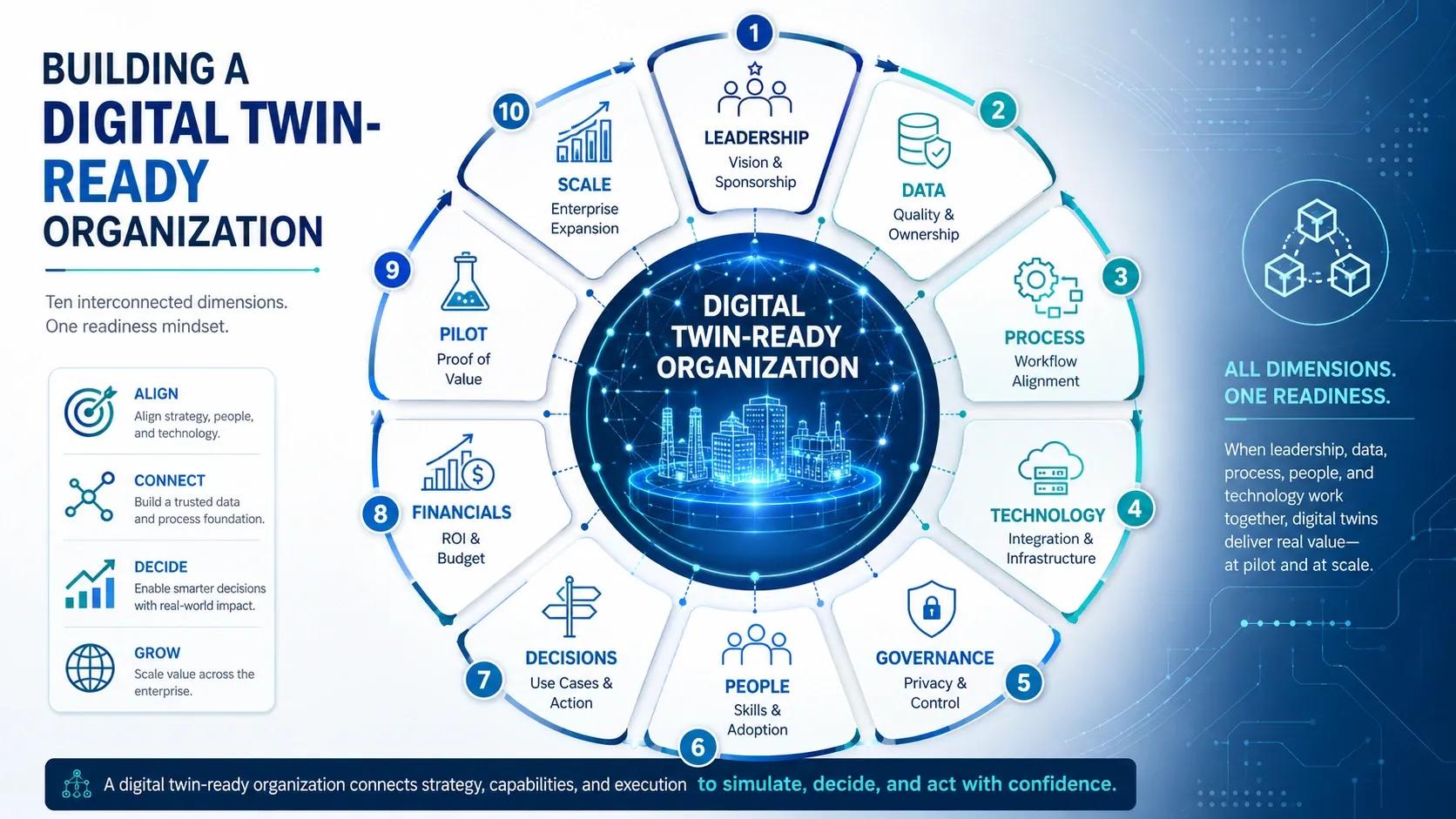
Most Digital Twin projects do not fail because the technology is unavailable.
They fail because the organization is not ready to use the technology effectively.
Introduction: The Readiness Question
In the previous article, we discussed regulatory and data privacy considerations. That discussion is closely connected to today’s topic.
A Digital Twin is not only a platform, dashboard, 3D model, AI system, or IoT integration.
It is an organizational capability.
It changes how teams collect data, share information, monitor assets, make decisions, respond to events, and measure outcomes.
That is why the important question is not only:
👉 Can we build a Digital Twin?
The deeper question is:
👉 Is the organization ready to operate with one?
A Digital Twin-ready organization is not defined by how advanced its software stack is. It is defined by how well its people, processes, data, governance, and decision systems are prepared to use a Digital Twin for real operational value.
The Core Shift: From Technology Project to Organizational Capability
Many organizations begin Digital Twin initiatives as technology projects.
They appoint a vendor.
They identify a platform.
They create a 3D model.
They integrate some IoT data.
They build dashboards.
But after the pilot, they struggle to scale.
Why?
Because the organization has not answered some basic questions:
👉 Who owns the Digital Twin?
👉 Which department will use it daily?
👉 Which decisions will it improve?
👉 Which workflows will change?
👉 Who maintains the data?
👉 Who approves actions recommended by the Twin?
👉 How will ROI be measured?
Without these answers, the Digital Twin remains impressive but underused.
A Digital Twin-ready organization treats the Twin as part of its operating model, not as an isolated innovation experiment.
1. Leadership Readiness
The first requirement is leadership clarity.
Digital Twin initiatives need executive sponsorship because they often cut across multiple departments:
operations
engineering
IT
maintenance
safety
planning
finance
compliance
field teams
data teams
If leadership sees the Digital Twin only as a visualization tool, the project will remain limited.
But if leadership sees it as a decision intelligence system, the organization can align it with business outcomes.
Leadership must define:
why the Digital Twin is needed
which business problems it will solve
which KPIs it will influence
which teams must participate
how decisions will be governed
how success will be measured
The role of leadership is not to choose the fanciest technology.
The role of leadership is to create organizational alignment.
2. Data Readiness
A Digital Twin is only as reliable as the data behind it.
Organizations often underestimate this.
They assume the data exists.
But when implementation begins, they discover:
asset records are incomplete
coordinates are inaccurate
drawings are outdated
BIM models are not maintained
GIS layers are inconsistent
sensor data has gaps
naming conventions vary across departments
maintenance records are stored in different systems
field data is not standardized
This creates a major problem.
If the Digital Twin is built on unreliable data, people will not trust it.
Data readiness requires:
asset inventories
data classification
data ownership
data quality checks
common naming standards
spatial accuracy validation
data lineage
update responsibility
master data management
integration readiness
For GeoAI-powered Twins, spatial data readiness becomes even more important.
A wrong coordinate, outdated boundary, or incorrect asset location can lead to wrong decisions.
Before building a Digital Twin, organizations should ask:
👉 Is our data ready to support operational decisions?
3. Process Readiness
A Digital Twin should not sit outside the organization’s workflows.
It must connect to real processes.
For example:
In a maintenance use case, the Digital Twin should connect to inspection schedules, work orders, spare parts, technician assignments, and closure reports.
In a flood management use case, it should connect to alerts, evacuation routes, emergency teams, shelters, road closures, and public communication.
In a manufacturing use case, it should connect to production planning, quality inspection, machine control, safety protocols, and ERP systems.
The Digital Twin becomes valuable only when insights move into action.
Process readiness means identifying:
current workflows
decision points
approval steps
escalation paths
response times
data handoffs
accountability gaps
automation opportunities
The organization must know where the Twin fits into daily operations.
Otherwise, it becomes another dashboard.
4. Technology Readiness
Technology readiness is not only about buying software.
It is about ensuring that the technology ecosystem can support Digital Twin operations.
This includes:
cloud or on-premise infrastructure
IoT connectivity
APIs
GIS systems
BIM platforms
data lakes or databases
cybersecurity controls
edge devices
integration middleware
analytics and AI tools
visualization and XR interfaces
The key question is:
👉 Can our systems talk to each other?
Many Digital Twin projects face difficulty because enterprise systems are fragmented.
GIS is separate.
BIM is separate.
ERP is separate.
CMMS is separate.
IoT platforms are separate.
Field apps are separate.
A Digital Twin-ready organization builds integration capability.
Without integration, the Twin cannot become operational intelligence.
5. Governance Readiness
Governance decides whether the Digital Twin can scale responsibly.
This includes:
data ownership
access control
privacy compliance
cybersecurity
model validation
AI accountability
change approval
audit trails
vendor responsibility
data retention
regulatory alignment
Governance is especially important when Digital Twins use:
personal data
worker movement
citizen mobility
critical infrastructure data
satellite imagery
operational telemetry
AI-driven recommendations
A Digital Twin-ready organization defines the rules before the system becomes powerful.
Because once the Twin begins influencing decisions, accountability becomes critical.
Governance answers:
👉 Who can see what?
👉 Who can change what?
👉 Who approves automated actions?
👉 Who is responsible if data is wrong?
👉 How are decisions audited?
👉 How are risks escalated?
Governance is not a barrier to innovation.
It is what allows innovation to scale safely.
6. People Readiness
Technology adoption depends heavily on people.
A Digital Twin may be technically strong, but if teams do not understand it, trust it, or use it, the value will not materialize.
People readiness requires:
training
role clarity
change management
user involvement
operational ownership
leadership communication
feedback loops
practical use-case demonstrations
Different users need different levels of understanding.
Executives need to understand decision value.
Managers need to understand workflow impact.
Engineers need to understand technical logic.
Field teams need to understand daily usage.
IT teams need to understand integration and security.
Data teams need to understand governance and quality.
A Digital Twin-ready organization does not train everyone the same way.
It builds role-based adoption.
7. Decision Readiness
This is one of the most important aspects.
A Digital Twin is designed to improve decisions.
But many organizations have unclear decision structures.
They may have data, dashboards, and alerts, but no clarity on:
who acts on the alert
when action is required
what threshold triggers escalation
who approves intervention
what happens if teams disagree
how decisions are recorded
how outcomes are measured
Decision readiness means defining how the Digital Twin will support actual decisions.
For every use case, the organization should define:
👉 What decision are we improving?
👉 Who currently makes that decision?
👉 What data do they use today?
👉 What delay or error exists today?
👉 How will the Twin improve it?
👉 What action will follow?
👉 How will success be measured?
This is where many projects become clearer.
The organization stops asking, “What can the Twin show?”
It starts asking, “What decision should the Twin improve?”
8. Financial Readiness
Digital Twins require investment.
But financial readiness is not only about budget.
It is about understanding the value model.
Organizations should identify where ROI will come from:
reduced downtime
faster inspections
better maintenance planning
reduced energy consumption
improved asset utilization
fewer failures
better compliance
faster response
improved safety
reduced rework
better capital planning
The organization should also understand cost components:
data preparation
platform development
system integration
IoT deployment
cloud or infrastructure cost
security
training
support
model updates
change management
A Digital Twin-ready organization does not treat the Twin as a one-time purchase.
It treats it as a long-term operational capability.
9. Pilot Readiness
Pilots are important, but they must be designed carefully.
A weak pilot creates confusion.
A strong pilot creates confidence.
A Digital Twin-ready organization selects pilots based on:
clear business problem
measurable outcome
available data
user involvement
operational relevance
scalability potential
manageable complexity
The best pilot is not always the most impressive one.
The best pilot is the one that proves value clearly.
For example:
a road maintenance prioritization pilot
a factory quality monitoring pilot
a flood risk prediction pilot
a campus energy optimization pilot
a port asset monitoring pilot
a utility network inspection pilot
The pilot should answer:
👉 Did the Twin improve a real decision?
If yes, scaling becomes easier.
10. Scaling Readiness
Scaling a Digital Twin is different from building a pilot.
A pilot may work with limited data, manual intervention, and a small user group.
Scaling requires:
standard architecture
reusable data models
integration patterns
governance frameworks
training programs
support teams
performance monitoring
cost control
security controls
vendor management
Many organizations get stuck after the pilot because they do not have a scale strategy.
A Digital Twin-ready organization plans for scale from the beginning.
It asks:
👉 Can this model be reused?
👉 Can this workflow be expanded?
👉 Can the data pipeline support more assets?
👉 Can governance support more users?
👉 Can the system integrate with enterprise tools?
👉 Can ROI be tracked across departments?
Scale is not an afterthought.
It is a design principle.
Indian Context
In India, Digital Twin readiness is becoming increasingly important across:
highways
smart cities
ports
airports
utilities
industrial corridors
railways
manufacturing
water systems
disaster management
healthcare infrastructure
agriculture
The opportunity is large, but organizational readiness will decide adoption speed.
Many Indian organizations are already digitizing their assets, adopting GIS, implementing IoT, using BIM, and exploring AI. But these systems are often fragmented.
The next challenge is integration.
India needs Digital Twin-ready organizations that can connect:
👉 geospatial data
👉 asset data
👉 operational data
👉 enterprise systems
👉 AI analytics
👉 decision workflows
This requires not just platforms, but readiness across leadership, data, people, governance, and execution.
For India, Digital Twins can become powerful tools for infrastructure resilience, urban planning, climate response, industrial efficiency, and public service delivery.
But only if organizations are ready to use them as operational systems.
Digital Twin Readiness Checklist
Before starting or scaling a Digital Twin, organizations should evaluate themselves across these areas:
Leadership
Is there executive sponsorship and a clear business objective?
Data
Is the required data accurate, updated, classified, and owned?
Processes
Are workflows mapped and ready for integration?
Technology
Can existing systems integrate through APIs, platforms, or data pipelines?
Governance
Are privacy, security, ownership, and accountability defined?
People
Are users trained and involved from the beginning?
Decisions
Are the decisions to be improved clearly identified?
Financials
Is ROI linked to operational outcomes?
Pilot
Is the pilot measurable, practical, and scalable?
Scale
Is there a roadmap for expansion beyond the pilot?
Conclusion
A Digital Twin-ready organization is not created by purchasing a platform.
It is created by aligning people, processes, data, technology, governance, and decisions.
The most successful organizations will be those that understand this early.
They will not treat Digital Twins as isolated innovation projects.
They will treat them as operating capabilities.
The real question is not:
👉 Do we have a Digital Twin?
The real question is:
👉 Are we ready to make better decisions because of it?
That is the difference between a Digital Twin project and a Digital Twin-ready organization.