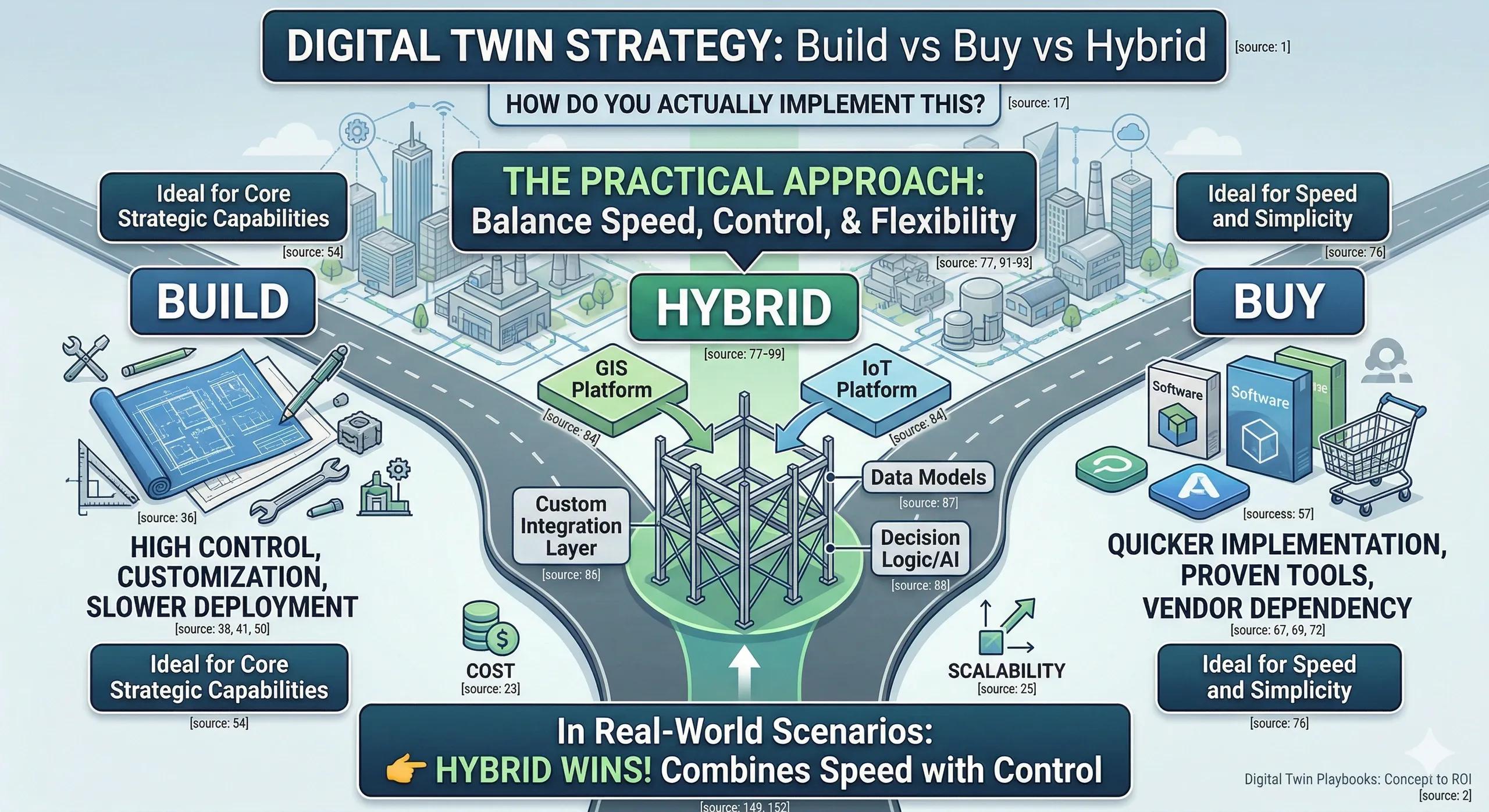
Should you build your Digital Twin platform or buy one?
The real answer is:
👉 it depends on what you’re trying to control.
Introduction
Over the last 10 days in Phase 2, we’ve covered:
architecture
sensors and data pipelines
integration (BIM + GIS + IoT)
cloud vs edge
AI/ML
interoperability
visualization
security and governance
Now comes a critical decision:
👉 How do you actually implement all of this?
Should you:
build your own system
buy an existing platform
or combine both?
This choice defines:
cost
flexibility
scalability
long-term control
The Core Problem: One Approach Does Not Fit All
Many organizations:
default to buying tools
or attempt to build everything internally
Both approaches can fail if not aligned with:
👉 business goals and technical maturity
Option 1: Build
What it means
Developing your own Digital Twin platform:
custom architecture
tailored integrations
full control over features
When Build Works Best
highly specialized use cases
need for deep customization
strong in-house technical capability
long-term platform strategy
Advantages
full control over architecture
no vendor lock-in
tailored to exact requirements
Challenges
high initial cost
longer development time
requires strong technical team
ongoing maintenance responsibility
👉 Build is ideal when:
your Digital Twin is a core strategic capability
Option 2: Buy
What it means
Using existing platforms or software solutions.
Examples include:
Digital Twin platforms
GIS platforms
IoT platforms
When Buy Works Best
need for faster deployment
standard use cases
limited internal resources
Advantages
quicker implementation
lower upfront effort
proven tools and frameworks
Challenges
limited flexibility
vendor dependency
integration constraints
hidden long-term costs
👉 Buy is ideal when:
speed and simplicity are priorities
Option 3: Hybrid (Most Practical Approach)
What it means
Combining:
existing platforms
with custom-built components
Typical Hybrid Setup
Buy: core platforms (GIS, IoT, visualization)
Build: integration layer data models decision logic custom workflows
Advantages
balance of speed and flexibility
control over critical components
scalable architecture
Challenges
requires strong architecture design
integration complexity
governance needed
👉 Hybrid is ideal when:
you want both control and speed
Practical Example
Scenario: Smart Infrastructure Project
Buy: GIS platform, IoT platform
Build: integration layer, data pipelines, AI models
👉 Outcome:
faster deployment
customized intelligence
scalable system
Where Organizations Go Wrong
1. Over-Building
building everything from scratch 👉 leads to delays and high costs
2. Over-Reliance on Vendors
expecting platforms to solve everything 👉 leads to limitations
3. No Clear Architecture
tools selected before defining structure
4. Ignoring Long-Term Strategy
focusing only on short-term delivery
How to Decide
Ask these key questions:
Is this a core capability or a supporting system?
Do we need full control or faster deployment ?
Do we have the technical capacity to build ?
How important is scalability and flexibility ?
Ask Yourself
Are you choosing based on:
👉 tools available
Or
👉 outcomes required?
Indian Context
In India:
budgets are constrained
systems are diverse
legacy infrastructure is common
👉 Hybrid approaches are often the most effective:
leverage existing platforms
build critical capabilities
Benefits of Choosing the Right Approach
optimized cost
faster implementation
better scalability
reduced risk
stronger long-term value
Conclusion
There is no universal answer to Build vs Buy.
The right approach depends on:
👉 your goals
👉 your constraints
👉 your long-term vision
But in most real-world scenarios:
👉 Hybrid wins
Because it combines:
speed of deployment
with control and flexibility