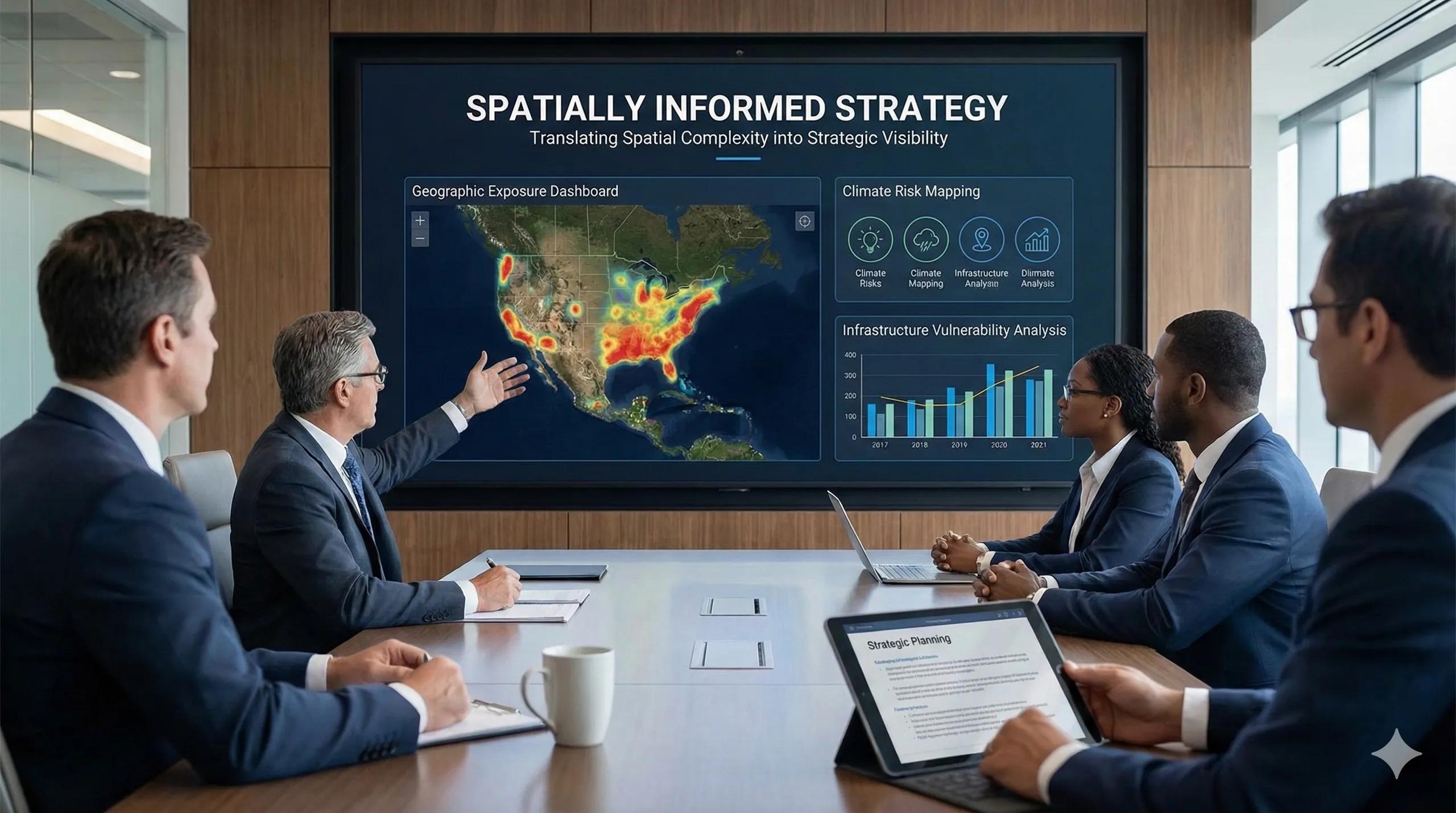
Strategy Has Coordinates
Every corporate strategy document discusses markets, growth, competition, and risk.
Very few discuss geography .
Yet every strategy unfolds somewhere.
Factories sit in flood plains.
Supply chains cross fragile corridors.
Customers concentrate in shifting urban regions.
Infrastructure ages differently across climates.
Strategy may be written in spreadsheets, but it executes on land .
The surprising reality is this:
Most boardrooms discuss financial exposure, but rarely discuss geographic exposure .
That gap creates one of the largest blind spots in modern enterprise strategy.
Why Geography Disappears in Strategy Discussions
There are several structural reasons why geography rarely appears in executive decision-making.
1. Aggregated Reporting
Most corporate reporting aggregates performance into:
revenue
cost
margin
asset value
Aggregation removes location context.
Geographic vulnerability disappears inside averages.
2. Organizational Silos
Spatial knowledge often sits inside:
GIS teams
engineering departments
planning units
Strategic leadership rarely interacts directly with these teams.
As a result, geography becomes operational detail instead of strategic input.
3. Non-Spatial Strategy Frameworks
Most strategy models focus on:
market share
competitive positioning
financial forecasting
organizational capability
Very few frameworks ask:
Where is risk geographically concentrated?
What the Board Actually Needs to See
When geography enters strategic planning, the conversation changes dramatically.
Instead of asking:
What is our growth potential?
Leadership begins asking:
Where are our assets geographically exposed?
Which regions concentrate operational risk?
How does climate volatility affect infrastructure?
Are we over-invested in fragile corridors?
These are strategic questions , not technical ones.
A Simple Example: Asset Concentration Risk
Consider two companies with identical asset values.
Company A:
Assets distributed across multiple climate zones
Diverse infrastructure networks
Balanced geographic exposure
Company B:
70% of assets located in coastal regions
High flood and cyclone exposure
Limited redundancy in logistics routes
Financial statements may look identical.
Geographic exposure does not.
Without spatial analysis, leadership cannot see the difference.
Geography Changes Strategic Decisions
Once geography becomes visible, strategy shifts.
Investment decisions change
Companies diversify asset placement to reduce geographic concentration.
Infrastructure planning evolves
Organizations strengthen facilities in climate-exposed regions.
Supply chains become more resilient
Routes are redesigned to avoid fragile corridors.
Insurance and risk management improve
Geographic exposure becomes measurable.
The Rise of Spatially Informed Strategy
Forward-looking organizations are beginning to embed spatial intelligence into executive planning through:
geographic exposure dashboards
climate risk mapping
infrastructure vulnerability analysis
regional performance heatmaps
These tools translate spatial complexity into strategic visibility.
The Leadership Skill Gap
Introducing spatial intelligence into strategy requires a new capability:
Spatial literacy at the leadership level.
Executives do not need to run GIS software.
But they must understand how geography influences:
capital risk
infrastructure resilience
regulatory exposure
market accessibility
Without that literacy, spatial insights remain underutilized.
The Monetization Bridge
As organizations recognize the importance of geographic exposure in strategy, many seek frameworks and platforms that translate complex spatial data into executive-level decision systems. These systems integrate asset locations, climate models, operational metrics, and market data into unified views that leadership teams can use to guide investment, risk management, and long-term planning.
Looking Ahead
Global volatility is increasing.
Climate events, infrastructure disruptions, and geopolitical shifts all have one thing in common:
They are geographic.
Organizations that understand the spatial dimension of strategy will respond faster to these disruptions.
Those that ignore geography will discover risk only after it materializes.
Closing Insight
Strategy does not unfold in abstract markets.
It unfolds across landscapes.
When geography enters the boardroom, strategy becomes grounded in physical reality.
And grounded strategy is resilient strategy.