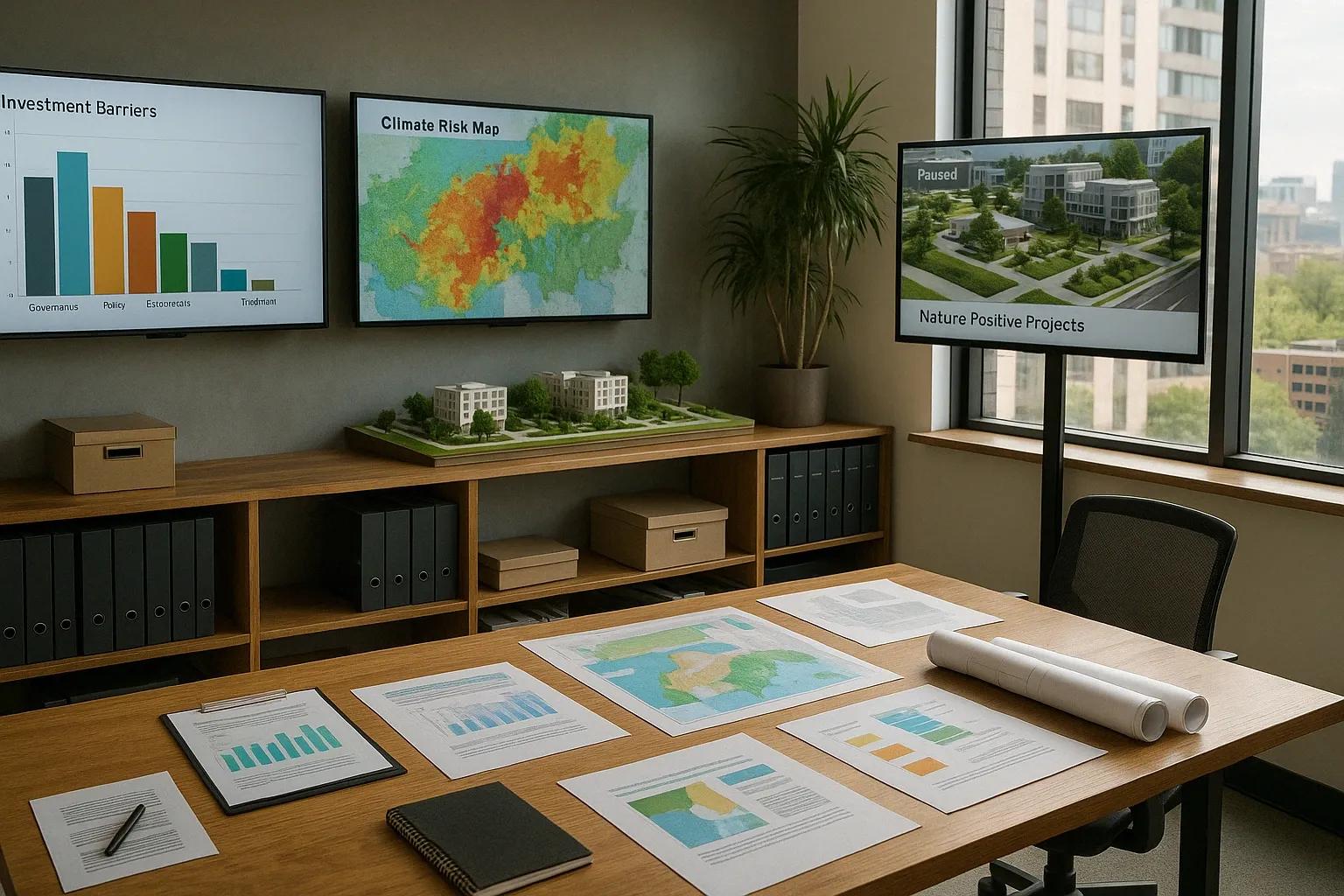
Cities are eager to implement nature-positive solutions, from green roofs and restored rivers to urban forests and biodiversity corridors.
But most nature-based initiatives struggle to attract sustained funding or reach implementation.
The problem is not intent. It’s a complex mix of structural, operational, and perception-related barriers.
To move forward, cities must first understand what’s holding them back, and how to remove those obstacles using the right mix of planning, policy, and digital tools.
The Top Barriers to Urban Nature Investment
1. Siloed Governance and Planning
Urban nature is often seen as the responsibility of one department, parks, environment, or health, with limited cross-sector integration.
This leads to fragmented priorities and underpowered budgeting.
Solution: Use Geospatial Planning Platforms to align environmental goals with infrastructure, housing, transport, and health departments using shared data layers.
2. Lack of Standardized Metrics
Investors need clear, quantifiable results. Cities often struggle to translate ecosystem benefits into metrics such as ROI, avoided costs, or resilience value.
Solution: Deploy Digital Twins and AI-based models to simulate and quantify the financial, climate, and health outcomes of nature-positive projects.
3. Perceived High Risk and Low Return
Nature projects are often seen as soft investments, aesthetic, unproven, or difficult to maintain.
Solution: Use UAV surveys and IoT sensors to track environmental performance over time. Real-time data builds investor confidence and accountability.
4. Limited Institutional Capacity
Many cities lack the financial engineering skills to structure bankable, blended-finance nature projects.
Solution: Standardize project proposals using BIM models and open-source impact templates that meet MDB and private funder requirements.
5. Weak Project Pipelines
Cities rarely have a portfolio of ready-to-fund projects with environmental and financial impact models.
Solution: Use AI tools to prioritize and package small projects into larger, investment-grade bundles with co-benefits across water, energy, and transport.
Role of Digital Technologies
Addressing these barriers requires credible, measurable, and collaborative solutions, and that's where your tech stack comes in:
Geospatial Tools : Break silos and create shared planning baselines
UAV Imagery : Track and document environmental change
BIM : Align ecological and infrastructure designs
Digital Twins : Simulate ROI and climate adaptation outcomes
IoT + AI : Quantify benefits, monitor KPIs, reduce risk perception
With the right data and digital systems in place, cities can shift from "nature hopeful" to "nature funded."
Conclusion
Nature-positive urban investment isn’t just about finding money, it’s about removing the barriers that prevent good ideas from becoming funded action.
By improving planning systems, strengthening data capabilities, and using scalable digital tools, cities can clear the path toward healthier, greener, and more resilient futures.