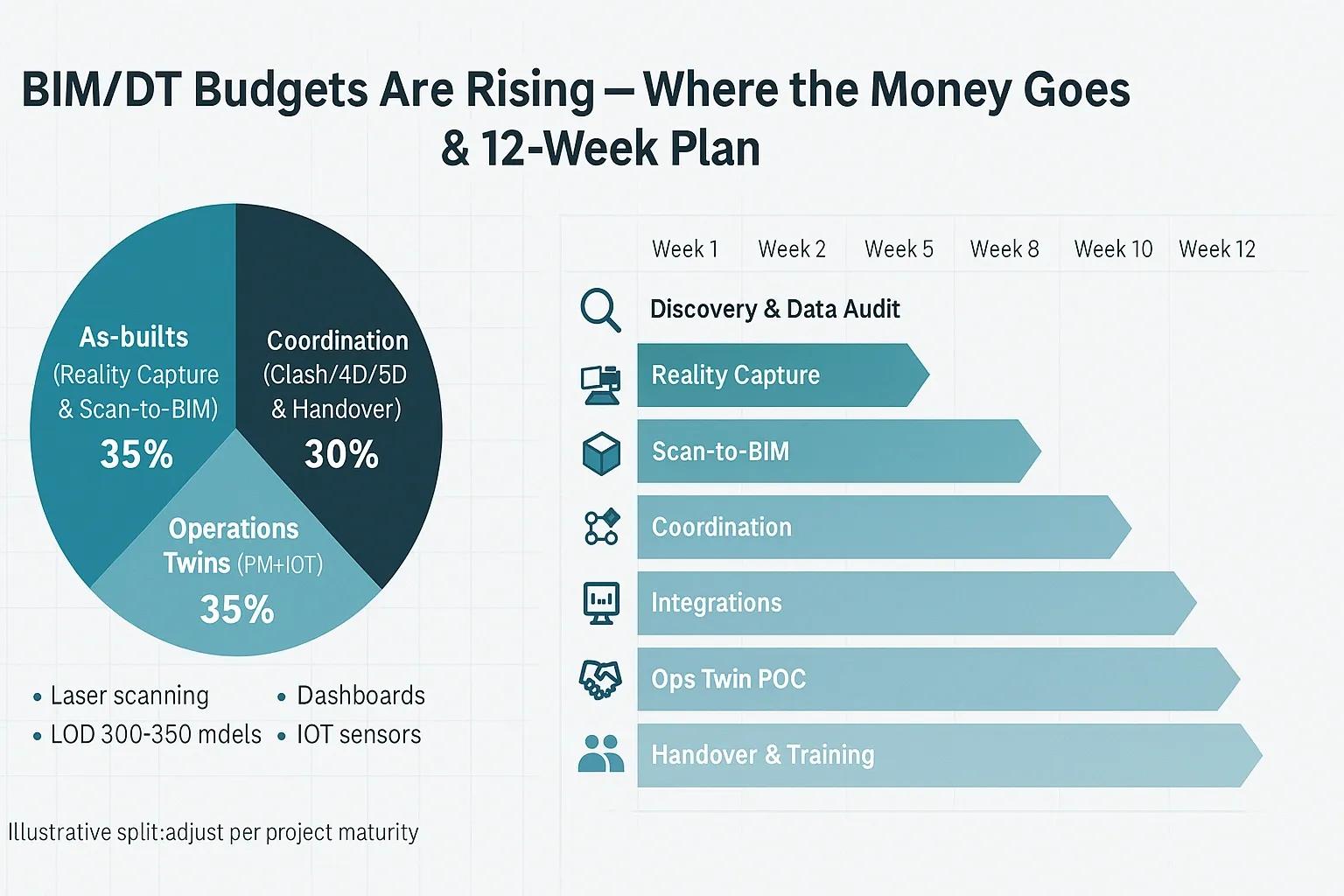
BIM and Digital Twin (DT) spend is moving from “pilot” to “program.” Owners are shifting budgets from one-off models to continuous, operations-grade data. The money is concentrating in three buckets: as-builts, coordination, and operations twins. This article breaks down where budgets are going, what outcomes owners expect, and a clear three-package services menu you can take to AECO market now.
Where owners are spending (and why)
1) As-builts: reality capture → usable models
What’s funded: laser scanning/360/drone capture; Scan-to-BIM (LOD 300–350); asset tagging and metadata alignment. Why now: many portfolios still rely on stale drawings. Accurate geometry and asset registers cut rework and unlock downstream coordination and FM.
Typical outputs
Unified site coordinate system + control report
LOD 300–350 architectural/MEP models with naming conventions
Asset list with unique IDs mapped to spaces/systems
2) Coordination: clash, 4D/5D, and handover quality
What’s funded: model federation, rules-based clash, constructability reviews, 4D look-ahead, and 5D change impact. Why now: owners want fewer RFIs, fewer Saturday fixes, and predictable handover. Good coordination compresses schedules and stabilizes cost.
Typical outputs
Weekly clash dashboards + issue logs linked to model elements
4D simulations for critical sequences and shutdowns
Data drops aligned to an Information Delivery Plan (IDP)
3) Operations twins: from handover to live performance
What’s funded: commissioning data ingestion, BMS/CMMS integrations, live KPIs for energy, comfort, and uptime. Why now: CFOs want operational ROI, not just “digital deliverables.” A basic ops twin enables condition monitoring, quicker troubleshooting, and better vendor accountability.
Typical outputs
Asset-system-space graph with maintenance regimes
Live dashboards (energy, IAQ, occupancy, equipment runtime)
Alerts, work orders, and change traceability
A three-package services menu (plug-and-play)
Package A: Essentials (Project Delivery Ready) Best for single projects or quick wins.
Scope: reality capture, Scan-to-BIM (LOD 300–350), model federation, clash & weekly issue logs, 4D look-ahead for critical paths, structured handover.
Data: IFC/Revit + COBie/asset register, drawing set, IDP-aligned drops.
KPIs: clash density ↓, RFI rate ↓, rework hours ↓, schedule variance ↓.
Typical timeline: 8–12 weeks per facility/phase.
Package B: Performance (Portfolio Coordination) For owners standardizing across multiple projects.
Scope: everything in Essentials plus a common data environment, model QA rulesets, 5D change impact, and template deliverables for all projects.
Data: portfolio model standards, naming, object dictionaries, approval workflows.
KPIs: cost predictability ↑, change cycle time ↓, cross-project reuse ↑.
Typical timeline: 12–16 weeks to stand up; then rolling adoption.
Package C: Operations Twin (FM-Ready) For lifecycle value and measurable OPEX gains.
Scope: commissioning data load, BMS/IoT/CMMS integrations, equipment trees, live dashboards, alerting, work-order sync, and a reliability playbook.
Data: asset-system-space graph; maintenance plans; SLA metrics.
KPIs: MTTR ↓, unplanned downtime ↓, energy intensity ↓, vendor SLA compliance ↑.
Typical timeline: 12–20 weeks for first site; scale via templates.
Adoption blueprint (what good looks like)
Start with ground truth. Don’t federate bad geometry. Kick off with capture and a data audit.
Lock standards early. File naming, parameters, classifications, and IDP cadence.
Operate a weekly value rhythm. Show a short list of KPIs tied to site risks and cost.
Integrate with the work. Push issues to the tools teams already use (CMMS, site logs).
Close the loop. Treat the twin as a living system: telemetry → insight → action → learn.
Use case: hospital retrofit (brownfield)
A 600-bed urban hospital needed to plan HVAC upgrades without service disruption.
As-builts: laser scanning captured congested shafts; Scan-to-BIM produced reliable LOD 350 MEP.
Coordination: 4D phasing avoided OT shutdowns; pre-fabricated sections reduced on-site time.
Ops twin: live BMS points mapped to equipment; alarms routed to CMMS with auto-generated work orders; energy dashboards highlighted low-cost setpoint fixes.
Result: fewer RFIs, weekend work cut by half, faster root-cause on chiller trips, and measurable energy savings within one quarter.
Benefits & ROI (owner’s view)
Rework reduction: fewer clashes and site surprises
Schedule stability: predictable handovers and shutdowns
OPEX impact: energy, uptime, and vendor performance tracked
Auditability: data lineage from capture to operations
Scalability: templates and standards that replicate across sites
Conclusion
BIM/DT budgets are rising because owners finally see a through-line from accurate as-builts to clean coordination to live operational value. The winning pattern is simple: start with truth, codify standards, and connect the twin to daily work. Use the three packages above to match maturity and prove ROI fast.