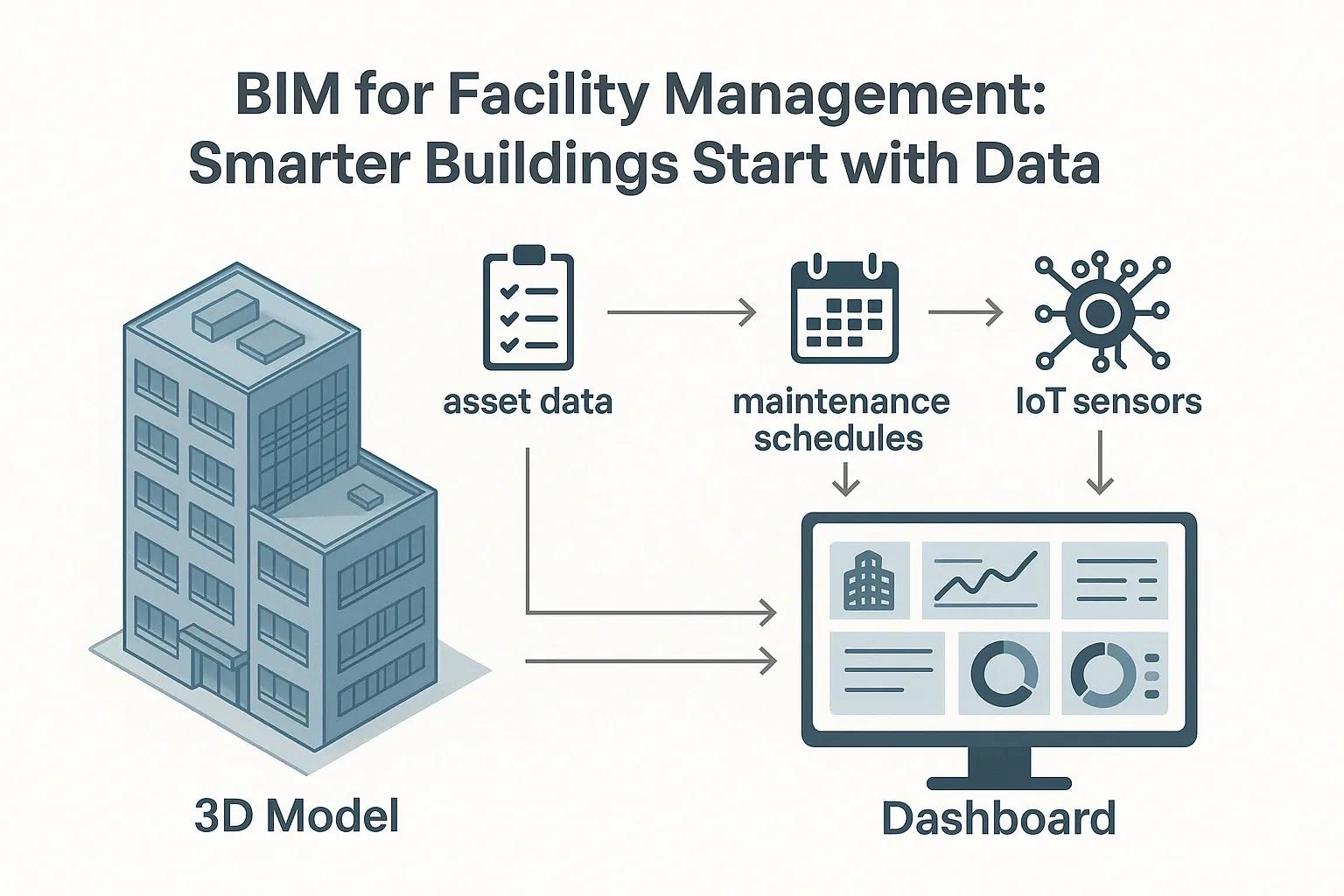
Building Information Modeling (BIM) has evolved far beyond its initial use in design and construction. Today, BIM is an integral component of facility management (FM), offering data-driven solutions for asset tracking, maintenance scheduling, energy optimization, and lifecycle planning. With facility operations accounting for 70–80% of a building’s total cost over its lifespan, leveraging BIM post-construction has become a strategic priority for building owners and operators.
This article explores how BIM empowers smarter facility management by centralizing building data, reducing operational downtime, and improving decision-making.
The Shift Toward Data-Centric Facility Management
Traditionally, facility management relied on paper-based records, spreadsheets, and disconnected systems for asset tracking and maintenance. This fragmented approach often led to inefficiencies, high downtime, and reactive maintenance practices.
BIM transforms this model by offering a unified, digital representation of a building’s physical and functional characteristics. From HVAC systems to lighting, elevators to security infrastructure, every component can be modeled, tagged, and linked to metadata within a Common Data Environment (CDE).
As industries adopt Industry 4.0 principles, BIM integrates with IoT, AI, and cloud platforms to form a data-rich ecosystem. These integrations enable real-time monitoring, predictive analytics, and automated workflows, laying the foundation for smart, responsive buildings.
Key Benefits of BIM in Facility Management
Centralized Asset Information Every element in a BIM model is associated with detailed asset data, manufacturer, serial number, service history, maintenance schedules, and warranty status. Facility managers no longer need to search through documents or conduct manual inspections. All asset data is available through a 3D interface or linked FM software.
Improved Maintenance Planning BIM supports preventive and predictive maintenance. For example, HVAC components linked to sensor data can alert managers before failure occurs. Scheduled tasks can be visualized and managed spatially, reducing guesswork and improving technician efficiency.
Reduced Downtime With real-time data and accurate as-built models, maintenance personnel can quickly locate and service equipment, minimizing disruption. In hospitals, airports, or data centers, where uptime is critical, BIM-integrated FM systems ensure smoother operations.
Lifecycle Cost Analysis BIM enables lifecycle tracking of all building components. Facility managers can simulate cost implications for replacement, retrofitting, or upgrades. This supports long-term capital planning and sustainability goals.
Integration with Building Automation Systems (BAS) BIM models can be connected with BMS/BAS platforms. Operators can control lighting, HVAC, or access control through BIM-based dashboards. Combined with IoT sensors, this facilitates condition-based maintenance and energy efficiency optimization.
Use Cases and Global Examples
Sydney Opera House, Australia One of the earliest adopters of BIM for operations. A detailed BIM model was developed to manage maintenance, preserve heritage elements, and optimize workflows. The model has helped the facilities team improve efficiency by 20% and cut down reactive maintenance requests.
Penn Medicine Pavilion, USA Penn Medicine embedded BIM into their facility management strategy by integrating Autodesk Revit models with FM software (Archibus). The model includes 3D asset data linked with room IDs, enabling precise service tracking across 1.5 million square feet.
Heathrow Airport Terminal 5, UK Heathrow uses BIM for complex asset management across terminals. Integrated with Maximo and IoT devices, the system helps monitor over 200,000 assets. BIM improves the turnaround time for maintenance and supports continuous operations in one of the world’s busiest airports.
Infosys Smart Campus, India Infosys implemented BIM for managing its high-tech buildings. Using BIM integrated with IoT and SCADA systems, energy usage, water systems, and facility access are monitored in real-time. This supports ESG targets, energy savings, and predictive infrastructure upkeep.
Emerging Technologies Amplifying BIM’s Value in FM
Digital Twins A digital twin extends BIM by incorporating live sensor data, enabling facility managers to monitor building performance continuously. For instance, vibration data from machinery can predict failures and alert maintenance teams well in advance.
AI and Predictive Analytics Machine learning models applied to BIM datasets can forecast equipment failures, energy consumption trends, or optimize cleaning schedules. AI algorithms help reduce unplanned downtime and extend asset life.
Augmented Reality (AR) and Virtual Reality (VR) Facility staff can wear AR headsets to visualize concealed MEP systems behind walls, improving accuracy in repair work. VR-based training environments built on BIM data can simulate maintenance procedures for complex systems.
Mobile BIM and Cloud Platforms With mobile access to BIM models, technicians can update asset status, upload images, or receive real-time instructions from the field. Cloud-based solutions allow centralized updates and integration with CAFM (Computer-Aided Facility Management) systems.
Challenges in Implementing BIM for FM
Despite its benefits, adoption is hindered by several challenges:
Data Handover Gaps : Often, BIM data created during construction isn't formatted or structured for FM use. This requires early collaboration between designers and facility managers.
Lack of Standards : Global inconsistencies in BIM FM standards make integration difficult. However, ISO 19650 and COBie are helping streamline handover processes.
Technology Integration : Legacy FM systems may not support BIM or lack APIs for seamless integration.
Training Needs : Facility staff may require upskilling to use BIM platforms effectively.
Addressing these barriers requires cross-functional coordination, defined BIM execution plans, and commitment from building owners to enforce digital delivery standards.
The Indian Context
In India, where smart city initiatives and large-scale infrastructure projects are gaining momentum, BIM-FM integration is still at a nascent stage. Government-backed projects like airports, metros, and government buildings are beginning to adopt BIM for lifecycle management.
Companies like DMRC (Delhi Metro Rail Corporation) have piloted BIM in O&M (Operations and Maintenance) activities, while campuses like Infosys and TCS are experimenting with BIM-IoT integration for energy optimization.
As India formalizes BIM mandates (e.g., by CPWD, NHAI), facility managers will increasingly require BIM-ready data to align with GRIHA, IGBC, and Smart City KPIs.
Conclusion
Facility management is undergoing a digital transformation, and BIM lies at the core of this shift. Moving beyond construction, BIM enables smarter buildings, data-driven operations that reduce costs, extend asset life, and enhance occupant experience.
For building owners, the path to operational efficiency, sustainability, and asset longevity begins with accurate, accessible data. As BIM integrates with IoT, AI, and digital twin technologies, it becomes a vital enabler of future-ready infrastructure.