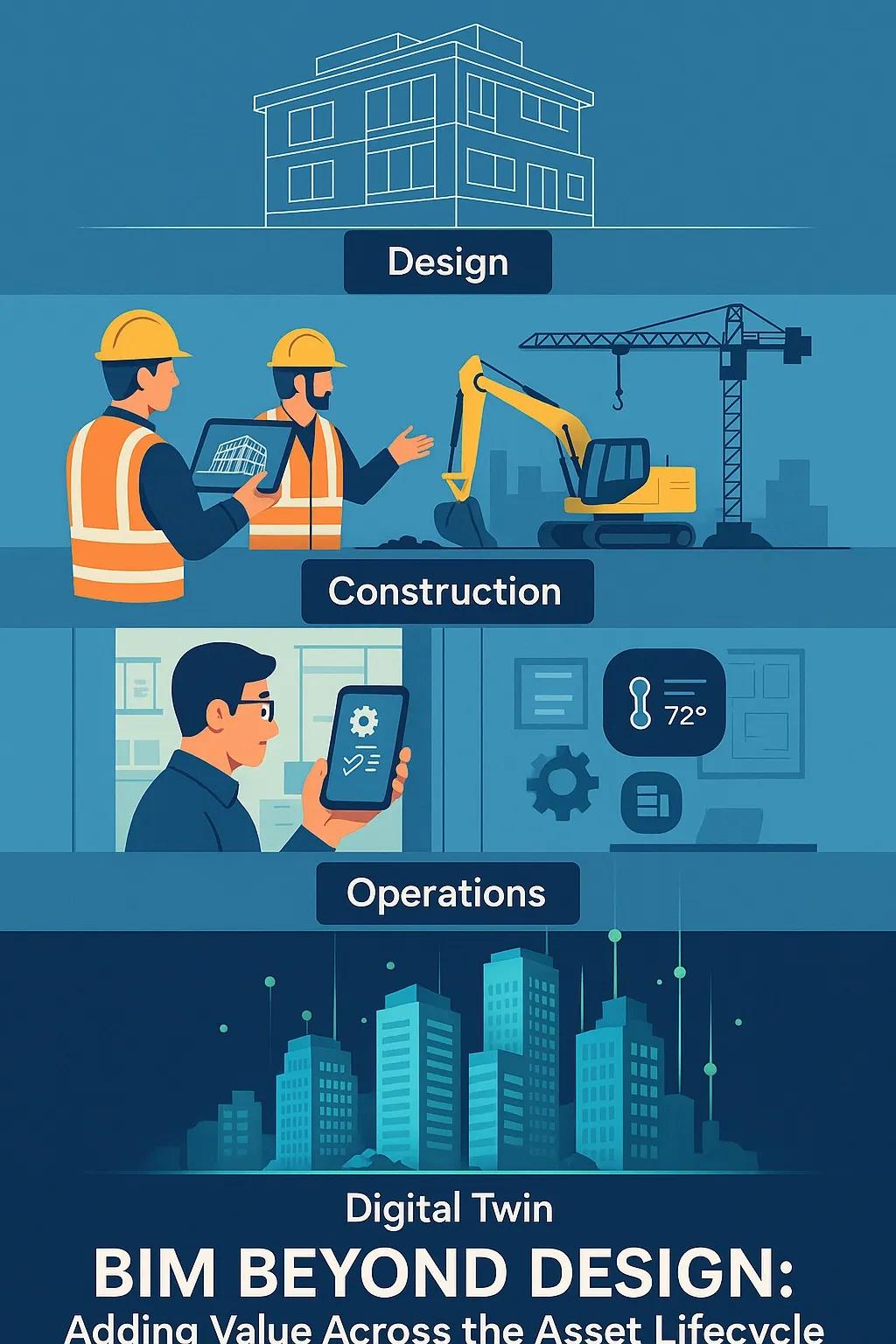
Building Information Modeling (BIM) has evolved far beyond its original use as a design coordination tool. Today, BIM serves as the backbone for managing information across the entire asset lifecycle, from early design stages to construction, operations, maintenance, and even integration with digital twin platforms.
In this article, we examine how BIM extends value post-design, particularly in construction execution, operational efficiency, and the digital twin ecosystem.
BIM in Construction: From Virtual Planning to Physical Execution
BIM’s impact during construction is profound. It shifts project delivery from fragmented, reactive processes to proactive, data-driven execution.
1. Clash Detection and Risk Mitigation Before construction begins, BIM enables multi-disciplinary model coordination, identifying clashes among structural, architectural, and MEP systems. This minimizes costly rework, reduces change orders, and ensures project timelines are met.
2. 4D Simulation for Sequencing and Logistics 4D BIM introduces the time dimension, linking construction tasks to the 3D model. Contractors can simulate construction sequences, optimize site logistics, anticipate resource bottlenecks, and enhance safety planning. This visualization improves stakeholder communication and enables real-time adjustments as site conditions evolve.
3. Quantity Take-Offs and Cost Control (5D BIM) By linking cost data to the model, BIM facilitates automated quantity take-offs and accurate cost estimation. This dynamic costing model allows project managers to assess the financial impact of design or scope changes instantly, promoting better budget adherence.
4. Prefabrication and Modular Construction BIM supports the precise design and manufacturing of prefabricated components. With model-based detailing, factories can produce modules with minimal errors, accelerating onsite assembly, lowering waste, and improving quality control.
5. Site Monitoring and Progress Tracking Through integration with UAVs, IoT sensors, and laser scanning, real-world progress can be compared against the BIM model. Deviations are identified early, allowing for corrective actions that prevent schedule drift.
BIM in Operations: Asset Management and Facilities Optimization
The value of BIM does not end once construction is complete. Owners and operators leverage BIM data for smarter, more efficient asset management.
1. Centralized Asset Information Repository The BIM model becomes the digital "source of truth" containing all building systems, components, and maintenance history. Facilities teams can access detailed specifications, warranty information, and operational manuals with a few clicks, reducing time spent on information retrieval.
2. Predictive Maintenance and Lifecycle Planning By combining BIM with sensor data from IoT devices, facility managers can monitor asset performance in real-time. Predictive analytics help forecast component failures, optimize maintenance schedules, and extend the lifespan of critical systems.
3. Space Utilization and Energy Optimization BIM models, linked with real-time occupancy and environmental data, enable dynamic space management. Facilities teams can adjust HVAC, lighting, and security systems based on usage patterns, improving energy efficiency and reducing operational costs.
4. Renovation and Retrofit Efficiency When buildings require upgrades or repurposing, the availability of an accurate as-built BIM model simplifies planning. Design teams can avoid intrusive surveys, quickly assess structural limitations, and propose interventions with minimal disruption to ongoing operations.
5. Compliance and Reporting BIM models facilitate easier compliance with safety, fire protection, accessibility, and sustainability regulations. Documentation needed for audits or certifications (like LEED or WELL) is streamlined through organized digital asset information.
BIM and Digital Twins: Bridging the Physical and Virtual Worlds
A digital twin is a dynamic, real-time digital replica of a physical asset. BIM forms the foundational dataset for developing effective digital twins.
1. BIM as the Core Data Structure Digital twins require a spatial framework to map real-world behaviors and states. BIM provides this spatial intelligence, including detailed geometry, systems relationships, and metadata necessary to anchor live sensor feeds to the virtual model.
2. Real-Time Data Integration When combined with IoT networks, AI algorithms, and cloud platforms, BIM models evolve into live digital twins. Data from HVAC systems, lighting, structural sensors, and occupancy trackers is visualized contextually within the 3D model, enabling real-time monitoring and simulation.
3. Scenario Simulation and Predictive Analysis With a digital twin, operators can simulate "what-if" scenarios, such as evaluating the impact of a new HVAC configuration or emergency evacuation routes under different conditions. These predictive capabilities drive more informed decision-making and proactive asset management.
4. Sustainability and Circular Economy Support Digital twins developed from BIM data allow tracking of resource consumption, carbon emissions, and material circularity throughout the asset’s life. Asset owners can plan for end-of-life recycling, refurbishment, or adaptive reuse, aligning with circular economy principles.
5. Urban-Scale Integration At a larger scale, federated BIM models contribute to city-wide digital twins. Urban planners can simulate infrastructure stress tests, emergency responses, and environmental impacts, fostering smarter, more resilient cities.
Challenges and Considerations
Despite the immense benefits, extending BIM beyond design requires careful planning and commitment.
Data Integrity : BIM models must be accurate, updated, and maintained post-construction to remain valuable during operations.
Standardization : Adopting standards like COBie (Construction-Operations Building information exchange) ensures that BIM data is structured for facilities management.
Technology Integration : Linking BIM with FM systems, IoT platforms, and analytics engines demands interoperability and cybersecurity readiness.
Change Management : Training facility teams to interact with BIM and digital twin tools is critical to realizing the full value.
Conclusion
BIM is no longer just a design tool. It is a strategic asset across the construction, operational, and digital lifecycle of buildings and infrastructure. By extending BIM into construction execution, facilities management, and digital twin development, owners and operators unlock significant value, optimizing costs, improving performance, extending asset life, and paving the way toward smarter, more sustainable environments.
Organizations that embrace BIM as a living resource, rather than a one-time deliverable, position themselves at the forefront of the next wave of built environment innovation.