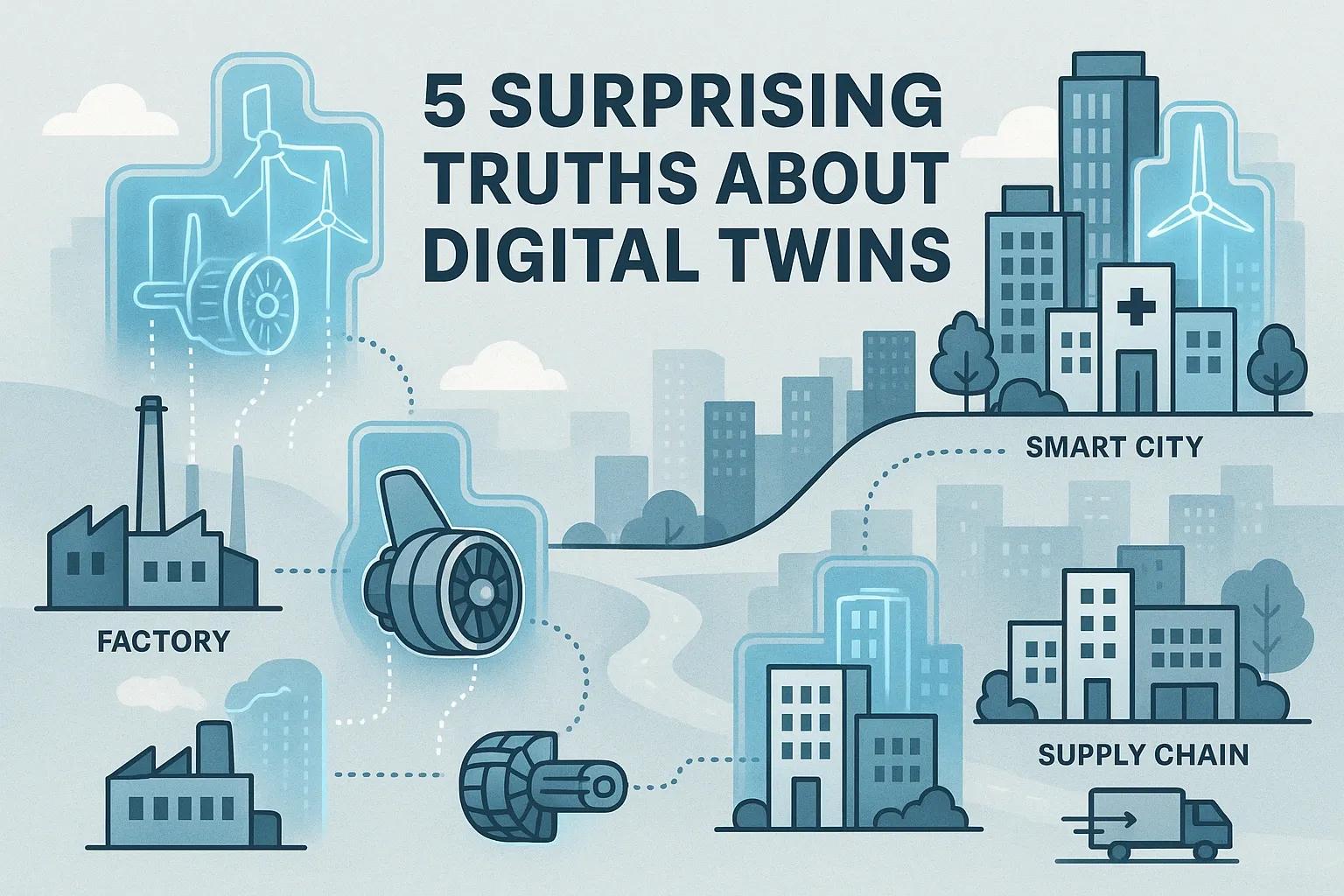
It’s nearly impossible to discuss the future of industry without hearing the term "Digital Twin." Often mentioned in the same breath as AI and Industry 4.0, it can sound like a concept pulled from science fiction, a perfect, living digital replica of a physical object or system.
But while the idea seems futuristic, its real-world applications have already moved from the laboratory to the front lines of business. Digital Twins are no longer theoretical; they are a cornerstone of modern strategy, delivering powerful and sometimes surprising results proven by hard data and tangible outcomes.
This article cuts through the noise to reveal five of the most impactful and counter-intuitive truths about what Digital Twins are, how they’re being used today, and where this transformative technology is headed next.
1. The Payback Isn't Just a Promise, It's Proven and Profitable
Unlike many emerging technologies that come with speculative promises of future value, Digital Twins are already delivering a clear and significant return on investment (ROI). The financial case has moved from the whiteboard to the balance sheet, backed by the experiences of companies that have already made the leap.
According to survey data from a Hexagon AB report covering 660 executives, the financial returns are not just positive, they are profound:
92% of companies tracking ROI see returns above 10% .
An impressive half of the companies reported returns exceeding 20% .
This strong performance is fueling a virtuous cycle of reinvestment. The same survey found that 74% of executives plan to increase their spending on Digital Twin technology. These hard numbers provide an undeniable business case, elevating the concept from an experimental technology to a strategic imperative for any organization aiming to maintain a competitive edge.
2. Not All 'Twins' Are Identical: The Critical Difference Between Virtual and Digital
As with any rapidly evolving technology, the vocabulary surrounding Digital Twins can be a minefield of jargon. One of the most common points of confusion is the distinction between a "Virtual Twin" and a "Digital Twin." While they sound interchangeable, they serve fundamentally different purposes, and knowing the difference is key to smart investment.
Virtual Twin: Think of this as a detailed simulation model used for exploration and testing in a virtual environment before a physical product or system exists. It’s a tool for asking "what-if," allowing engineers to test countless scenarios and optimize designs without real-world consequences. The data flow is primarily one-way, from designer to model.
Digital Twin: This is a dynamic, digital replica of an existing physical asset. Crucially, it is continuously updated with real-time data from IoT sensors, creating a live, two-way information flow. This constant connection allows for real-time monitoring, predictive analysis, and even remote control of the physical object.
The world of engineering offers a perfect illustration. Using a simulation to test various wind turbine designs under hypothetical weather conditions is the work of a Virtual Twin . In contrast, monitoring a real, operational wind turbine’s health and performance using live sensor data to proactively adjust its blade pitch is the job of a Digital Twin . Understanding this distinction is critical for applying the right technology to the right problem.
3. It's Still the Wild West: There Are No Universal Standards
Here is a paradox: despite the technology’s rapid adoption and proven ROI, the field is still in its infancy when it comes to formal standardization. This creates both a frontier for innovation and a significant challenge for widespread implementation.
Researchers from the University of Cambridge and the University of Oxford , after studying the landscape extensively, concluded that "there is no universally accepted definition of a digital twin, or standards for implementing it."
This lack of universal standards means organizations have the flexibility to pioneer new approaches tailored to their specific needs. However, it also highlights the challenges businesses face in ensuring interoperability, scalability, and long-term viability. It underscores the urgent need for a systematic methodology and careful strategic planning to ensure a successful implementation that can evolve as the technology, and the standards governing it, inevitably mature.
4. They Are Becoming Frighteningly Good at Predicting the Future
The true power of a Digital Twin isn’t just mirroring the present; it's about proactively predicting the future. By combining real-time sensor data with historical records and advanced machine learning, these models can forecast failures with remarkable accuracy, fundamentally transforming how industries approach maintenance and operations.
A case study of an industrial pump system reveals just how potent this predictive power is. The Digital Twin model was able to:
Predict failures with a 92% success rate .
Provide these warnings at least 2 hours before the failure occurred.
This proactive approach led to a 30% reduction in the mean time to repair.
This capability is the very essence of what a Digital Twin is designed to achieve, a fact captured perfectly in its formal definition:
"An integrated multiphysics, multiscale, probabilistic simulation of an as-built system, enabled by digital thread, that uses the best available models, sensor information, and input data to mirror and predict activities/performance over the life of its corresponding physical twin."
Ultimately, this predictive power shifts industrial maintenance from a reactive or scheduled process to a truly proactive and intelligent one, saving companies from costly downtime and extending the lifespan of their most critical assets.
5. They're Not Just for Jet Engines and Factories Anymore
While Digital Twins gained prominence in complex manufacturing and aerospace, their application is exploding into a surprisingly diverse range of sectors. The underlying principles of monitoring, simulating, and optimizing are universal, making the technology adaptable to almost any system imaginable.
One of the most compelling examples comes from smart city management. A city struggling with pollution and resource depletion implemented Digital Twin technology to transform its waste management system. The benefits were immediate and measurable:
Real-time monitoring of waste generation patterns across the city.
Dynamic routing of collection vehicles to optimize schedules and slash fuel consumption.
Analysis of recycling rates to identify areas needing better infrastructure or public education.
This is just one example of the technology's astonishing versatility. Digital Twins are now being used to optimize vast supply chains, design personalized healthcare treatments, and improve energy efficiency in facilities like Italian distilleries. It proves that the technology’s potential is not confined to the factory floor; its ability to model, understand, and improve any complex system is its most revolutionary feature.
Conclusion
Digital Twins have decisively moved beyond the buzzword phase. They are a practical, profitable, and remarkably versatile technology that is fundamentally reshaping how industries operate. From delivering proven financial returns and predicting failures with stunning accuracy to optimizing entire city services, they are creating a seamless, intelligent loop between the physical and digital worlds.