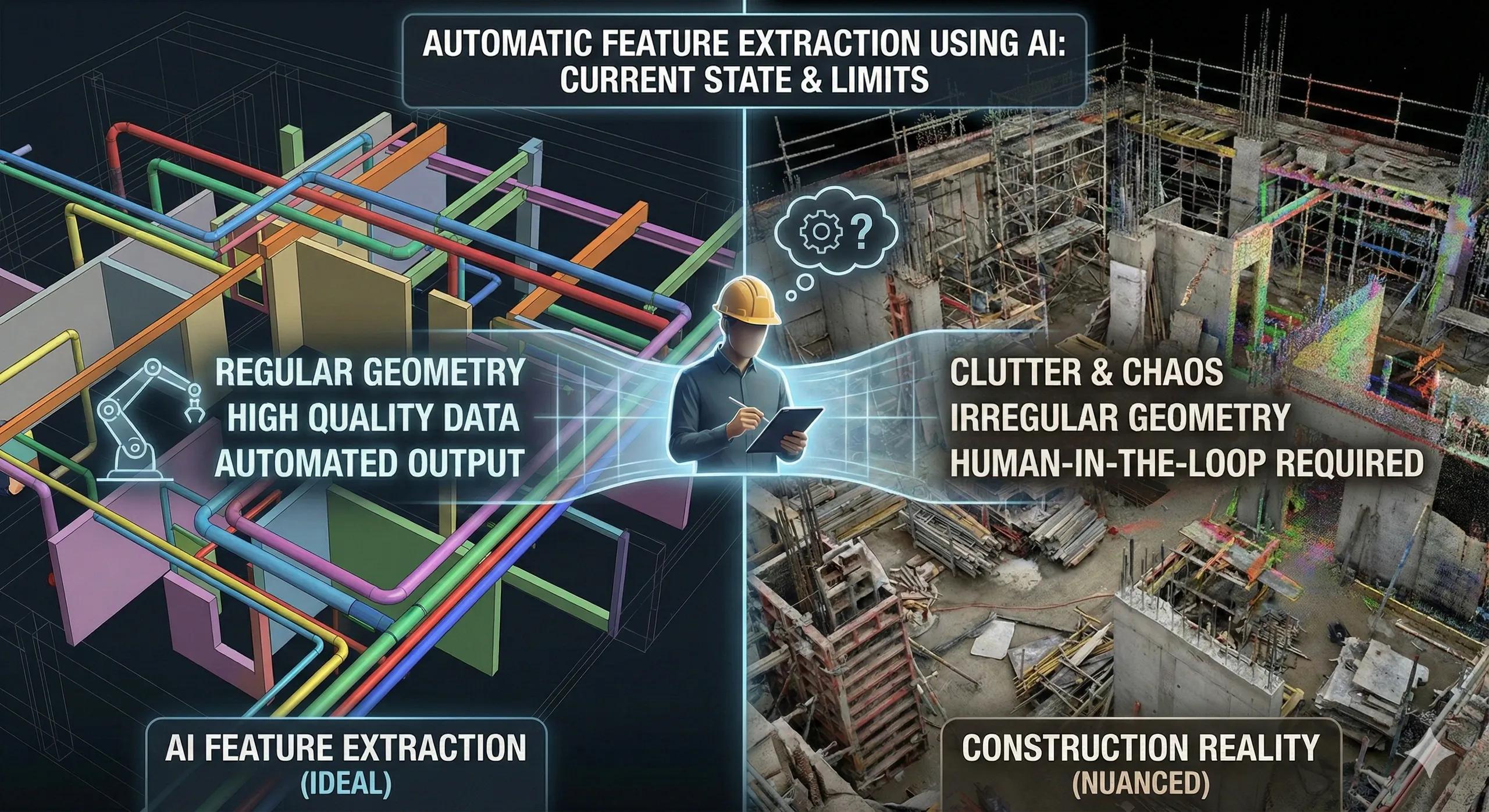
Automatic feature extraction from point clouds and reality data is one of the most talked-about promises in construction tech. Vendors often showcase AI that can “auto-detect walls, columns, pipes, and assets” and imply that Scan-to-BIM can now be fully automated.
The reality is more nuanced.
AI-based feature extraction does work , but only within well-defined boundaries. When expectations exceed those boundaries, projects end up with half-correct models, broken trust, and manual cleanup that costs more than traditional workflows.
This article explains the current state of AI-driven feature extraction , where it delivers real value today, and where its limits still matter in BIM-to-field execution.
1. What Automatic Feature Extraction Actually Means
At its core, AI feature extraction attempts to:
Segment point clouds into logical regions
Classify geometry into object types
Fit parametric shapes to detected features
Common outputs include:
Planar surfaces (floors, walls)
Linear elements (pipes, ducts, beams)
Repetitive assets (columns, poles, sleepers)
This is pattern recognition , not understanding intent.
2. Where AI Feature Extraction Works Well Today
AI performs reliably when three conditions are met:
a) Geometry Is Regular
Straight walls
Vertical columns
Cylindrical pipes
Flat slabs
Repetition improves confidence.
b) Data Quality Is High
Clean scans
Good density
Minimal noise
Consistent coverage
AI does not fix bad capture, it amplifies it.
c) Context Is Limited
Single discipline focus
Minimal clutter
Controlled environments
This is why AI performs best in:
Industrial plants
Data centers
Warehouses
Brownfield MEP-heavy sites
3. Where AI Still Struggles
Despite progress, AI extraction breaks down in common construction scenarios.
a) Temporary & Transitional Conditions
Scaffolding
Formwork
Partially installed systems
Construction clutter
AI cannot infer what is permanent .
b) Irregular or Deformed Geometry
Excavation surfaces
Legacy structures
As-built deviations
Poor workmanship realities
BIM expects idealization; AI sees chaos.
c) Multi-Trade Overlap
Dense MEP zones
Intersections
Congested shafts
Feature boundaries become ambiguous.
4. Classification ≠ Modeling
A critical misunderstanding:
Classifying a feature is not the same as modeling it.
AI may correctly label:
“This is a pipe”
But still fail to:
Assign correct system
Apply correct tolerance
Decide if it should be modeled at all
This decision still belongs to human intent .
5. The False Promise of ‘Fully Automated Scan-to-BIM’
End-to-end automation remains unrealistic because:
Construction intent changes weekly
Modeling rules vary by phase
Tolerances are decision-dependent
Governance cannot be inferred from geometry
AI does not know:
What will be demolished
What is provisional
What must survive handover
Automation without intent leads to false confidence .
6. Where AI Delivers Real Value Today
The most successful deployments use AI selectively :
Pre-classification to reduce manual effort
Candidate detection for reviewer approval
Repetitive asset identification
Change detection between time steps
Filtering noise and irrelevant geometry
Think AI-assisted , not AI-driven.
7. Human-in-the-Loop Is Not a Weakness
In construction, human review is not a failure of AI, it is a requirement.
Best workflows:
Let AI do 70–80% of the mechanical work
Keep humans responsible for: What to model What to ignore What tolerance applies
This balance delivers speed and trust.
8. Accuracy vs Semantic Risk
AI often achieves geometric accuracy while failing semantically.
Examples:
Correct pipe geometry, wrong system
Correct wall, wrong level
Correct object, wrong lifecycle relevance
Semantic errors are more dangerous than geometric ones in BIM.
9. India Context: Why Limits Matter More
Indian construction sites amplify AI challenges:
Higher clutter
Frequent design changes
Mixed construction quality
Temporary works dominating reality
Blind automation here leads to:
Excess cleanup
Poor adoption
Technology fatigue
AI must be context-aware and cost-aware to succeed.
10. A Practical Rule for Using AI Feature Extraction
Use AI extraction only when:
Geometry is repetitive
Capture quality is controlled
Modeling rules are pre-defined
Human validation is planned
Avoid AI extraction when:
Conditions are transitional
Decisions change weekly
Governance is unclear
Conclusion
AI-based feature extraction is not a silver bullet, but it is no longer a gimmick either.
Its real value lies in:
Reducing manual effort
Speeding up early stages
Supporting human decision-making
Its limits remind us of a core truth:
Scan-to-BIM is not a geometry problem. It is a decision problem.
Until AI understands construction intent, governance, and lifecycle priorities, it will remain a powerful assistant, not an autonomous modeler.