The increasing frequency and severity of natural disasters, particularly flooding, have become a global concern. While climate change is a significant contributor to this trend, human activities, such as rapid urbanization in flood-prone areas, are exacerbating the situation. A recent study published in the scientific journal Nature has shed light on this alarming trend, particularly in lower and middle-income countries. This article aims to delve into the key findings of this study, focusing on the escalating risks and the underlying causes.
Rapid Expansion in Flood-Prone Areas
One of the most striking findings of the study is the rapid rate at which human settlements are expanding in flood-prone areas. These settlements are growing at a pace that outstrips the average rate of urban development globally. This trend is not only alarming but also counterintuitive, given the increasing awareness of climate change and its impact on natural disasters like flooding.
The Role of Climate Change
Climate change is undeniably a significant factor that increases the risk of floods. Rising global temperatures lead to more extreme weather events, including heavy rainfall and storms, which in turn contribute to flooding. Despite this well-established fact, the study found that more people are choosing to live in high-risk flood areas, thereby increasing the likelihood of human and economic disasters.
Regional Focus: East Asia and the Pacific
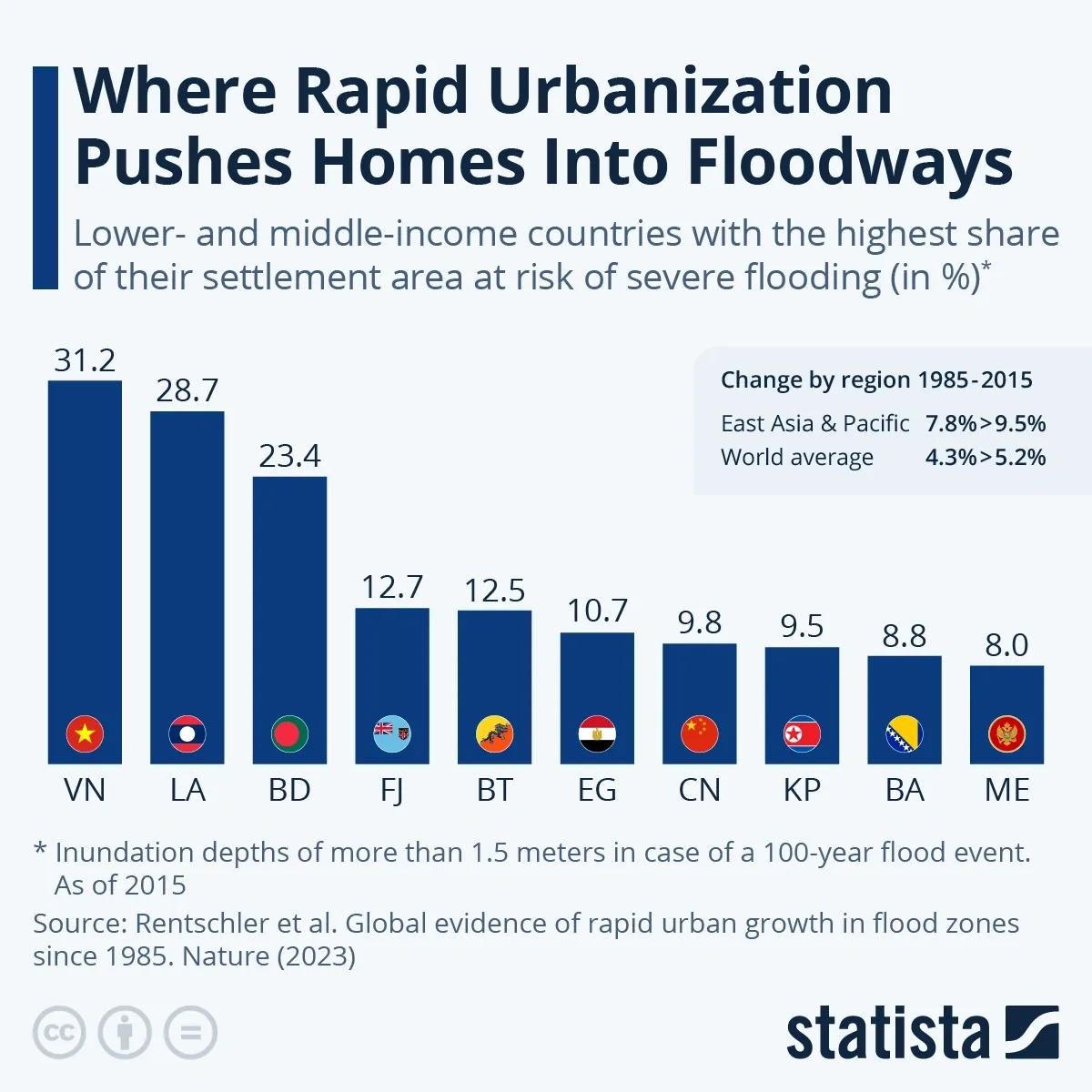
The region most affected by this trend is East Asia and the Pacific. Data from the study indicates that between 1985 and 2015, the share of settlements at risk of severe flooding in this region increased from 7.8% to 9.5%. This is a significant jump, especially considering that the region is already prone to natural disasters due to its geographical location.
Global Statistics and Countries Most at Risk
Globally, the study found that 5.2% of all human settlements are at risk of being inundated by more than 1.5 meters of water in the event of a 100-year flood. This is an increase from 4.3% in 1985. When we look at specific countries, Laos and Bangladesh have more than 20% of their settlements in extremely flood-prone areas. Vietnam is even more alarming, with upwards of 30% of its settlements in such high-risk zones. China also features in the list, with 9.8% of its settlements at risk, up from 8.1% in 1985.
Underlying Causes: Urban Planning and Land Scarcity
The study identifies a lack of urban planning and disaster awareness as one of the primary reasons for this increasing risk. In many lower and middle-income countries, rapid urbanization is often not accompanied by adequate planning, leading to settlements in high-risk areas. Land scarcity is another contributing factor. As cities grow and available land becomes limited, people are forced to settle in less-than-ideal locations, often ignoring the associated risks.
Economic Drivers
The pressure of rapidly growing cities attracting people in search of economic opportunities is another reason for this trend. The lure of better job prospects and improved living conditions often overshadows the inherent risks of living in flood-prone areas. This is particularly true in lower and middle-income countries, where economic considerations often take precedence over safety concerns.
Thought-Provoking Questions
Urban Planning and Disaster Awareness : How can GIS (Geographic Information Systems) and other geospatial technologies be leveraged to improve urban planning and raise disaster awareness?
Role of Climate Change : What adaptive measures can be implemented to mitigate the risks associated with climate change-induced flooding?
Economic Opportunities vs. Risks : How can governments and organizations strike a balance between economic development and risk mitigation?
In conclusion, the increasing risk of flooding in lower and middle-income countries is a complex issue with multiple contributing factors, including climate change, rapid urbanization, and inadequate urban planning. Addressing this issue requires a multi-faceted approach that involves better urban planning, increased disaster awareness, and adaptive measures to mitigate climate change impacts. Geospatial technologies can play a crucial role in risk assessment and planning, providing data-driven insights to make more informed decisions. As the study suggests, the time to act is now, before the risks become unmanageable disasters.
Reference
https://www.statista.com/chart/31037/lower--and-middle-income-countries-highest-share-of-settlement-risk-of-severe-flooding/?utm_source=Statista+Newsletters&utm_campaign=7b5347c83c-All_Camp_InfographTicker_Asia_PanAsia_00163&utm_medium=email&utm_term=0_662f7ed75e-7b5347c83c-351304766