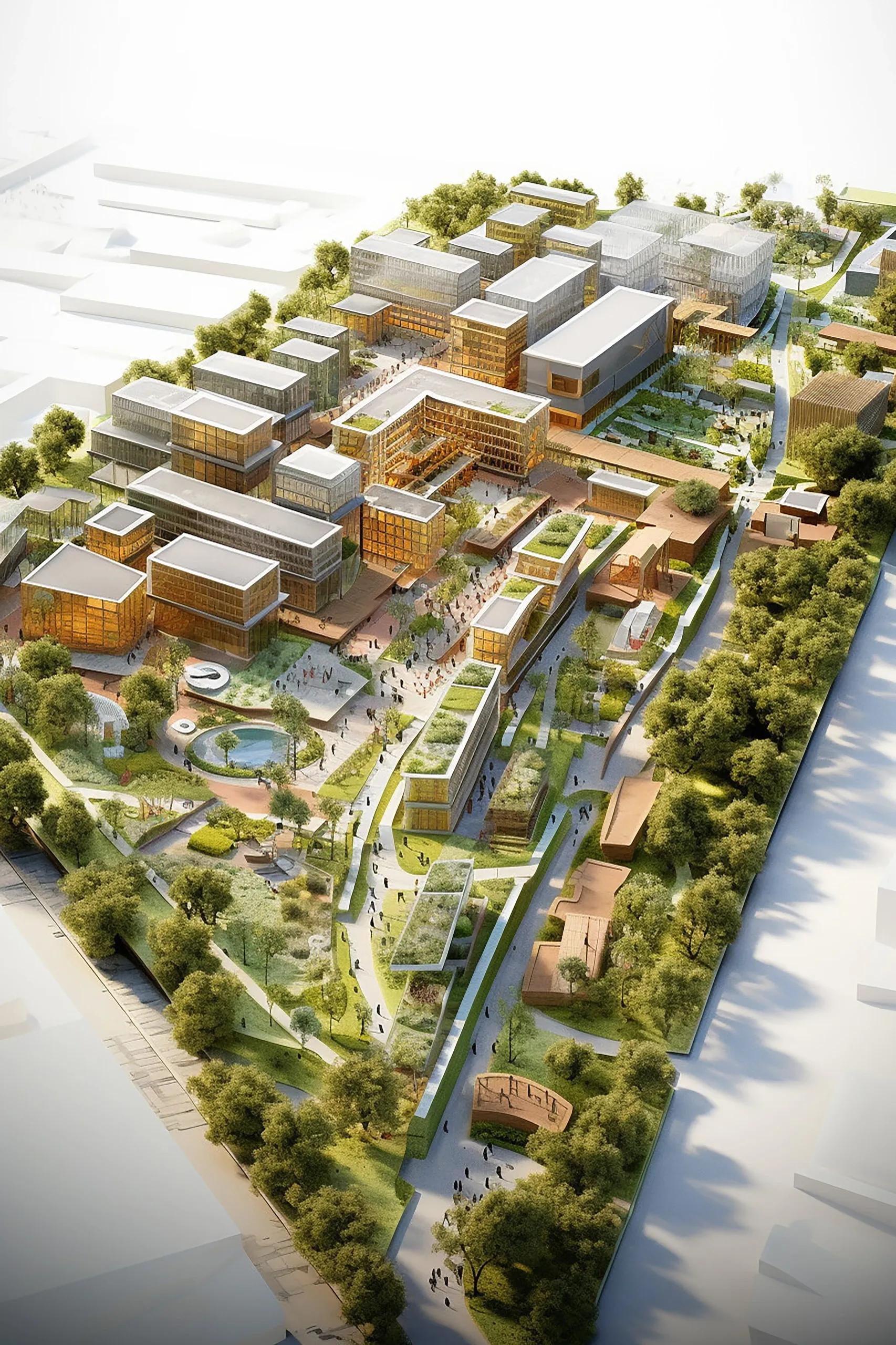
Urban planning is rapidly evolving, driven by the need to accommodate growing populations, optimize resource utilization, and enhance the quality of life in cities. The integration of digital technologies, particularly Artificial Intelligence (AI), has become a key component in modern urban development strategies. Among these technologies, large-scale digital twins—virtual replicas of physical environments, have emerged as powerful tools in simulating, analyzing, and optimizing urban systems. AI, with its data-driven capabilities, is revolutionizing the development and deployment of these digital twins, enabling urban planners to make informed decisions with unprecedented accuracy and foresight. This article explores how AI transforms large-scale digital twins in urban planning, addressing the challenges, technologies, and benefits involved.
Understanding Digital Twins in Urban Planning
Digital twins in urban planning are virtual models that replicate the physical characteristics of cities, including buildings, infrastructure, public spaces, and transportation networks. These models are created using a combination of geospatial data, sensor data, 3D modeling, and advanced simulation tools. The primary purpose of a digital twin is to provide city planners, engineers, and policymakers with a dynamic, real-time representation of urban systems that can be used for monitoring, analysis, and decision-making.
However, the complexity of urban environments makes it difficult to maintain accurate and real-time digital twin models without advanced computational tools. This is where AI steps in, bringing its capacity for data analysis, machine learning, and predictive modeling to significantly enhance the utility of digital twins in urban planning.
The Role of AI in Enhancing Digital Twins
AI is revolutionizing digital twins by addressing several key challenges associated with large-scale urban planning projects:
Data Management and Integration: Large-scale digital twins require massive amounts of data, including geospatial information, infrastructure specifications, environmental data, traffic patterns, and real-time sensor inputs. AI algorithms excel at aggregating and processing these vast data sets, ensuring seamless integration from various sources. AI-powered systems can automatically classify, organize, and tag incoming data, reducing the need for manual intervention and improving the efficiency of data management in urban planning projects.
Predictive Analytics for Urban Growth: One of the most critical applications of AI in digital twins is its predictive capabilities. AI can analyze historical data, current trends, and real-time inputs to forecast urban growth patterns, infrastructure demands, and potential bottlenecks. For example, AI models can predict how traffic congestion will evolve as population densities increase in certain areas, helping urban planners design infrastructure that can accommodate future demands. These predictive models are vital for long-term urban planning, allowing cities to adapt to changes in population, climate, and resource availability.
Optimization of Urban Infrastructure: AI-driven digital twins enable the optimization of urban infrastructure by simulating different scenarios and identifying the most efficient solutions. For instance, AI can simulate the impact of building new roads, bridges, or public transportation systems on traffic patterns and energy consumption. By running thousands of simulations in a short time, AI helps urban planners evaluate the best options for infrastructure development. This leads to cost savings, reduced environmental impact, and improved sustainability in urban projects.
Real-Time Monitoring and Adaptation: One of the significant advantages of digital twins is their ability to provide real-time monitoring of urban environments. AI enhances this capability by continuously analyzing real-time data from sensors, cameras, and IoT devices. In the case of traffic management, AI algorithms can detect congestion in real-time and suggest alternative routes to reduce traffic jams. Similarly, AI can monitor energy consumption in buildings and suggest energy-saving measures based on current conditions. This real-time feedback loop allows urban planners to make immediate adjustments and improve city operations.
Environmental Impact and Sustainability: AI-powered digital twins are increasingly being used to address environmental concerns in urban planning. Cities are under pressure to reduce their carbon footprints and adopt sustainable development practices. AI can model the environmental impact of urban infrastructure projects, such as how much CO2 will be emitted from new construction or how green spaces can be optimized to improve air quality. Furthermore, AI can optimize energy grids, water distribution networks, and waste management systems to minimize resource usage and environmental harm.
Disaster Preparedness and Risk Mitigation: Urban planning must account for natural disasters and other unforeseen events. AI is being used to enhance the predictive capabilities of digital twins in disaster management scenarios. For instance, AI models can simulate the impact of earthquakes, floods, or hurricanes on urban infrastructure. These simulations help city planners identify vulnerable areas and design infrastructure that can withstand such events. Additionally, AI can assist in emergency response planning by modeling evacuation routes and resource allocation during a disaster.
Enhancing Citizen Engagement: AI-powered digital twins are also being leveraged to improve citizen engagement in urban planning. AI-driven models can visualize proposed urban development projects in ways that are easily understood by the public. Through AI-enhanced simulations, citizens can explore how new developments will impact their neighborhoods, enabling more informed participation in decision-making processes. This fosters a collaborative approach to urban development, ensuring that the needs and concerns of the community are considered.
Key Technologies Driving AI-Enabled Digital Twins
Several cutting-edge AI technologies are integral to the development of digital twins in urban planning:
Machine Learning (ML): ML algorithms process vast amounts of data to identify patterns and make predictions. In urban planning, ML can predict traffic flow, energy consumption, and population growth, helping to optimize city infrastructure.
Natural Language Processing (NLP): NLP can analyze feedback from public forums, social media, and other communication channels, providing insights into citizen concerns and priorities for urban development.
Computer Vision: Computer vision technologies, combined with AI, enable the automated detection and mapping of urban features such as roads, buildings, and green spaces from satellite imagery or drone data. This helps create highly detailed and accurate digital twins.
Reinforcement Learning: This AI technique is used to optimize urban systems over time. For instance, reinforcement learning can improve traffic light systems, making them more responsive to real-time traffic conditions, reducing congestion and emissions.
Benefits of AI in Large-Scale Urban Planning
The integration of AI with digital twins offers several benefits for large-scale urban planning projects:
Improved Decision-Making: AI enhances decision-making processes by providing planners with accurate data-driven insights and predictive models. This helps cities make informed choices regarding infrastructure development, resource allocation, and environmental sustainability.
Cost and Time Efficiency: By automating data analysis, simulation, and scenario planning, AI reduces the time and cost associated with traditional urban planning methods. This allows for faster implementation of projects with greater accuracy.
Enhanced Resilience: AI-powered digital twins can predict and mitigate risks, ensuring that cities are better prepared for natural disasters and other emergencies. This enhances the overall resilience of urban environments.
Sustainability: AI enables cities to optimize resource usage, reduce energy consumption, and minimize environmental impact. This contributes to the development of sustainable urban environments that prioritize the well-being of both citizens and the planet.
In conclusion, AI is undeniably revolutionizing large-scale digital twins in urban planning by offering advanced data analytics, real-time monitoring, predictive modeling, and optimization capabilities. As cities continue to grow and evolve, the role of AI in digital twins will become even more critical, enabling urban planners to design smarter, more resilient, and sustainable cities for the future. The seamless integration of AI into digital twins marks a significant leap forward in how urban environments are planned, managed, and optimized, laying the foundation for the cities of tomorrow.