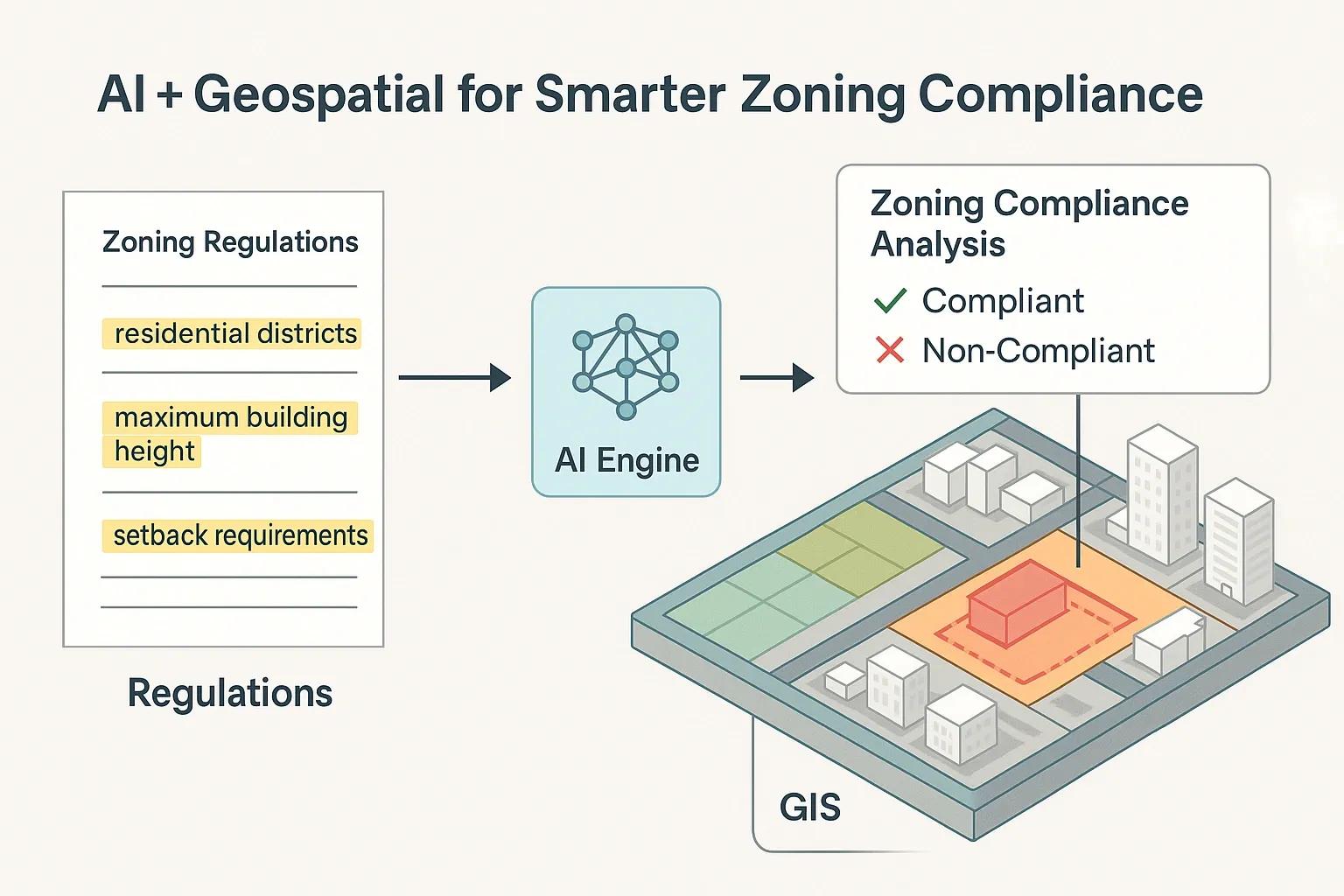
The construction industry is highly regulated, with numerous zoning laws, building codes, environmental regulations, and permit requirements that vary by jurisdiction. Ensuring compliance with these legal frameworks is essential not only for avoiding penalties and project delays but also for ensuring safe, sustainable development. Traditionally, legal compliance mapping has been a manual, resource-intensive task, relying heavily on human interpretation of zoning maps and legal documents.
With the advent of Artificial Intelligence (AI) and the integration of geospatial data, a new paradigm is emerging, automated legal compliance mapping. By leveraging AI algorithms, especially those based on natural language processing (NLP), computer vision, and machine learning (ML), combined with geographic information systems (GIS), the construction industry can now streamline the compliance review process, minimize risks, and accelerate planning approvals.
1. Understanding Legal Compliance Mapping in Construction
Legal compliance mapping in construction involves analyzing various regulations, zoning restrictions, land-use codes, setback requirements, height limitations, environmental protection zones, floodplain boundaries, and more, to determine whether a proposed development plan aligns with local and national laws.
Traditionally, planners and legal consultants manually extract zoning information from municipal codes, overlay it on GIS-based maps, and assess whether proposed designs fit within permissible land-use categories. This process is time-consuming and prone to interpretation errors, particularly when regulations are complex or ambiguous.
2. The Role of AI in Automating Compliance
AI enables automation of legal compliance mapping by mimicking human reasoning in interpreting rules, understanding natural language in legal texts, and recognizing spatial patterns. Below are the key AI technologies driving this transformation:
a. Natural Language Processing (NLP)
Zoning regulations are usually written in legal language that needs interpretation. NLP models can be trained to extract rules from zoning ordinances and convert them into structured data. For example:
Identifying permitted land uses per zone.
Parsing rules on building height, Floor Area Ratio (FAR), and setback distances.
Tagging conditional use requirements.
b. Machine Learning and Rule-Based Systems
ML models can classify land parcels based on historical land-use decisions and predict the likelihood of approval based on previous cases. Rule-based AI engines can apply parsed regulations to proposed building parameters to detect violations or flag inconsistencies.
c. Computer Vision with Geospatial Integration
Using satellite imagery and drone data, computer vision models can detect existing land features, water bodies, vegetation, slope, existing structures, and align them with legal overlays such as protected zones or environmental buffers.
3. Workflow: How AI-Driven Legal Compliance Mapping Works
The AI-driven workflow typically follows these stages:
Data Ingestion Collect zoning maps, legal codes, land-use plans, satellite imagery, and topographic data. Integrate structured GIS datasets (parcel maps, utility networks) and unstructured documents (PDFs, scanned maps).
Legal Text Parsing (NLP) Use NLP algorithms to convert text from zoning regulations into machine-readable rules. Classify zoning codes and associate them with geographical areas.
Geospatial Analysis and Overlay GIS tools overlay zoning boundaries with proposed construction footprints. AI flags mismatches (e.g., residential construction proposed in industrial zones).
Automated Reasoning and Violation Detection AI applies zoning rules to spatial data. Highlights potential violations: height exceeding permissible limits, encroachments into green zones, improper setbacks, or building in flood-prone areas.
Visualization and Reporting Generates automated reports with mapped violations and compliance checks. Provides “compliance scorecards” for each proposed project.
4. Real-World Applications and Examples
a. City-Scale Zoning Intelligence Platforms
In cities like Singapore, New York, and Amsterdam, AI-based zoning platforms are being developed to assist planners and developers in quickly assessing legal feasibility. These platforms provide interactive maps where users can select a plot and instantly receive a summary of applicable codes and a compliance score for proposed projects.
b. Permit Approval Acceleration
Some municipal planning departments now use AI-based compliance engines during the permit application stage. These systems cross-reference submitted blueprints with zoning and building codes, accelerating approval from weeks to days.
c. Construction Monitoring and Enforcement
By integrating drone surveillance and AI, local governments can detect unpermitted construction, boundary encroachments, or violations of green zone regulations in real-time. This improves enforcement and reduces regulatory blind spots.
5. Benefits of AI in Legal Compliance Mapping
Benefit - Impact
Speed and Efficiency - Cuts down regulatory review from weeks to days
Accuracy and Consistency - Minimizes human interpretation errors
Cost Reduction - Reduces dependence on legal consultants and manual compliance checks
Risk Mitigation - Early detection of violations prevents costly rework or penalties
Transparency and Audit Trail - AI-generated reports create traceable records for due diligence
Scalability - Easily applied to new jurisdictions and evolving regulations
6. Challenges and Limitations
Despite its advantages, the implementation of AI for legal compliance in construction has challenges:
Data Standardization : Regulatory data formats vary widely across jurisdictions. Lack of standardized zoning documentation makes parsing difficult.
Model Generalization : NLP models trained on one jurisdiction’s legal texts may not transfer well to another.
Interpretation Ambiguities : Some zoning rules require subjective interpretation or discretionary review, which is hard to encode in algorithms.
Data Privacy and Governance : Use of real-time imagery and land records must comply with privacy laws like India’s Digital Personal Data Protection Act or the EU’s GDPR .
To mitigate these, AI models should be combined with human oversight, and regulatory bodies must work toward digitizing and standardizing zoning information.
7. The Indian Context and Emerging Opportunities
India's rapid urbanization and smart city initiatives present a unique opportunity to adopt AI-based compliance tools. Many municipal bodies are digitizing their Master Plans and integrating GIS into Urban Local Bodies (ULBs). The National Urban Digital Mission (NUDM) provides a framework to build platforms that can host AI zoning engines for faster approval of housing, infrastructure, and commercial projects.
Startups and geospatial companies can build APIs and compliance engines that plug into these digital platforms, providing value-added services for architects, civil engineers, and legal consultants. AI can also assist in harmonizing discrepancies between Development Control Regulations (DCRs) and on-ground realities, which are common in Tier-II and Tier-III cities.
8. Future Outlook
As AI models mature and zoning regulations become more digitized, compliance mapping will become a standard component of the pre-construction workflow. Integrating this with Building Information Modeling (BIM) can further automate the design-validation process, where building plans are instantly assessed against legal boundaries in real-time.
With 3D GIS and AI-powered regulation engines, the future may see an interactive design environment where architects receive real-time feedback on zoning compliance as they draft, allowing for legal feasibility to be baked into the design process from the start.
Conclusion
AI in legal compliance mapping is transforming how the construction industry navigates the complex regulatory landscape. By combining geospatial intelligence with advanced machine learning, it is now possible to automate zoning interpretation, flag legal risks early, and reduce project uncertainty. While technical and institutional challenges remain, the benefits in terms of speed, transparency, and scalability make AI a powerful enabler for future-ready construction planning.
As cities continue to grow, automating compliance checks will not only streamline development but also ensure that urban expansion happens within the boundaries of law and sustainability.