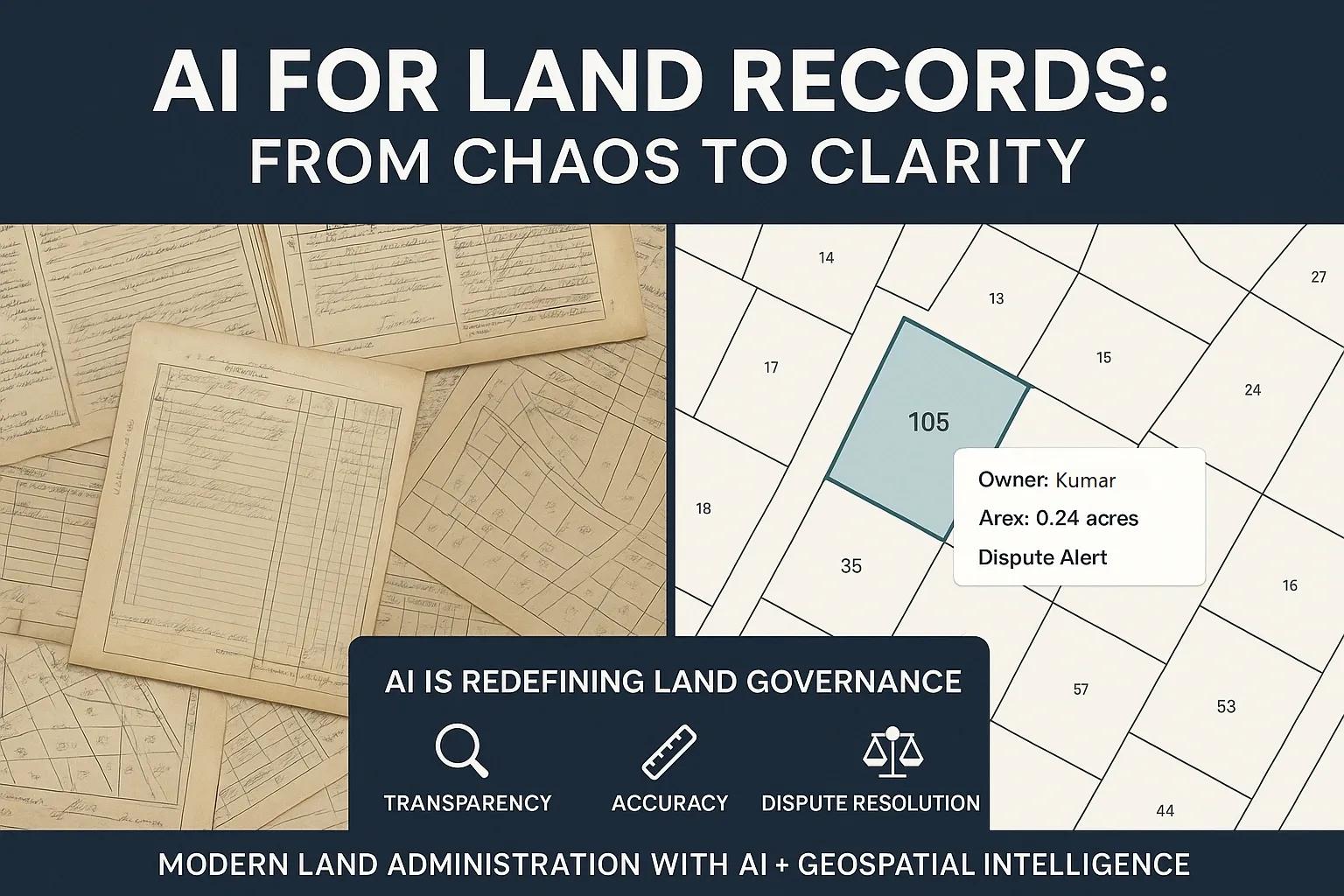
Modernizing land records is a critical task for any country aiming to streamline governance, improve citizen services, and enable secure investments. In many parts of the world, especially in developing economies like India, the challenge of outdated, fragmented, and often manually maintained land records has been a long-standing barrier to equitable land use and efficient administration. The introduction of Artificial Intelligence (AI) into land records modernization is significantly changing this scenario by enabling digital precision, real-time verification, predictive analytics, and proactive governance.
This article explores how AI technologies are being integrated into land governance systems, improving transparency, accuracy, and dispute resolution.
1. The Legacy Problem: Fragmented and Unreliable Land Records
Land records in many regions are maintained across multiple government departments, revenue, registration, municipal, and forest departments, often resulting in data inconsistencies, duplication, and human error. Manual interventions and lack of data integration lead to opaque land transactions, encroachments, and legal disputes. Moreover, inheritance updates, transfers, and changes in land use are not regularly captured, leaving millions of records outdated or unclear.
2. Role of AI in Land Records Modernization
AI enables land governance systems to evolve from static databases into dynamic, intelligent platforms that continuously update, validate, and learn. Here’s how AI is driving the transformation:
3. AI-Powered Data Digitization and Extraction
Legacy documents, property deeds, cadastral maps, sale agreements, and mutation records, are typically paper-based and often degraded. AI techniques such as:
Optical Character Recognition (OCR) ,
Natural Language Processing (NLP) , and
Image Recognition
are used to digitize and extract relevant data, even from low-quality scanned images. AI can identify names, locations, area measurements, boundary descriptions, and transaction details automatically, reducing manual errors and speeding up digitization.
Example: In India’s Digital India Land Records Modernization Programme (DILRMP), OCR and NLP are being applied to scan and extract structured data from millions of handwritten land records.
4. Detecting Anomalies and Duplicate Records
AI algorithms can perform pattern recognition to identify discrepancies in land ownership, overlapping boundaries, or duplicate property IDs across departments. By integrating datasets such as registration data, cadastral maps, and survey records, machine learning models can flag inconsistencies and suggest probable corrections.
Benefit: This ensures data integrity and reduces manipulation or fraudulent claims.
5. AI for Geospatial Analysis and Boundary Detection
Geospatial intelligence plays a central role in land administration. When combined with AI, high-resolution satellite imagery, drone data, and GIS layers can be processed to:
Detect land encroachments,
Track changes in land use over time,
Automatically delineate property boundaries, and
Validate ground realities with official records.
Computer vision algorithms analyze satellite or drone imagery to detect physical changes or inconsistencies in plot dimensions, enabling proactive interventions.
Example: AI-powered geospatial platforms are being tested in several Indian states to identify illegal construction or encroachment on government land using satellite data.
6. Intelligent Search and Query Resolution
AI-driven platforms allow citizens and officials to perform intelligent searches across digitized records using partial inputs, phonetic spellings, or vernacular language support. NLP enables the system to understand queries such as:
“Show ownership history for plot X,”
“Locate unregistered plots in district Y,” or
“Find land records under dispute in area Z.”
This reduces reliance on manual clerical staff, minimizes corruption, and empowers users with real-time access to information.
7. Predictive Analytics for Dispute Resolution
AI models can assess historical patterns in land-related disputes and predict areas with high probability of litigation or conflict. Factors considered include:
Frequency of past disputes,
Changes in ownership,
Boundary overlap issues, and
Delays in mutation or registration.
This insight enables authorities to proactively mediate and implement preventive governance strategies, such as targeted awareness campaigns or focused audits.
8. Automation of Mutation and Registration Processes
Using AI to track and validate land transactions, mutation processes (change of title) can be automated. Smart contracts and blockchain integration further enhance this by ensuring immutability and traceability of ownership history.
AI can also trigger automatic mutation workflows post-sale deed registration or inheritance events by linking with civil registry and revenue systems.
Impact: Reduces delays, minimizes corruption, and builds trust in the system.
9. AI in Land Valuation and Taxation
AI models analyze multiple parameters, market rates, location, proximity to infrastructure, usage type, and historical transactions, to generate dynamic property valuations. These valuations can support fair taxation, eliminate arbitrary assessments, and help both citizens and authorities make informed decisions.
10. Addressing Inclusivity and Language Diversity
In multilingual societies, AI-powered NLP tools support land record access and query handling in multiple local languages. Voice-based interfaces and chatbots trained on domain-specific language models can further assist semi-literate users in navigating the land record systems.
Example: AI chatbots in Indian languages like Telugu, Hindi, and Marathi help farmers check land ownership or mutation status using simple spoken commands.
11. Challenges in Implementation
While AI holds great promise, several challenges remain:
Data Quality: Inconsistent, outdated, or missing data can affect AI model accuracy.
Infrastructure: Many rural areas lack internet connectivity or digital access.
Capacity Building: Training government staff to understand and use AI tools is crucial.
Privacy and Ethics: Land data involves sensitive ownership information; AI use must adhere to data protection laws, such as India’s Digital Personal Data Protection Bill, 2023.
Resistance to Change: Institutional inertia and vested interests can delay adoption.
12. Future Outlook
AI will play a central role in the next phase of e-Governance reforms. As land becomes a core economic asset for citizens, businesses, and governments, the demand for transparent, accessible, and tamper-proof land records will grow. Upcoming trends include:
Blockchain-AI Integration for immutable transaction records,
AI-enabled Drone Mapping for real-time boundary updates,
Digital Twin Models of land parcels for urban planning and development, and
AI-driven Decision Support Systems for policy makers.
Conclusion
Artificial Intelligence is not a silver bullet, but it is undoubtedly a powerful enabler for land records modernization. By automating processes, reducing manual errors, enhancing access, and proactively managing disputes, AI is helping build a transparent, efficient, and citizen-centric land governance system. Governments must combine technological innovation with policy support, infrastructure development, and stakeholder training to realize the full potential of AI in this domain.
As the world moves towards smarter governance, integrating AI in land administration is not just an option, it’s an imperative.