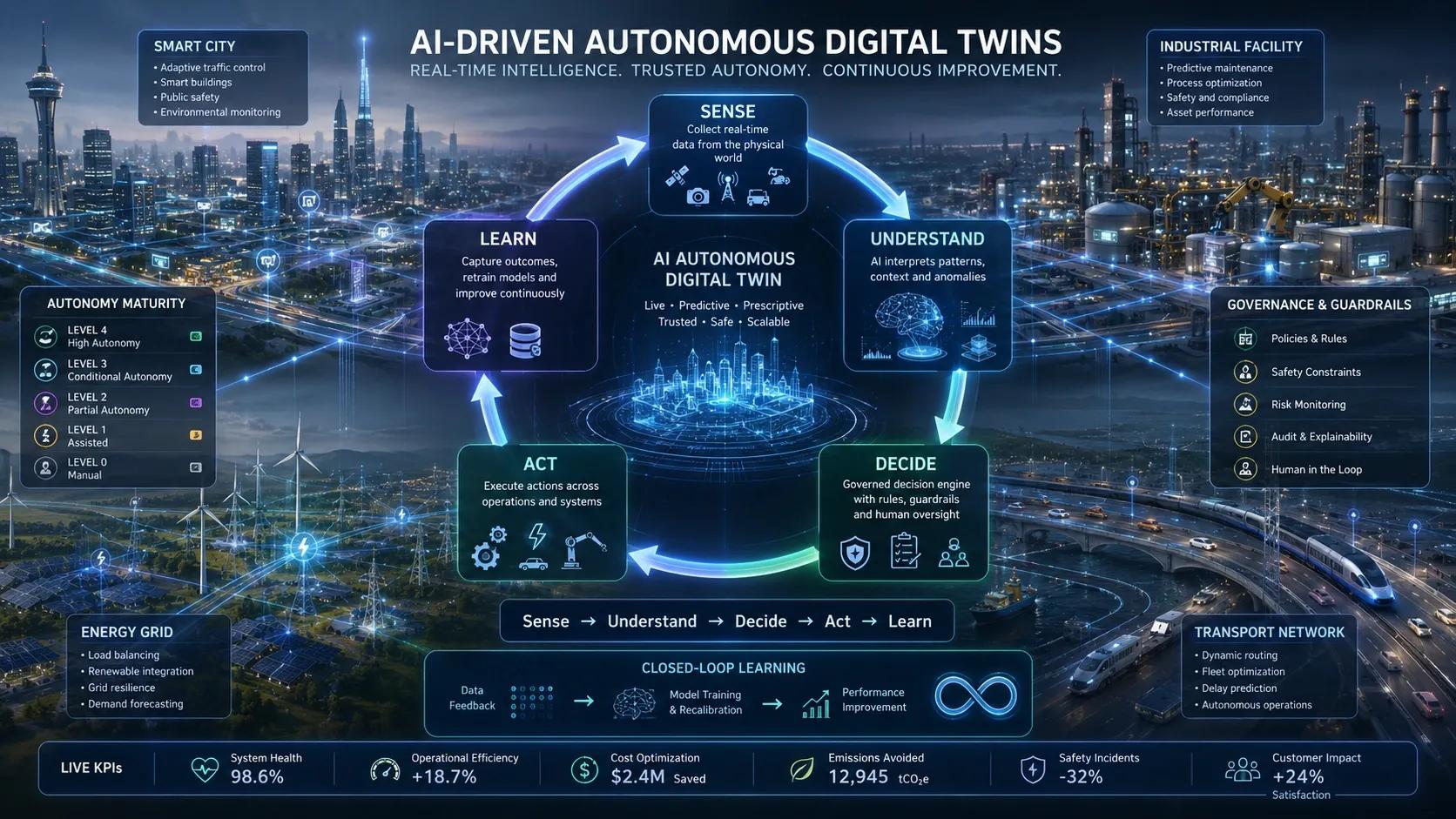
The next generation of Digital Twins will not only show what is happening.
They will decide, act, and learn within defined boundaries.
Introduction: Phase 5 Begins
Over the last 50 days, we explored the full Digital Twin journey:
fundamentals and misconceptions
architecture and technology stack
sector-specific applications
KPIs, ROI, adoption, governance, and operations
One clear message emerged:
👉 Digital Twins create value only when they move from visibility to decisions.
Now we enter:
PHASE 5: Future & Strategic Direction
The goal of this phase is to look ahead.
Not just at what Digital Twins are today, but what they are becoming.
And the first major shift is:
AI-Driven Autonomous Digital Twins
This is where Digital Twins move beyond:
monitoring
prediction
recommendation
toward:
👉 controlled autonomy
What Is an AI-Driven Autonomous Digital Twin?
An AI-driven autonomous Digital Twin is a system that can:
sense real-world conditions
understand operational context
predict outcomes
recommend decisions
trigger actions
learn from results
with limited human intervention.
But autonomy does not mean uncontrolled automation.
In mature systems, autonomy must operate within:
governance rules
safety limits
business priorities
compliance boundaries
human oversight
The goal is not to remove humans.
The goal is to reduce delays between:
👉 signal → decision → action
The Core Shift: From Decision Support to Decision Execution
Most Digital Twins today support decisions.
They help people understand:
what is happening
what may happen
what risks are emerging
But autonomous Digital Twins go further.
They begin to act on predefined logic.
For example:
adjusting HVAC based on occupancy
rerouting logistics based on congestion
triggering maintenance work orders
balancing energy loads
modifying production schedules
activating flood warning protocols
This is the shift from:
👉 decision support
To
👉 decision execution
Why Autonomy Matters
Operations are becoming faster, more complex, and more distributed.
Human teams cannot manually evaluate every signal in real time.
In large systems such as:
smart cities
ports
power plants
factories
railways
telecom networks
disaster response systems
thousands of events happen continuously.
If every decision waits for manual review:
👉 the system becomes reactive.
Autonomous Digital Twins reduce this delay by allowing systems to act within approved boundaries.
The Autonomy Maturity Curve
Autonomous Digital Twins will not appear fully formed.
They evolve through levels.
Level 1: Monitoring
The system shows what is happening.
Example:
dashboard displays equipment temperature.
Level 2: Prediction
The system predicts what may happen.
Example:
equipment may fail within 72 hours.
Level 3: Recommendation
The system suggests what should happen next.
Example:
schedule maintenance during low-load window.
Level 4: Assisted Execution
The system triggers a workflow but requires human approval.
Example:
work order is created and sent for supervisor approval.
Level 5: Controlled Autonomy
The system executes approved actions automatically within defined rules.
Example:
HVAC adjusts automatically
load balancing happens instantly
logistics rerouting is triggered
alerts and response workflows activate
This is where Digital Twins become operationally autonomous.
What Makes Autonomy Possible?
Autonomous Digital Twins require more than AI.
They need a strong foundation.
1. Trusted Data
Autonomy fails if data is unreliable.
The system must know:
what data is valid
where it came from
when it was updated
whether it can be trusted
Without trusted data:
👉 autonomy becomes dangerous.
2. Clear Decision Rules
AI may identify patterns.
But operational action requires rules.
For example:
when can the system act automatically?
when is human approval needed?
what thresholds trigger escalation?
what actions are restricted?
Autonomy needs boundaries.
3. Workflow Integration
An autonomous system must connect with:
ERP
CMMS
SCADA
GIS
field apps
control systems
Otherwise, decisions remain trapped inside the Digital Twin.
4. Feedback Loops
Every action must create learning.
The system should understand:
what action was taken
whether it worked
what outcome occurred
how future decisions should improve
This is how autonomy becomes adaptive.
5. Governance and Human Oversight
Autonomy without governance creates risk.
Human oversight remains essential for:
exceptions
ethical decisions
safety-critical actions
regulatory compliance
strategic judgment
The future is not human vs machine.
It is:
👉 humans defining boundaries,
👉 AI operating within them.
Practical Example: Smart Manufacturing
A factory Digital Twin detects that one machine is likely to fail.
A traditional system:
shows alert
waits for review
depends on manual action
An AI-driven autonomous Digital Twin:
checks production schedule
verifies spare part availability
identifies maintenance window
creates work order
assigns technician
updates production sequence
learns from the outcome
The human may approve the action at first.
Over time, low-risk repetitive actions can become autonomous.
That is how operational intelligence matures.
Where Autonomous Digital Twins Can Create Value
1. Infrastructure
automatic maintenance prioritization
traffic signal optimization
flood response workflows
2. Manufacturing
production schedule adjustment
machine health intervention
quality control optimization
3. Energy
load balancing
renewable forecasting
demand-response automation
4. Facilities
energy optimization
occupancy-based control
predictive maintenance
5. Logistics
route optimization
warehouse load balancing
delivery rescheduling
The Risks of Autonomous Digital Twins
Autonomy also introduces serious risks.
1. Bad Data, Fast Decisions
If the system acts on poor data:
👉 errors scale quickly.
2. Black-Box Decisions
If users cannot understand why the system acted:
👉 trust collapses.
3. Over-Automation
Not every decision should be automated.
Some decisions need human judgment.
4. Accountability Gaps
If the system acts incorrectly:
👉 who is responsible?
This is why autonomous Digital Twins need strong governance from the beginning.
The Key Question
The future is not:
👉 Can AI make decisions?
The real question is:
👉 Which decisions should AI be allowed to make?
That is the heart of autonomous Digital Twin strategy.
Indian Context
In India, autonomous Digital Twins can play a major role in:
smart infrastructure
industrial automation
power systems
transportation networks
water management
disaster response
But adoption must be gradual.
The immediate opportunity is not full autonomy.
It is:
👉 assisted autonomy.
Where systems recommend, trigger workflows, and support faster action while humans retain oversight.
This approach fits India’s operational reality:
diverse infrastructure maturity
legacy systems
high field dependency
regulatory complexity
need for trust-building
Controlled autonomy will be the practical path forward.
Benefits of AI-Driven Autonomous Digital Twins
reduced decision latency
faster response
improved asset performance
lower operational risk
continuous optimization
scalable decision-making
stronger resilience
Conclusion
AI-driven autonomous Digital Twins are not about replacing people.
They are about building systems that can:
👉 sense faster
👉 decide within rules
👉 act in time
👉 learn continuously
The future of Digital Twins will not be defined by better dashboards.
It will be defined by:
👉 trusted autonomy inside governed operational systems
That is where Digital Twins move from:
👉 representing reality
To
👉 actively improving it.