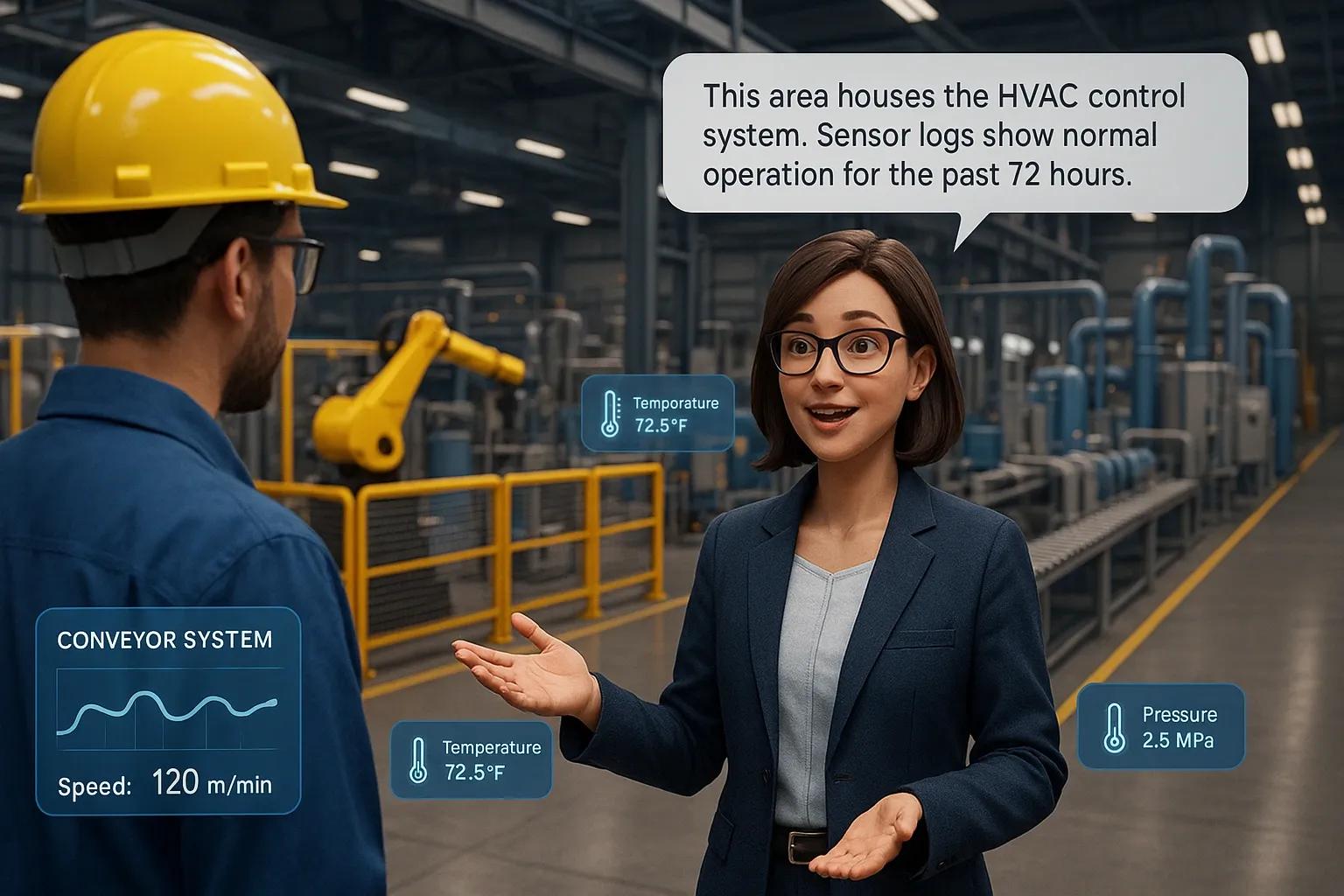
In the age of digital transformation, real-time visualization and immersive interactions are becoming central to industries that rely on physical infrastructure, construction, real estate, manufacturing, logistics, and more. A promising advancement in this area is the integration of AI avatars with digital twins and conversational AI to enable real-time site walkthroughs. These AI-powered virtual guides provide users with contextual information, respond to queries, and simulate physical presence, bridging the gap between the physical and digital realms.
This article explores the technical architecture, components, applications, and future potential of AI avatars used in real-time site walkthroughs.
1. Concept Overview
AI avatars for site walkthroughs are intelligent, animated digital personas that provide guided tours of a digital twin, a virtual replica of a physical site. These avatars combine the power of:
Digital Twins – Real-time, data-rich models of physical environments.
Conversational AI – Natural language interfaces powered by LLMs (e.g., GPT), enabling contextual, voice- or text-based interaction.
3D Visualization Platforms – WebGL, Unreal Engine, Unity, or XR systems rendering the virtual environment.
Multimodal AI – Processing voice, text, images, and spatial data in parallel.
2. Architecture and Components
Let’s break down the technical stack that enables AI avatar-driven walkthroughs:
a. Digital Twin Engine
3D Environment Modeling : Created using photogrammetry, LiDAR scans, BIM models, or drone imagery.
Real-Time Data Integration : IoT sensors, asset tags, or operational systems stream live data (e.g., temperature, occupancy, equipment status).
Spatial Anchors : Semantic mapping of areas within the environment (e.g., Zone A: Control Room; Zone B: Assembly Line).
b. AI Avatar Framework
Visual Avatar Layer : Built using motion capture data and rendered using a game engine. Lip-syncing, gestures, and expressions enhance realism.
Voice and Language Engine : Text-to-speech (TTS) and speech-to-text (STT) modules integrated with NLP backends.
Contextual Memory : The avatar accesses user history, current location in the twin, and site metadata to deliver accurate responses.
c. Conversational AI Engine
LLM Integration : OpenAI GPT, Google Gemini, or open-source models fine-tuned on site-specific knowledge.
Prompt Engineering : Ensures the AI understands technical terminology and spatial contexts.
Multilingual Capabilities : Essential for deployment in non-English regions or global operations.
d. Interaction Layer
User Interface : Browser-based or XR headset interface for immersive navigation.
Command Options : Voice commands, chatbot interfaces, and guided clickable menus.
Role-Based Views : The avatar tailors its responses based on whether the user is a project manager, safety inspector, or external client.
3. Key Functionalities
Here’s what an AI avatar can do during a real-time walkthrough:
a. Context-Aware Narration
As users move through the environment, the avatar automatically provides descriptions of assets, safety instructions, maintenance data, or project progress. For example:
“This area houses the HVAC control system. Sensor logs show normal operation for the past 72 hours.”
b. Question-Answering on the Fly
Users can ask:
“What’s the current temperature in this section?”
“When was this pipeline last inspected?”
“Who’s the subcontractor handling this area?”
The avatar processes this using conversational AI and responds using live or stored data.
c. Remote Collaboration
Multiple users can join a walkthrough, with the AI avatar acting as a shared guide. It manages turn-taking, annotations, and even schedules follow-up tasks via integrations (e.g., Slack, email, CMMS).
d. Simulated Scenarios
Users can ask the avatar to simulate events:
“Show what happens during a fire drill.”
“Visualize asset failure in this area.”
“Highlight equipment due for servicing this week.”
4. Use Cases Across Industries
a. Construction and Real Estate
Pre-sales walkthroughs with a personalized assistant.
Site progress review with real-time construction updates.
Safety training for new workers in high-risk zones.
b. Manufacturing
Remote audits and inspections with contextual explanations.
Onboarding plant workers through guided orientation tours.
Troubleshooting equipment via conversational diagnostics.
c. Utilities and Energy
Virtual tours of power plants, grids, and substations.
AI avatars explaining emergency procedures.
Condition-based monitoring insights delivered through natural language.
d. Smart Cities
Urban planners exploring digital twins of public infrastructure.
Stakeholder engagement using AI narrators for smart road or park projects.
Interactive visualization of sustainability KPIs.
5. Benefits
Cost Savings : Reduces need for frequent physical visits.
Scalability : One avatar can guide multiple users simultaneously.
24/7 Accessibility : Walkthroughs can be done anytime from anywhere.
Knowledge Democratization : Makes technical details accessible to non-experts.
Improved Training : New staff get site-specific knowledge through interactive sessions.
6. Technical Challenges
a. Real-Time Synchronization
Maintaining accurate sync between live sensor data and the digital twin.
b. Latency and Performance
Heavy 3D rendering and AI computations can introduce lag, especially in low-bandwidth regions.
c. Privacy and Access Control
Role-based authentication is critical to prevent unauthorized data access during walkthroughs.
d. Multimodal Integration
Aligning voice, 3D visuals, gestures, and data feeds into one coherent user experience requires complex orchestration.
7. Future Outlook
The next wave of AI avatars in real-time walkthroughs will likely include:
Holographic Interfaces : Mixed reality avatars appearing in physical spaces.
Emotion Recognition : Tailoring tone and content based on user mood or confusion.
Auto-Translation : On-the-fly translation for global collaboration.
Agentic AI Capabilities : Avatars making autonomous decisions, like suggesting repairs or ordering materials.
8. Conclusion
AI avatars combined with digital twins and conversational AI are transforming how we engage with physical spaces virtually. By acting as intelligent, context-aware guides, these avatars enhance decision-making, training, and communication across multiple industries.
As digital twin maturity improves and generative AI evolves, these virtual walkthroughs won’t just be representations, they’ll be actionable, intelligent environments driven by real-time data and interactive conversations.