Disclaimer: This article is based on my personal interpretation of an image published by Geospatial World. It is not an official analysis or representation of the data but rather a reflective exploration of the geospatial industry investment landscape.
The geospatial industry, with its diverse array of sectors and complex web of applications, has witnessed a surge of investment that has transformed the sector into a dynamic and rapidly evolving field. As a keen observer of the industry, I find myself compelled to delve into the intricacies of the investment landscape to decipher the nuances that define the industry today.
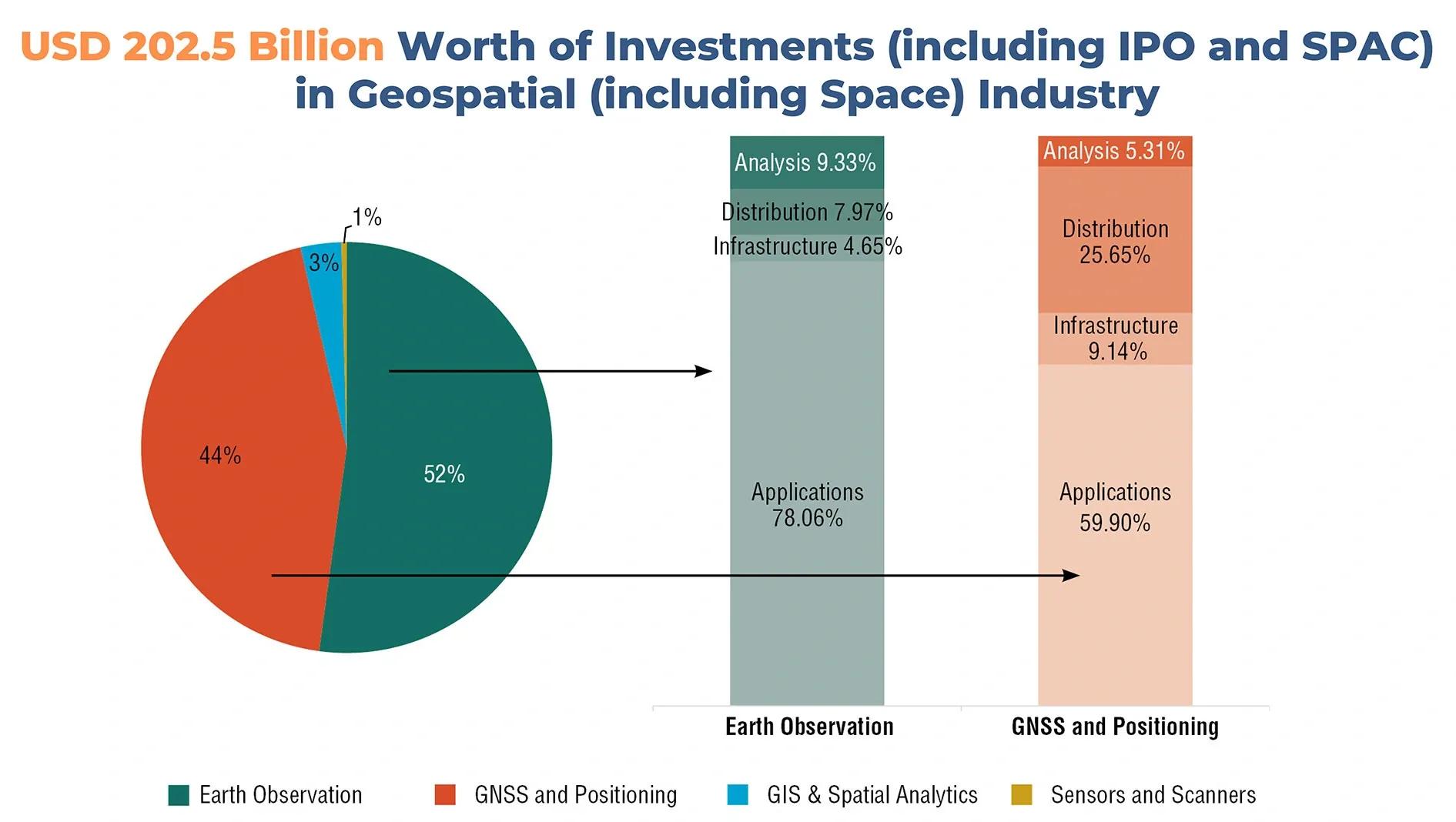
The industry's investment scenario, as depicted in the image, is quite intriguing. The total worth of investments, including Initial Public Offering (IPO) and Special Purpose Acquisition Companies (SPAC), is estimated to be an impressive USD 202.5 billion. This figure speaks volumes about the perceived value and potential of the geospatial industry, reinforcing its significance in today's tech-driven world.
The distribution of investments across various sectors within the geospatial industry is the first aspect that caught my attention. A striking 52% of the total investment is channeled into the Earth Observation sector, followed by 44% into the GNSS and Positioning sectors. The remaining 4% is shared by the GIS and Spatial Analytics sector and the Sensors and Scanners sector, receiving 3% and 1%, respectively.
This distribution is interesting, painting a picture of an industry heavily focused on Earth Observation and GNSS & Positioning technologies. But why is this so? Could it be the promise of higher returns or the potential to transform other industries that are driving investments into these sectors?
On reflection, it's not difficult to understand why. Earth Observation technologies, leveraging satellite imagery and remote sensing, enable us to monitor our planet in ways that were previously unimaginable. From tracking climate change to optimizing agricultural practices, the applications are vast and critical to our future.
Similarly, GNSS and Positioning technologies underpin many modern applications, from navigation systems in our cars and phones to precision farming and autonomous vehicles. The investment in this sector reflects its pervasiveness and potential to transform everyday life.
However, the modest investment in the GIS and Spatial Analytics and Sensors and Scanners sectors should not be overlooked. While these sectors may currently attract less investment, they provide indispensable tools and technologies that enable the practical application of geospatial data. With the continuous evolution of technology, these sectors may hold untapped potential for future growth.
The sub-sector breakdown of investments within the Earth Observation and GNSS and Positioning sectors is also worth noting. In both cases, the lion's share of investment goes into Applications, followed by Distribution, Infrastructure, and Analysis. This distribution, to me, signifies a market-driven industry where the creation of user-friendly applications and effective distribution networks takes precedence.
Yet, the relatively lower investment in Infrastructure and Analysis prompts me to ponder. Are we perhaps underestimating the importance of robust infrastructure and in-depth analysis in the long-term sustainability and growth of the geospatial industry? Or is it simply a reflection of the industry's maturity, where the infrastructure is largely established and the focus has now shifted to application development and distribution?
In conclusion, my interpretation of the investment landscape in the geospatial industry reveals an industry in flux, with a clear emphasis on application-oriented sectors like Earth Observation and GNSS and Positioning. However, as the industry continues to evolve, I believe we might witness a more balanced distribution of investments, acknowledging the importance of all sectors in creating a holistic and sustainable geospatial ecosystem.
Again, it is important to note that these reflections are based on my personal interpretation of the data and might differ from other interpretations. Nevertheless, it provides a starting point for further exploration and discussion on this exciting and impactful industry.