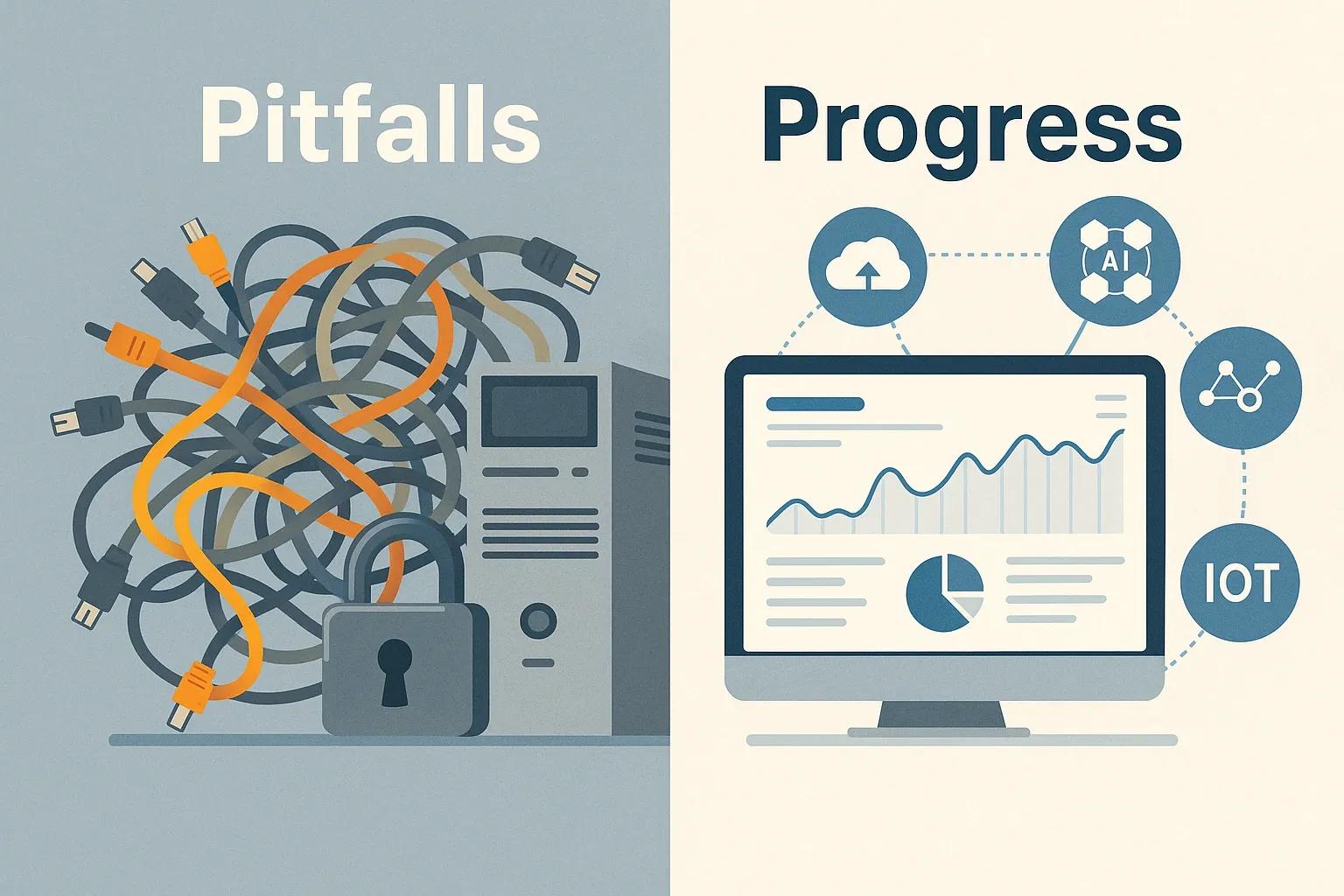
Digital transformation has become a board-level priority as enterprises shift from legacy models to data-driven, connected, and intelligent systems. IDC estimates that worldwide spending on digital transformation will reach $3.9 trillion by 2027 , reflecting the urgency and scale of change. Yet, despite the investment, a McKinsey study found that 70% of digital transformation initiatives fail to meet their stated goals , leading to wasted capital, employee frustration, and competitive setbacks. Avoiding common pitfalls is therefore critical for organizations striving to move from digital projects → digital businesses .
1. Lack of Clear Business Objectives
Many organizations start with technology-first initiatives, deploying AI, IoT, or cloud, without a clear link to business outcomes. The result is “technology in search of a problem.” For instance, several early smart city projects in India installed IoT sensors but lacked integration with citizen services, leading to unused data streams.
How to Avoid: Anchor every digital initiative to measurable KPIs such as cost reduction, revenue growth, or customer retention. Amazon Web Services’ migration frameworks succeed because they tie cloud adoption directly to agility and scalability targets, not just infrastructure replacement.
2. Underestimating Cultural Resistance
Transformation often stalls not because of poor technology, but because employees resist new workflows. Deloitte reports that 62% of executives cite culture as the biggest barrier to digital adoption.
Case Example: General Electric’s early digital twin projects in aviation struggled until teams were retrained and incentivized to use predictive insights rather than traditional maintenance schedules.
How to Avoid: Embed change management programs, training, communication, and leadership buy-in, to ensure that transformation is seen as an enabler, not a threat.
3. Poor Data Governance
Data is the backbone of digital transformation. Yet, fragmented, duplicate, or inaccurate datasets derail efforts. Gartner predicts that through 2026, 65% of organizations will fail to realize full value from AI due to poor data quality and governance .
Example: In European healthcare pilots, inconsistent electronic health records across hospitals created interoperability gaps, slowing AI-driven diagnostics.
How to Avoid: Establish enterprise-wide data governance policies, data lineage tracking, and master data management. This ensures analytics and AI deliver reliable insights for decision-making.
4. Over-Engineering Technology Stacks
Many firms fall into the trap of deploying overly complex systems. From multi-cloud orchestration to unnecessary blockchain pilots, the result is cost inflation and stalled ROI.
Example: A Southeast Asian telecom giant spent millions building a multi-layer digital service stack but later scaled back to a simplified architecture after discovering that only 40% of modules were used.
How to Avoid: Apply the principle of “minimum viable transformation.” Start with lightweight, interoperable platforms, and scale capabilities as value is proven.
5. Ignoring Legacy Integration
Transformation cannot happen in isolation. Legacy systems often still run mission-critical operations. Ignoring integration leads to bottlenecks and redundant manual work.
From X → To Y Example: Banking has moved from siloed mainframe systems → API-driven open banking ecosystems . In contrast, institutions that failed to integrate legacy platforms remain burdened by high maintenance costs and delayed customer services.
How to Avoid: Adopt a phased modernization roadmap that blends APIs, middleware, and selective system replacement. HSBC, for example, has successfully layered APIs over core banking systems to enable digital services without immediate rip-and-replace.
6. Short-Term ROI Obsession
Digital initiatives often require sustained investment before delivering measurable returns. Companies that push for immediate ROI cut projects prematurely.
Example: Walmart’s early e-commerce investments in the 2000s showed little profit but laid the foundation for today’s omnichannel dominance, where it rivals Amazon in the U.S. grocery segment.
How to Avoid: Define both short-term (efficiency gains) and long-term (new revenue models) metrics. Use balanced scorecards that track adoption rates, cost-to-serve, and innovation outcomes.
7. Neglecting Cybersecurity and Compliance
As digital platforms expand, so does the attack surface. IBM’s 2024 Cost of a Data Breach Report notes that the global average cost of a breach reached $4.45 million , a 15% increase in three years. Non-compliance with regulations such as GDPR in Europe or the Digital Personal Data Protection Act in India can also bring penalties.
Example: In 2021, Colonial Pipeline’s ransomware incident disrupted U.S. fuel supply chains, showing how digital vulnerabilities cascade into national crises.
How to Avoid: Embed security-by-design, integrating encryption, identity management, and regulatory compliance frameworks, into transformation roadmaps.
Implications for Industry Leaders
Avoiding these pitfalls requires a holistic operating model . Successful organizations don’t just adopt new technologies, they redesign processes, reskill talent, and embed governance. Industries such as construction are already demonstrating results: BIM adoption has cut project timelines by up to 50% in major Middle Eastern smart city projects. Similarly, in manufacturing, digital twins are delivering 15–30% productivity gains , underscoring how alignment of technology, people, and processes drives business outcomes.
Outlook
The next wave of digital transformation will accelerate with generative AI, edge computing, and immersive XR. But these technologies will amplify existing pitfalls if governance, culture, and clarity are ignored. Leaders must think beyond pilots and ensure transformation efforts scale sustainably. The window for experimentation is narrowing as competitors move toward operationalized digital-first models.
Conclusion
Digital transformation is no longer optional, it is a competitive necessity. The difference between success and failure lies in anticipating and avoiding the seven common pitfalls outlined here. Organizations that build resilient strategies, integrate legacy with innovation, and prioritize culture alongside technology will not just survive disruption but thrive in it. The time to act is now, before today’s experiments become tomorrow’s missed opportunities.