Most cost overruns don’t happen because estimates were wrong.
They happen because cost stopped keeping up with reality .
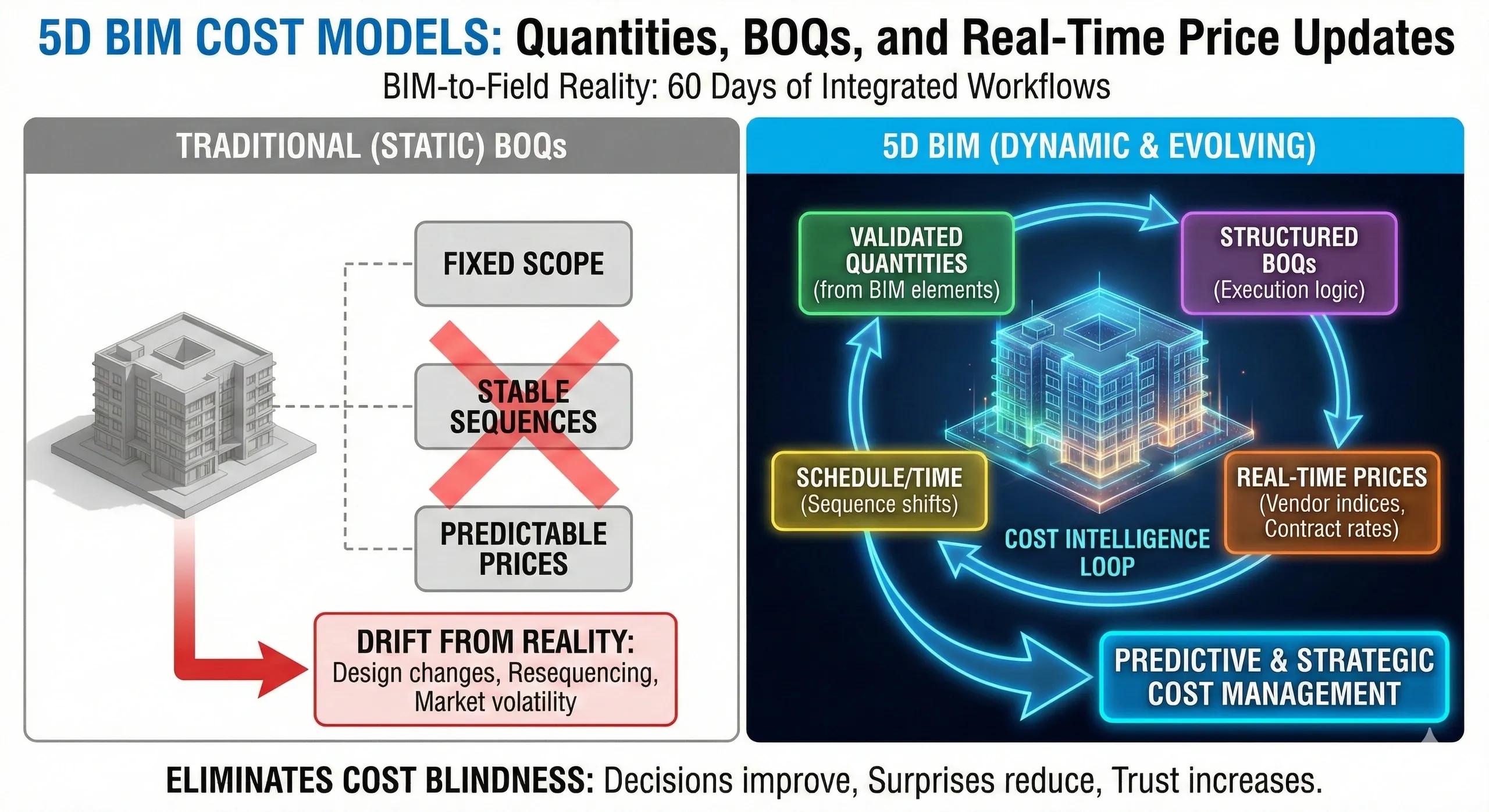
Design changed. Sequences shifted. Market prices moved.
But the cost model stayed static.
5D BIM links quantities, BOQs, and prices to the evolving project, so cost reflects what is actually being built, when it’s being built, and at today’s prices .
1. What 5D BIM Really Means
5D BIM is not just quantity takeoff from a model.
It is:
Quantities derived from validated BIM elements
BOQs structured around execution logic
Cost data that updates with design and schedule changes
5D connects scope + time + price into a single cost intelligence loop.
2. Why Traditional BOQs Drift from Reality
Static BOQs assume:
Fixed scope
Stable sequences
Predictable prices
Reality includes:
Design iterations
Resequencing and delays
Market volatility (materials, labor, fuel)
When BOQs don’t evolve, decisions are made on outdated numbers.
3. Quantity Accuracy Starts with Model Discipline
5D success depends on:
Construction-level modeling (not design abstraction)
Clear element classification
Consistent measurement rules
Exclusion of provisional or duplicate geometry
If the model is ambiguous, quantities will be misleading, no matter how good the software is.
4. Linking Quantities to BOQs the Right Way
Effective 5D setups:
Map BIM elements to BOQ items via rules, not manual picks
Align BOQs with WBS and construction sequence
Support zone-, floor-, and phase-based breakdowns
Rule of thumb:
A BOQ item should correspond to something you can point to on site.
5. Real-Time Price Updates: Where 5D Gets Powerful
5D models can integrate:
Vendor price indices
Contract rate libraries
Escalation formulas
Market-driven adjustments
This allows teams to:
See cost impact of delays
Compare alternatives before committing
Avoid surprises during procurement
Cost becomes predictive , not reactive.
6. 5D Is a Decision Tool, Not Just a Control Tool
Used correctly, 5D helps:
Evaluate design options financially
Test resequencing impacts on cash flow
Optimize material procurement timing
Support value engineering with evidence
It shifts cost conversations from “why did it increase?” to “which option makes sense?”
7. Common Reasons 5D Implementations Fail
5D fails when:
Models are not construction-ready
BOQs are copied without restructuring
Price data is disconnected from time
Updates are manual and delayed
Outputs are used only for reporting
5D must live with the project, not at milestones.
8. India Context: Why 5D Matters More Than Ever
In Indian projects:
Price volatility is high
Cash flow timing is critical
Scope changes are frequent
Claims and disputes are common
5D BIM helps:
Maintain cost transparency
Reduce downstream disputes
Support data-backed negotiations
9. From Cost Reports to Cost Intelligence
Spreadsheets report what happened.
5D models show what will happen if you decide differently .
That difference defines modern cost management.
10. A Simple 5D Rule
If a design change doesn’t immediately show its cost impact, your cost model is already late.
Conclusion
5D BIM doesn’t eliminate overruns.
It eliminates cost blindness .
When quantities, BOQs, and prices are continuously aligned:
Decisions improve
Surprises reduce
Trust increases
Cost regains credibility
Without 5D, cost management is retrospective.
With 5D, it becomes strategic and proactive .