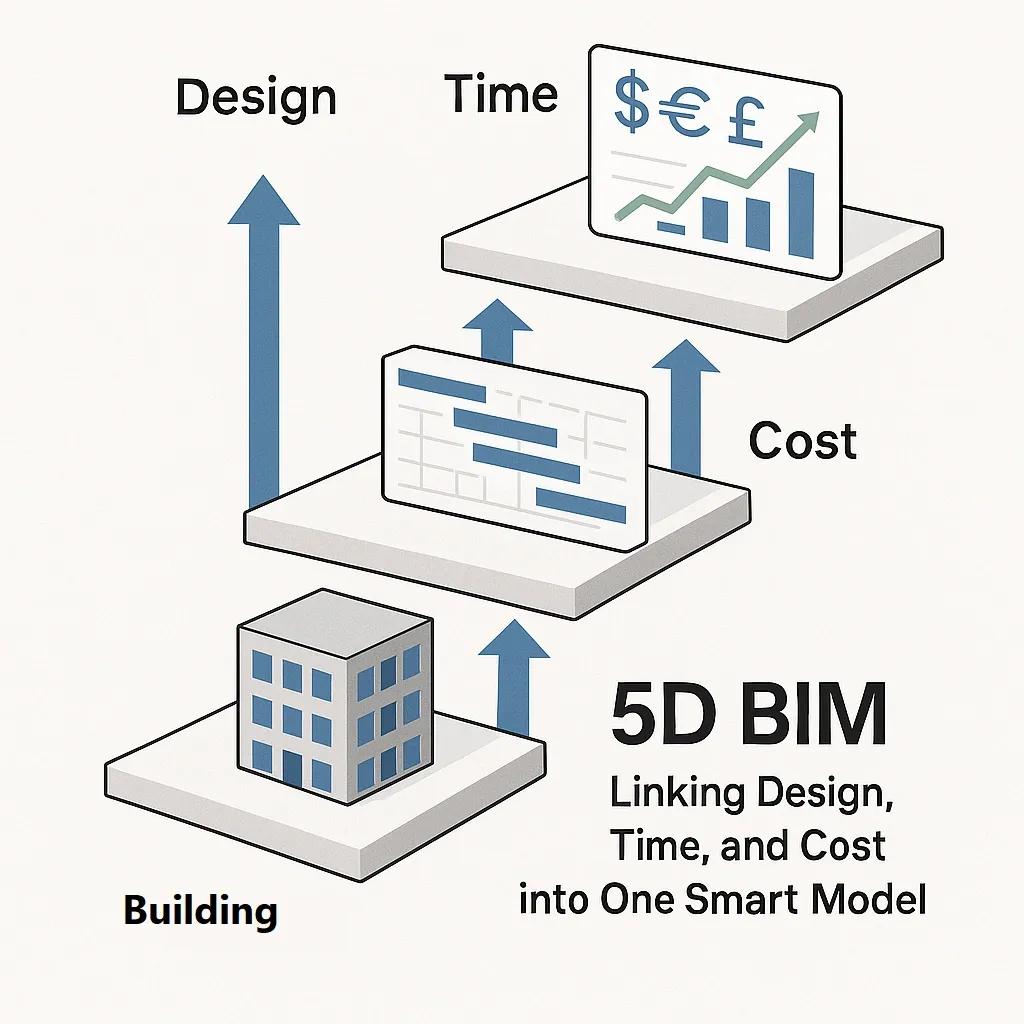
Building Information Modeling (BIM) has matured from a 3D modeling tool into a comprehensive project management framework. While 3D BIM focuses on visual representation, and 4D BIM adds the dimension of time (scheduling), 5D BIM integrates cost data into the model, enabling tighter control over project timelines and budgets. In an industry where delays and cost overruns are common, 5D BIM acts as a proactive tool to mitigate risks, enhance decision-making, and ensure project outcomes align with original objectives.
This article explores how 5D BIM controls time and cost in construction projects, emphasizing the role of integrated models in preventing delays and budget overruns.
What is 5D BIM?
5D BIM extends the functionalities of 3D and 4D BIM by linking each building component to its associated cost data. In simple terms, it brings visual models, construction schedules, and budget forecasts into one coherent environment.
At its core:
3D = Physical model (geometry)
4D = 3D model + Time scheduling
5D = 4D model + Cost estimation
Through 5D BIM, stakeholders can visualize the impact of changes on both schedules and budgets in real-time, leading to faster, more informed decisions.
The Traditional Challenges in Construction
Despite technological advances, construction projects are still plagued by:
Project delays (due to design changes, supply chain issues, or site conditions)
Cost overruns (caused by inaccurate estimation, scope creep, and miscommunication)
Fragmented workflows (poor coordination between architects, engineers, contractors, and owners)
Reactive problem-solving (issues identified too late in the process)
These challenges often result from the lack of an integrated, dynamic planning environment.
How 5D BIM Addresses These Challenges
1. Dynamic Cost Estimation
Traditional cost estimation is usually done at fixed milestones, with manual updates leading to lags and errors. 5D BIM automates cost tracking by linking model elements to real-time material, labor, and equipment costs.
Benefits:
Instant visibility of the financial impact of design changes.
More accurate forecasting.
Easier evaluation of multiple design options based on cost implications.
Example: A change in façade material is immediately reflected in the model’s cost estimates, helping the project team decide if the upgrade aligns with the budget before proceeding.
2. Schedule-Cost Integration
In 5D BIM, each element is not only tied to a cost but also to a construction activity and timeline. As a result, stakeholders can simulate construction sequences alongside financial implications.
Benefits:
Identification of time-cost trade-offs early.
Simulation of "what-if" scenarios (e.g., accelerating a task vs. increasing labor cost).
Reduced likelihood of schedule slippage and financial surprises.
Example: By simulating different sequencing strategies, a contractor can determine that prefabricating certain components off-site could shorten project time by 10% with a modest 3% cost increase, a trade-off that might be justified to meet critical deadlines.
3. Enhanced Change Management
Changes are inevitable in construction. Without 5D BIM, analyzing the ripple effects of changes is time-consuming and often incomplete.
With 5D BIM:
Changes in design automatically update associated costs and schedules.
Stakeholders can immediately assess its impact.
Approval processes are faster and better informed.
Example: A structural redesign for seismic compliance is updated in the BIM model, automatically revising both material quantities and timelines. The project team can present revised budgets and schedules to the client within hours, not weeks.
4. Better Cash Flow Management
5D BIM helps project managers create more detailed and accurate cash flow forecasts by integrating construction activities, timelines, and payment schedules.
Benefits:
Smoother financial planning.
Easier financing arrangements.
Fewer disputes with contractors and suppliers over payments.
Example: By mapping cost curves over the construction timeline, a developer can plan fund releases in alignment with project needs, avoiding liquidity issues.
5. Improved Collaboration and Transparency
Because 5D BIM centralizes data in a shared environment, it promotes transparency and collaboration among all parties:
Designers see how their choices affect cost.
Contractors can plan procurement based on real-time schedules.
Owners gain early visibility into project risks.
This shared visibility reduces conflicts, misunderstandings, and rework.
Example: During a coordination meeting, all stakeholders review a proposed design change together in the 5D model, discussing impacts on cost, time, and quality before making a collective decision.
Real-World Adoption Trends
Many large-scale projects today, airports, hospitals, smart cities, are increasingly mandating 5D BIM to drive project efficiency.
Notable examples:
Sydney Metro (Australia) : Used 5D BIM to simulate construction activities, monitor costs in real-time, and avoid budget blowouts.
Apple Park (USA) : Integrated cost and schedule data into the BIM environment to manage an extremely complex design and construction process.
India’s Smart City Initiatives : Cities like Amaravati have explored integrating 5D BIM for better cost controls and faster project delivery.
The World Economic Forum and McKinsey reports consistently highlight that early adopters of integrated BIM (especially 5D) achieve 20–30% faster project delivery and cost savings of 10–15% compared to traditional methods.
Challenges in 5D BIM Implementation
Despite its advantages, 5D BIM is not without hurdles:
Data consistency : Accurate input data is critical; otherwise, outputs are misleading.
Software interoperability : Different vendors and tools can make integration difficult.
Skill gaps : Teams must be trained to work with cost-loaded BIM models.
Initial investment : Costs associated with setting up BIM infrastructure can be high.
However, the long-term savings and risk reduction make 5D BIM a worthwhile investment for serious construction players.
The Future of 5D BIM
The future of 5D BIM lies in automation, AI integration, and cloud-based platforms. Predictive analytics, powered by machine learning, can automatically flag cost and schedule risks based on historical project data.
Key directions:
AI-assisted cost estimation.
Real-time collaboration platforms.
Integration with IoT devices for progress tracking.
Smart contracts linked to BIM models for automatic payments.
5D BIM will increasingly become the foundation for digital twins of infrastructure assets, supporting not just construction but also operation and maintenance over the asset lifecycle.
Conclusion
5D BIM is transforming the way construction projects are planned, executed, and managed. By tightly linking design, schedule, and cost data into one dynamic model, it provides a single source of truth for all stakeholders.
The result: fewer delays, better cost control, improved collaboration, and ultimately, more successful project outcomes.
In an era where efficiency is non-negotiable, 5D BIM is not just an option, it is a strategic imperative.