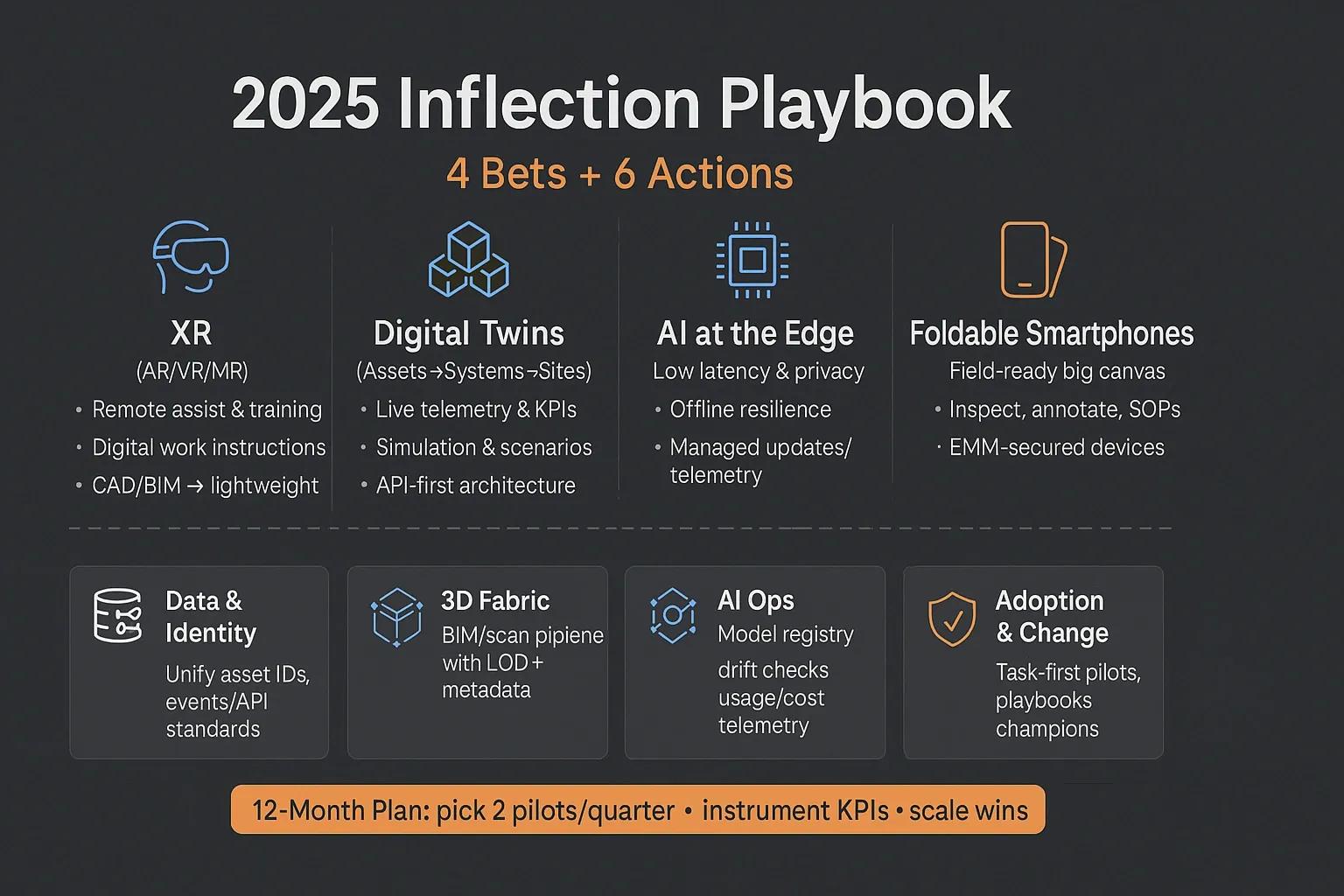
2025's biggest technology trends and marks a practical inflection point: extended reality (XR), digital twins, edge AI, and even foldable smartphones are exiting hype cycles and entering execution. Analyst outlooks suggest uneven near-term volumes in XR and foldables but strong medium-term rebounds, while edge AI and digital twins continue to compound as data and infrastructure mature. The winners won’t adopt everything, they’ll adopt well , with tight data foundations, risk controls, and change playbooks.
The Four Trajectories to Watch
1) XR becomes business-grade
Hardware cycles are bumpy, IDC expects a shipment dip in 2025 due to delayed launches, followed by a strong rebound in 2026 and beyond. Bottom line: plan for mixed-reality workflows (remote assist, training, work instructions), not just headsets. Align content pipelines (CAD/BIM→lightweight assets), single sign-on, and EMM policies from day one.
Do now
Create an XR content backlog mapped to top 10 field tasks.
Pilot “see-what-I-see” remote support with SOP capture; measure first-time fix and training time.
Budget for 2026 device refresh as supply stabilizes; keep app code portable across vendors.
2) Digital twins move from pilots to platforms
Adoption is broadening: ~29% of manufacturers report fully or partially implemented digital twin strategies, with budgets shifting toward predictive maintenance and plant simulation. Treat the twin as a product with layered data, APIs, and simulation, not a one-off visualization.
Do now
Standardize asset IDs and telemetry schemas; expose twins over APIs/events.
Start with a single high-value use case (e.g., bottleneck analysis), then scale to multi-asset views.
Tie twin KPIs to safety, throughput, energy, and downtime to defend ROI.
3) AI at the edge becomes default, not niche
Analysts expect the edge-AI market to expand rapidly through 2030 as real-time and privacy needs push inference onto gateways, mobiles, and embedded devices. Pair that with device makers doubling down on on-device AI experiences, the “AI phone” era, and you get a practical shift of intelligence closer to the work.
Do now
Prioritize latency-sensitive use cases (inspection, anomaly alerts, AR overlays).
Standardize an edge stack (container runtime, model format, remote update, telemetry).
Implement model-risk and drift checks at the device boundary; log inference usage and costs.
4) Foldable smartphones go from novelty to field tool
Counterpoint signaled 2025 as a transition year (potential annual decline) even as Q2 2025 volumes rose YoY, pointing to uneven but ongoing interest. For enterprises, foldables are valuable where bigger canvases drive task speed: drawing mark-ups, checklists with photos, and side-by-side SOPs.
Do now
Pilot foldables with CAD/3D view, offline checklists, and secure camera flows.
Lock devices via EMM; test drop resistance and glove-touch.
Compare TCO vs. tablet + phone combos in field teams.
A Pragmatic Readiness Playbook (12 months)
Data & Identity – Unify asset IDs; implement governance, lineage, IAM, and event schemas that XR, twins, and edge devices can all consume.
3D Fabric – Maintain a BIM/scan pipeline with LOD rules and metadata; compress to lightweight formats for mobile/XR.
Edge Stack – Choose connectivity per use case (Wi-Fi/5G/private LTE/LoRa/RedCap), standardize gateways, and secure OTA updates.
AI Ops – Stand up a model registry, automated drift checks, cost/usage telemetry, and rollback paths at the edge.
Security & Safety – Extend threat modeling to models and devices; enforce privacy-by-design and supply-chain checks.
Change & Adoption – Task-first pilots; document playbooks; equip champions; measure time-to-value.
“Which single capability, data foundations, 3D assets, edge ops, or change management, most limits your roadmap today?”
Use-case snapshots (fast ROI)
Smart facilities: XR work instructions + digital twin KPIs → faster MRO, reduced energy variance.
Discrete manufacturing: Edge vision models for defect catching + twin-driven bottleneck simulation → lower scrap and higher throughput.
Field inspection: Foldables with offline checklists, large drawings, and secure photo capture → fewer revisits and faster close-outs.
Risk controls that matter
Model risk: document datasets, intended use, bias checks; monitor drift and confidence thresholds at the edge.
Operational safety: fail-open vs fail-safe behavior for edge inference; simulate procedures in a twin before rollout.
Vendor concentration: avoid single-vendor lock-in; favor portable formats (ONNX, glTF, USDZ) and open APIs.
Change fatigue: limit parallel pilots; fold new tools into existing SOPs and KPIs.
Benefits & ROI (what to measure)
XR: first-time-fix, training time, travel avoided.
Digital twins: OEE/throughput, downtime avoided, energy intensity, scenario lead-time.
Edge AI: detection latency, bandwidth saved, cloud-inference cost avoided.
Foldables: task duration, error rate, device TCO vs. phone+tablet.
Conclusion
Treat 2025 as groundwork for scale in 2026–2028. XR will settle into durable workflows; digital twins will become platforms; edge AI will default for latency and privacy; foldables will find their enterprise home in field-first tasks. The organizations that win won’t just test, they’ll standardize data, secure the edge, productize twins, and industrialize change. Use the 12-month playbook to pick two pilots per quarter, measure ruthlessly, and compound the wins.